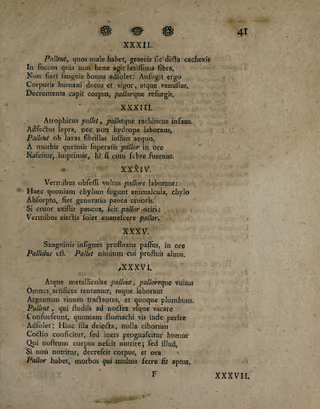
XXXVI.

Poet
Christian Tobias Ephraim Reinhard
Book
Medicus poeta , 1762
Form
Not identifiable from book
Open the page in the book
The page this poem fills. Each opens in the Medicus poeta reader.

Hover or tap a word to see its match.

XXXVI.

And miners grow pale, and by pallor of the countenance

All artisans are assailed, and they suffer from it

Who handle quicksilver, and also lead.

They grow pale who are accustomed to devote themselves to studies even into the night,

Since the strength of the stomach is wont to perish therefrom:

Hence, when that is cast down, no digestion of food

Is accomplished, but a sluggish humor is produced

Which knows not how to nourish our body; but that

Body, if it is not nourished, wastes away, and the face

Pallor possesses, which becomes apt to bring on many diseases.

Atque metallicolae pallent, palloreque vultus

Omnes artifices tentantur, eoque laborant

Argentum viuum tractantes, et quoque plumbum.

Pallent, qui studiis ad noctes vsque vacare

Consuescunt, quoniam stomachi vis inde perire

Adsolet: Hinc illa deiecta, nulla ciborum

Coctio conficitur, sed iners prognascitur humor

Qui nostrum corpus nescit nutrire; sed illud,

Si non nutritur, decrescit corpus, et ora

Pallor habet, morbos qui multos ferre fit aptus.
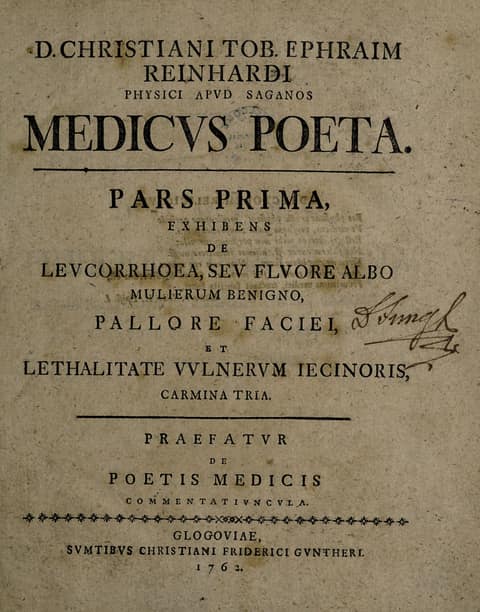
Title page of Medicus poeta
Title page of Medicus poeta , 1762

About this text

Provenance

This edition uses the Wellcome Collection copy, catalogued as _Medicus poeta. Pars prima, exhibens de leucorrhoea, pallore faciei, et lethalitate vulnerum jecinoris, carmina tria_ (b30503395). Scans 1 to 4 are the front cover and flyleaves with handwritten notes. Scan 5 is the title page. Scans 75 to 80 are blank leaves and the back cover.

Rights

The work is in the public domain by age. Wellcome Collection marks this copy with Public Domain Mark 1.0. Credit Wellcome Collection. Poet Doctor is a non-commercial site.

Original scans: Wellcome Collection ( Public Domain Mark 1.0 ).

Historian’s note. This text records the medicine of its own time, and later evidence has replaced most of it. It is not medical advice. We read it as history, and we ask what, if anything, connects it to medicine today. More on how we read old medical books