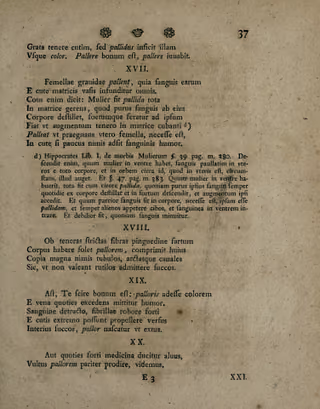
XIX.

Poet
Christian Tobias Ephraim Reinhard
Book
Medicus poeta , 1762
Form
Not identifiable from book
Open the page in the book
The page this poem fills. Each opens in the Medicus poeta reader.

Hover or tap a word to see its match.

XIX.

Moreover, it is good for you to know: that the color of pallor is present

whenever excess moisture is let from a vein.

When blood is drawn off, the little fibers with strong force

can drive the juices from the outermost part of the skin

toward the interior, so that pallor arises on the outside.

Ast, Te scire bonum est: palloris adesse colorem

E vena quoties excedens mittitur humor.

Sanguine detracto, fibrillae robore forti

E cutis extremo possunt propellere versus

Interius succos, pallor nascatur vt extus.
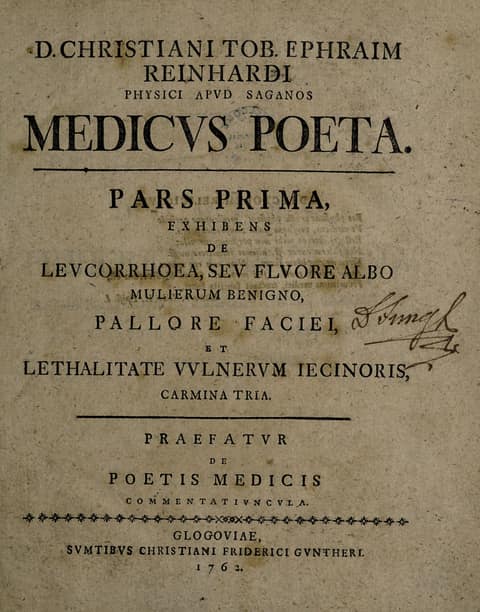
Title page of Medicus poeta
Title page of Medicus poeta , 1762

About this text

Provenance

This edition uses the Wellcome Collection copy, catalogued as _Medicus poeta. Pars prima, exhibens de leucorrhoea, pallore faciei, et lethalitate vulnerum jecinoris, carmina tria_ (b30503395). Scans 1 to 4 are the front cover and flyleaves with handwritten notes. Scan 5 is the title page. Scans 75 to 80 are blank leaves and the back cover.

Rights

The work is in the public domain by age. Wellcome Collection marks this copy with Public Domain Mark 1.0. Credit Wellcome Collection. Poet Doctor is a non-commercial site.

Original scans: Wellcome Collection ( Public Domain Mark 1.0 ).

Historian’s note. This text records the medicine of its own time, and later evidence has replaced most of it. It is not medical advice. We read it as history, and we ask what, if anything, connects it to medicine today. More on how we read old medical books