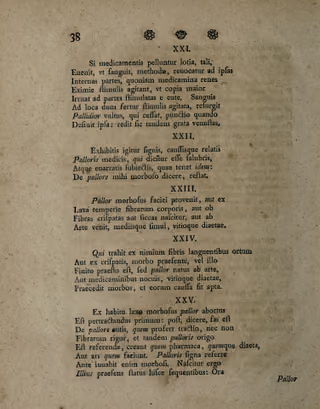
XXI.

Poet
Christian Tobias Ephraim Reinhard
Book
Medicus poeta , 1762
Form
Not identifiable from book
Open the page in the book
The page this poem fills. Each opens in the Medicus poeta reader.

Hover or tap a word to see its match.

XXI.

If urine is expelled by medicines, by such a

Method it happens that the blood is recalled to those very

Internal parts, since the medicines agitate the kidneys

Exceedingly with stimuli, so that a greater abundance

Rushes from the skin to the stimulated parts. While the blood

Is carried to the places agitated by stimuli, a paler

Countenance arises again, which ceases when the pricking

Itself stops: thus at last the pleasing comeliness returns.

Si medicamentis pelluntur lotia, tali,

Euenit, vt sanguis, methodo, reuocatur ad ipsas

Internas partes, quoniam medicamina renes

Eximie stimulis agitant, vt copia maior

Irruat ad partes stimulatas e cute. Sanguis

Ad loca dum fertur stimulis agitata, resurgit

Pallidior vultus, qui cessat, punctio quando

Desinit ipsa: redit sic tandem grata venustas,
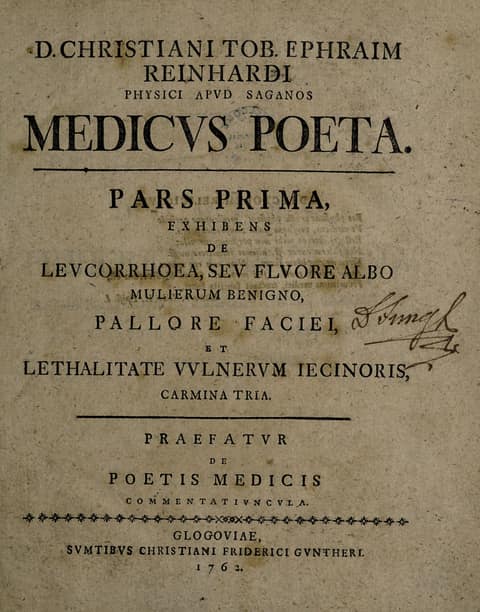
Title page of Medicus poeta
Title page of Medicus poeta , 1762

About this text

Provenance

This edition uses the Wellcome Collection copy, catalogued as _Medicus poeta. Pars prima, exhibens de leucorrhoea, pallore faciei, et lethalitate vulnerum jecinoris, carmina tria_ (b30503395). Scans 1 to 4 are the front cover and flyleaves with handwritten notes. Scan 5 is the title page. Scans 75 to 80 are blank leaves and the back cover.

Rights

The work is in the public domain by age. Wellcome Collection marks this copy with Public Domain Mark 1.0. Credit Wellcome Collection. Poet Doctor is a non-commercial site.

Original scans: Wellcome Collection ( Public Domain Mark 1.0 ).

Historian’s note. This text records the medicine of its own time, and later evidence has replaced most of it. It is not medical advice. We read it as history, and we ask what, if anything, connects it to medicine today. More on how we read old medical books