Hover or tap a word to see its match.
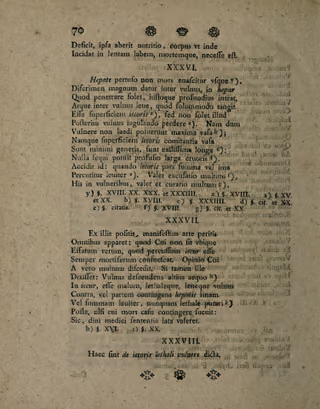
XXXVI.
When the liver is pierced, death does not always arise y),
A great distinction is made between a wound which
is wont to penetrate into the liver, and enters deeper than is right,
And a slight wound, which only touches
the surface of the liver z), for that
latter wound is not wont to destroy by killing a). For since
the largest vessels could not be injured by the wound b);
(For the vessels accompanying the surface of the liver
Are of the smallest kind, they are by far the most slender c)):
No copious profusion of blood could follow d).
This happens: when the highest or lowest part of the liver
Is lightly struck e). Exoneration avails much f),
In these wounds, and treatment avails much g).
Hepate pertuso non mors enascitur vsque y),
Discrimen magnum datur inter vulnus, in hepar
Quod penetrare solet, iustoque profundius intrat,
Atque inter vulnus leue, quod solummodo tangit
Esse superficiem iecoris z), sed non solet illud
Posterius vulnus iugulando perdere a). Nam dum
Vulnere non laedi potuerunt maxima vasa b);
Namque superficiem iecoris comitantia vasa
Sunt minimi generis, sunt exilissima longe c):
Nulla sequi potuit profusio larga cruoris d).
Accidit id: quando iecoris pars summa vel ima
Percutitur leuiter e). Valet excusatio multum f),
His in vulneribus, valet et curatio multum g).