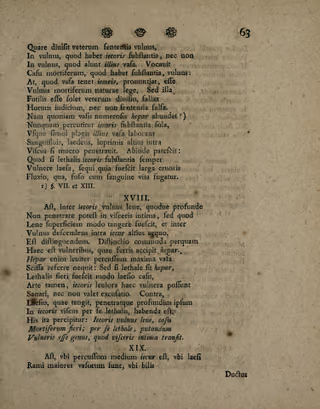
XVIII.
However, between a slight wound of the liver, or one that deeply
Cannot penetrate into the innermost parts of the viscus, but which
Mildly is wont to touch only the surface, and between
A wound descending deeper than is fitting within the liver,
A distinction must be made. Exceedingly convenient is this
Distinction for the wounds which the liver receives from iron weapons.
For the liver when lightly struck cannot show its largest vessels
Severed: But if the liver becomes lethal,
The injury is wont to become lethal only by accident,
Yet by art, these lighter wounds of the liver can
Be healed, and an excuse is also valid. On the contrary,
An injury which touches and penetrates more deeply into the very
Viscus of the liver must be considered lethal in itself.
From these things it is thus perceived: That a slight wound of the liver by accident
Becomes mortal; that lethal in itself must be considered
The kind of wound which passes through the innermost parts of the viscus.
Ast, inter iecoris vulnus leue, quodue profunde
Non penetrare potest in visceris intima, sed quod
Lene superficiem modo tangere suescit, et inter
Vulnus descendens intra iecur altius aequo,
Est distinguendum. Distinctio commoda perquam
Haec est vulneribus, quae ferris accipit hepar.
Hepar enim leuiter percussum maxima vasa
Scissa referre nequit: Sed si lethale fit hepar,
Lethalis fieri suescit modo laesio casu,
Arte tamen, iecoris leuiora haec vulnera possunt
Sanari, nec non valet excusatio. Contra,
Laesio, quae tangit, penetratque profundius ipsum
In iecoris viscus per se lethalis, habenda est.
His ita percipitur: Iecoris vulnus leue, casu
Mortiferum fieri; per se lethale, putandum
Vulneris esse genus, quod visceris intima transit.