Hover or tap a word to see its match.
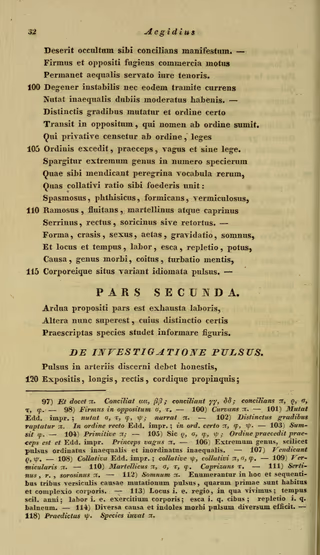
The pulse ought to be discerned in suitable arteries,
Exposed, long, straight, and close to the heart;
Whence the left hand, since it is bordering on the heart,
Is proven to be more related for the judgment of the pulse:
There is certain faith there, the constancy of true motion,
A truthful pulse, a faithful servant of nature.
The right part, because it is hotter, because the life-giving
Vapor irradiates it more fully, and it receives the lamp of the heart
More abundantly, where the liver, the author of pure blood,
Reigns, the mild persuader of tender love,
By which the bilious gall boils as the incentive of evil,
Renders the pulse ambiguous, confused by so much heat,
Entangles errors, adulterates the examination of the art. —
Let the left hand of the physician lift and guide the left hand of the sick person,
The weak part requires the help of a supporter.
Which, if it were to guide itself, shaken by a slight tremor
Would deceive the practitioner, and an error of examination would be made. —
But beware, lest the sick person compress his fingers into a fist,
Or extend them too much; lest the arm be compressed by the mass
Of the side; let the order of a moderate posture
Be present, so that moderation may remove an ambiguous motion. —
The right hand, since it excels in the investigation of sense,
And a more vivid experience of touch is given to it,
Let it apply its fingers to the artery: let the manifest one be noted
With fingers applied lightly, the hidden one with them pressed;
Nor should it withdraw before the hundredth motion
Is made, which number serves nature, and by the judgment
Of this number the sentence of truth becomes clear. —
Pulsus in arteriis discerni debet honestis,
Expositis, longis, rectis, cordique propinquis;
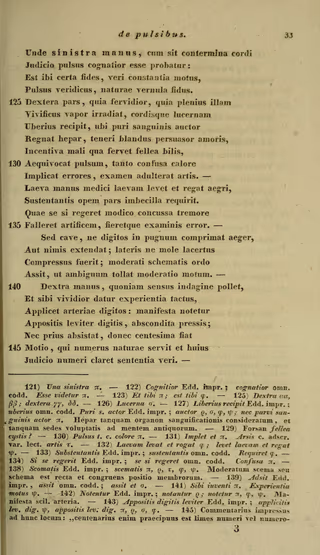
Unde sinistra manus, cum sit contermina cordi
Iudicio pulsus cognatior esse probatur:
Est ibi certa fides, veri constantia motus,
Pulsus veridicus, naturae vernula fidus.
Dextera pars, quia fervidior, quia plenius illam
Vivificus vapor irradiat, cordisque lucernam
Uberius recipit, ubi puri sanguinis auctor
Regnat hepar, teneri blandus persuasor amoris,
Incentiva mali qua fervet fellea bilis,
Aequivocat pulsum, tanto confusa calore
Implicat errores, examen adulterat artis. —
Laeva manus medici laevam levet et regat aegri,
Sustentantis opem pars imbecilla requirit.
Quae se si regeret modico concussa tremore
Falleret artificem, fieretque examinis error. —
Sed cave, ne digitos in pugnum comprimat aeger,
Aut nimis extendat; lateris ne mole lacertus
Compressus fuerit; moderati schematis ordo
Assit, ut ambiguum tollat moderatio motum. —
Dextra manus, quoniam sensus indagine pollet,
Et sibi vividior datur experientia tactus,
Applicet arteriae digitos: manifesta notetur
Appositis leviter digitis, abscondita pressis;
Nec prius absistat, donec centesima fiat
Motio, qui numerus naturae servit et huius
Iudicio numeri claret sententia veri. —