Hover or tap a word to see its match.
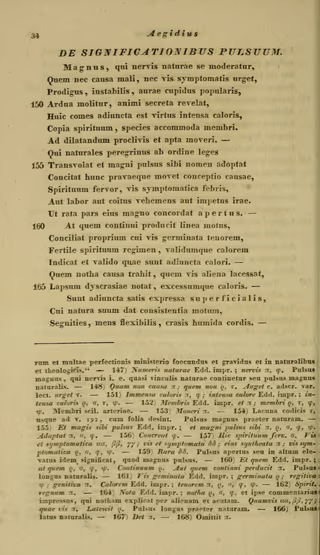
The *large* [pulse], which regulates itself by the sinews of nature,
Which neither the cause of an illness nor the force of a symptom urges on,
Is lavish, unstable, desirous of popular favor,
Undertakes arduous things, and reveals the secrets of the mind.
Joined to this as a companion is an intense virtue of heat,
An abundance of spirits, and an appropriate form of the member,
Prone to dilate and apt to be moved. —
He who, as a stranger from their order, flies past the natural laws
And adopts for himself the name of a large pulse,
Is aroused and moved by the conception of a depraved cause,
The fervor of spirits, the symptomatic force of fever,
Or labor, or vehement coitus, or the onset of anger.
As its fixed part, the *open* [pulse] agrees with the large one. —
But the one that the line of continuous motion produces,
For whom a germinated force procures its proper tenor,
Indicates a fertile governance of spirits, strong heat,
And those things which are adjoined to strong heat. —
The one that a spurious cause draws, that an alien force provokes,
Denotes a lapse of dyscrasia, and an excess of heat. —
The adjuncts are quite expressly stated for the *superficial* [pulse],
To which a consistent nature gives its motion:
Sluggishness, a flexible mind, and a humid crasis of the heart. —
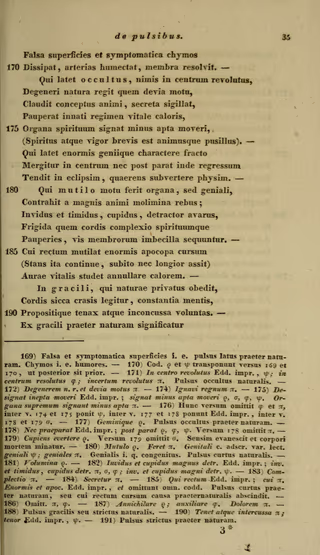
A false and symptomatic surface dissipates the humors,
moistens the arteries, relaxes the limbs. —
The one which lies hidden as *occult*, turned back too much into the center,
which a deviating nature rules with degenerate motion,
closes off the concepts of the mind, seals secrets,
impoverishes the vital governance of innate heat,
indicates the organs of the spirits to be less fit to be moved,
(the spirit and vigor are brief, and the mind is petty). —
The one which lies hidden as abnormal and with the character of its genius broken
is submerged into the center and does not afterward prepare a return from there,
tends toward an eclipse, seeking to subvert nature. —
The one which strikes the organs with a *mutilated* motion, but a congenital one,
draws the mind's endeavors away from great things;
envious and timid, desirous, a detractor, greedy,
which a cold complexion of the heart, and an impoverishment
of spirits, and a weak force of the limbs follow. —
The one for which an abnormal apocope mutilates the right course
(standing thus continuously, and not suddenly appearing longer)
strives to annul the heat of the vital breath. —
In the *slender* [pulse], which deprived obeys nature,
a dry crasis of the heart is read, constancy of mind,
and a will tenacious of its purpose and unshaken. —
From a slender [pulse] beyond nature is signified
Dryness of the body, compactness of matter. —
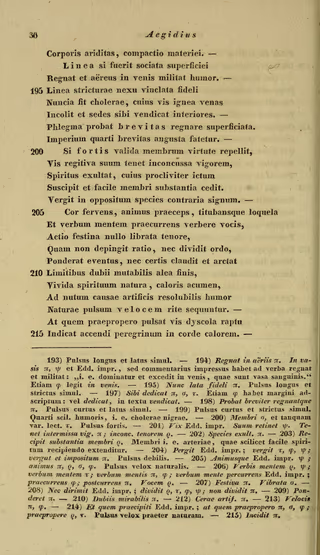
If the *line* is allied to the surface,
The airy humor reigns and battles in the veins. —
The line bound by the faithful knot of strictness
Becomes the messenger of choler, whose fiery force
Inhabits the veins and claims the inner regions for itself. —
A surfaced *shortness* proves that phlegm reigns.
A narrow shortness confesses the empire of the fourth. —
If a *strong* one repels the limb with valid virtue,
The ruling force maintains its vigor unshaken,
The spirit exults, whose stroke the substance of the limb
Readily receives and yields to easily.
The contrary species inclines to the opposite sign. —
A burning heart, a headlong mind, and faltering speech,
And the word outstripping the mind by the lash of the voice,
Hasty action balanced by no steady course,
Which reason does not delineate, nor does order divide,
Nor weighs outcomes, nor does the changeable hazard of an uncertain end
Enclose and confine within sure limits,
The lively nature of the spirits, the sharpness of the heat,
And a humor resolvable at the nod of the artificer cause
Duly follow the *swift* pulse of nature. —
But that which a troublesome force beats with overhasty seizure
Indicates that a foreign heat is kindled in the heart. —
The *slow* pulse refutes the swift one by a different law.
It stands apart from the extremes and withdraws with an equal balance,
the *middle* pulse, the faithful companion and paranymph of eucrasia. —
Hardness of the vessel, stiffness of the heart, dry humor,
a mind excessively austere, are the secrets of the *hard* pulse.
Hardness of the pulse in pleurisy is pernicious;
the matter is proved to be dry, earthy, crude,
difficult to be dissolved, from which the resolution of the disease
is prolonged, strength is oppressed, nature grows weary,
and, conquered, succumbs, exhausted by the long duel. —
In the pulse to which nature supplies *softness*,
the substance of the heart and artery alike being soft,
a moist crasis of the body is indicated, a womanish mind,
waxy, flexible, pious, mild, and insufficiently faithful. —
An adventitious softness, which a symptomatic
impetus urges on, dissolves the humors and softens the vessels. —
A full abundance of spirits is noted by a *full* pulse,
a most abundant flood of blood filling the vessels. —
In an *empty* pulse, the veins thirst, the strength of the vegetative air
perishes, being absorbed, the fountain of living blood dries up,
which dryness drinks up, the file of adventitious heat. —
But the *hot* pulse, whose biting puncture burns
the fingers continuously, is an index of acute fever.
If the hot pulse burns the fingers at intervals,
it is noted as intervallic and remitting.
A hot pulse associated with an empty one is a witness of hectic fever. —
It proves the setting of the spirits, and the lamp of life
the *cold* pulse conceals, and extinguishes the breathing-holes of the heart.
*Magnus*, qui nervis naturae se moderatur,
Quem nec causa mali, nec vis symptomatis urget,
Prodigus, instabilis, aurae cupidus popularis,
Ardua molitur, animi secreta revelat,
Huic comes adiuncta est virtus intensa caloris,
Copia spirituum, species accommoda membri.
Ad dilatandum proclivis et apta moveri. —
Qui naturales peregrinus ab ordine leges
Transvolat et magni pulsus sibi nomen adoptat
Concitat hunc pravaeque movet conceptio causae,
Spirituum fervor, vis symptomatica febris,
Aut labor aut coitus vehemens aut impetus irae.
Ut rata pars eius magno concordat *apertus*. —
At quem continui producit linea motus,
Conciliat proprium cui vis germinata tenorem,
Fertile spirituum regimen, validumque calorem
Indicat et valido quae sunt adiuncta calori. —
Quem notha causa trahit, quem vis aliena lacessat,
Lapsum dyscrasiae notat, excessumque caloris. —
Sunt adiuncta satis expressa *superficialis*,
Cui natura suum dat consistentia motum,
Segnities, mens flexibilis, crasis humida cordis. —
Falsa superficies et symptomatica chymos
Dissipat, arterias humectat, membra resolvit. —
Qui latet *occultus*, nimis in centrum revolutus,
Degeneri natura regit quem devia motu,
Claudit conceptus animi, secreta sigillat,
Pauperat innati regimen vitale caloris,
Organa spirituum signat minus apta moveri,
(Spiritus atque vigor brevis est animusque pusillus). —
Qui latet enormis geniique charactere fracto
Mergitur in centrum nec post parat inde regressum
Tendit in eclipsim, quaerens subvertere physim. —
Qui *mutilo* motu ferit organa, sed geniali,
Contrahit a magnis animi molimina rebus;
Invidus et timidus, cupidus, detractor avarus,
Frigida quem cordis complexio spirituumque
Pauperies, vis membrorum imbecilla sequuntur. —
Cui rectum mutilat enormis apocopa cursum
(Stans ita continue, subito nec longior assit)
Aurae vitalis studet annullare calorem. —
In *gracili*, qui naturae privatus obedit,
Cordis sicca crasis legitur, constantia mentis,
Propositique tenax atque inconcussa voluntas. —
Ex gracili praeter naturam significatur
Corporis ariditas, compactio materiei. —
*Linea* si fuerit sociata superficiei
Regnat et aëreus in venis militat humor. —
Linea stricturae nexu vinclata fideli
Nuncia fit cholerae, cuius vis ignea venas
Incolit et sedes sibi vendicat interiores. —
Phlegma probat *brevitas* regnare superficiata.
Imperium quarti brevitas angusta fatetur. —
Si *fortis* valida membrum virtute repellit,
Vis regitiva suum tenet inconcussa vigorem,
Spiritus exultat, cuius procliviter ictum
Suscipit et facile membri substantia cedit.
Vergit in oppositum species contraria signum. —
Cor fervens, animus praeceps, titubansque loquela
Et verbum mentem praecurrens verbere vocis,
Actio festina nullo librata tenore,
Quam non depingit ratio, nec dividit ordo,
Ponderat eventus, nec certis claudit et arctat
Limitibus dubii mutabilis alea finis,
Vivida spirituum natura, caloris acumen,
Ad nutum causae artificis resolubilis humor
Naturae pulsum *velocem* rite sequuntur. —
At quem praepropero pulsat vis dyscola raptu
Indicat accendi peregrinum in corde calorem. —
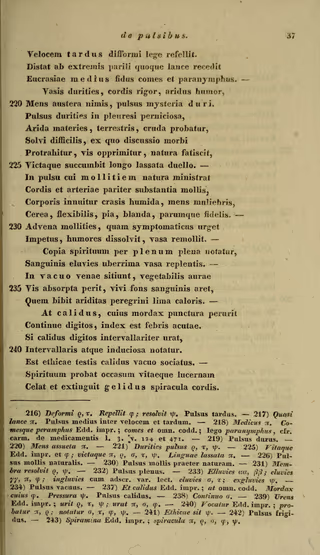
Velocem *tardus* difformi lege refellit.
Distat ab extremis parili quoque lance recedit
Eucrasiae *medius* fidus comes et paranymphus. —
Vasis durities, cordis rigor, aridus humor,
Mens austera nimis, pulsus mysteria *duri*.
Pulsus durities in pleuresi perniciosa,
Arida materies, terrestris, cruda probatur,
Solvi difficilis, ex quo discussio morbi
Protrahitur, vis opprimitur, natura fatiscit,
Victaque succumbit longo lassata duello. —
In pulsu cui *mollitiem* natura ministrat
Cordis et arteriae pariter substantia mollis,
Corporis innuitur crasis humida, mens muliebris,
Cerea, flexibilis, pia, blanda, parumque fidelis. —
Advena mollities, quam symptomaticus urget
Impetus, humores dissolvit, vasa remollit. —
Copia spirituum per *plenum* plena notatur,
Sanguinis eluvies uberrima vasa replentis. —
In *vacuo* venae sitiunt, vegetabilis aurae
Vis absorpta perit, vivi fons sanguinis aret,
Quem bibit ariditas peregrini lima caloris. —
At *calidus*, cuius mordax punctura perurit
Continue digitos, index est febris acutae.
Si calidus digitos intervallariter urat,
Intervallaris atque induciosa notatur.
Est ethicae testis calidus vacuo sociatus. —
Spirituum probat occasum vitaeque lucernam
Celat et extinguit *gelidus* spiracula cordis.