Hover or tap a word to see its match.
By five modes the practitioner's skill examines the pulse,
From which a doubled number of genera is drawn out:
From the form of the movement, three: the large, the strong, the fast;
The substance of the member produces the soft, the full, the hot,
From which, along with the first ones, a sixfold series arises;
Delay, which separates the arses, constitutes the frequent;
That which declines downwards from high with a dactylic foot,
And that which, failing, rises and resumes its strength,
Is noted from the comparative ratio of the theses;
The last ones joined to the first as if to the principal ones,
In which the movement is discordant or consonant, a single
Order or adverse, to be noted by the ratio of number. —
An augmented threefold dimension makes the large,
If small, a small one; if moderately increased, a medium one;
The large one rises in length, breadth, and depth,
The small one falls into the hidden, the narrow, and the cut short;
That which follows the middle is rightly held to be medium.
The long one goes beyond the bellies of four fingers,
The mutilated stops short, and the medium one becomes equal to all,
The broad one holds the fingers in breadth, the high one stands out,
The narrow one occurs as slender, and the deep one settles down. —
Frequency allied with greatness constitutes the strong one,
The contrary species arises from opposite causes. —
A slow arsis produces a slow one, a hasty one a swift one. —
If the hard organs strike the fingers with austere stiffness,
they set up a hard one; if lax, a relaxed one;
If they yield: an empty one; if they stand firm and turgid: a full one. —
Arterial heat sets up a hot pulse,
A cold one occurs through the coldness of the underlying limb. —
While the remaining species are bound by some mediating factor,
the strong is joined to the weak, with no distinction
the equal to the unequal; the cause of this connection
let those solve who unravel the hidden enigmas of things. —
If with a sudden snatch, with a small interval of delay,
a numerous series multiplies the arsis, it constitutes
a frequent pulse, the contrary species a rare one. —
The falling one from strong and manifest rhythms
gradually degenerating tends with silent foot to the bottom,
It verges into the hidden, struggling to escape the sense.
The rising one surges, breathes, tends to the height
It leaves behind the hidden, joining to itself the manifest. —
Firm and fleeing the interactions of opposite motion,
It remains equal, with the law of its course preserved.
Degenerate, unstable, and not running by the same path,
It falters, unequal, controlled by doubtful reins. —
By distinct steps it is changed, and in a certain order
It passes into its opposite, which takes its name from order.
That which is considered privatively from order, exceeds
The laws of order, headlong, wandering, and without law.
The extreme genus is dispersed into a number of species
Which beg for themselves foreign names of things,
Which the logic of a comparative alliance unites to them:
Spasmodic, phthisical, ant-like, worm-like,
Branching, floating, hammer-like and goat-like,
Saw-like, straight, mouse-like or twisted. —
Form, *crasis*, sex, age, pregnancy, sleep,
And place and time, labor, food, repletion, drink,
Cause, kind of disease, coitus, disturbance of mind,
And bodily position vary the idioms of the pulse. —
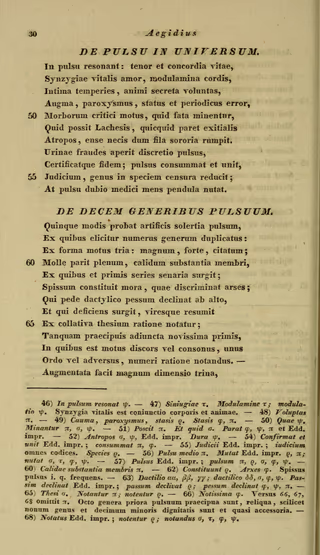
Quinque modis probat artificis solertia pulsum,
Ex quibus elicitur numerus generum duplicatus:
Ex forma motus tria: magnum, forte, citatum;
Molle parit plenum, calidum substantia membri,
Ex quibus et primis series senaria surgit;
Spissum constituit mora, quae discriminat arses;
Qui pede dactylico pessum declinat ab alto,
Et qui deficiens surgit, viresque resumit
Ex collativa thesium ratione notatur;
Tanquam praecipuis adiuncta novissima primis,
In quibus est motus discors vel consonus, unus
Ordo vel adversus, numeri ratione notandus. —
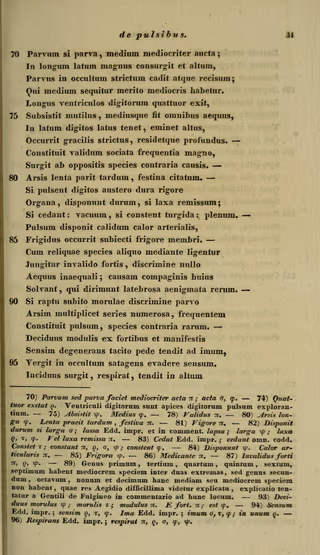
Augmentata facit magnum dimensio trina,
Parvum si parva, medium mediocriter aucta;
In longum latum magnus consurgit et altum,
Parvus in occultum strictum cadit atque recisum;
Qui medium sequitur merito mediocris habetur.
Longus ventriculos digitorum quattuor exit,
Subsistit mutilus, mediusque fit omnibus aequus,
In latum digitos latus tenet, eminet altus,
Occurrit gracilis strictus, residetque profundus. —
Constituit validum sociata frequentia magno,
Surgit ab oppositis species contraria causis. —
Arsis lenta parit tardum, festina citatum. —
Si pulsent digitos austero dura rigore
Organa, disponunt durum, si laxa remissum;
Si cedant: vacuum, si constent turgida: plenum. —
Pulsum disponit calidum calor arterialis,
Frigidus occurrit subiecti frigore membri. —
Cum reliquae species aliquo mediante ligentur,
Jungitur invalido fortis, discrimine nullo
Aequus inaequali; causam compaginis huius
Solvant, qui dirimunt latebrosa aenigmata rerum. —
Si raptu subito morulae discrimine parvo
Arsim multiplicet series numerosa, frequentem
Constituit pulsum, species contraria rarum. —
Deciduus modulis ex fortibus et manifestis
Sensim degenerans tacito pede tendit ad imum,
Vergit in occultum satagens evadere sensum.
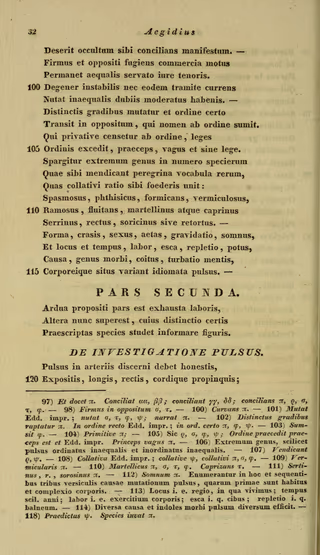
Inciduus surgit, respirat, tendit in altum
Deserit occultum sibi concilians manifestum. —
Firmus et oppositi fugiens commercia motus
Permanet aequalis servato iure tenoris.
Degener instabilis nec eodem tramite currens
Nutat inaequalis dubiis moderatus habenis. —
Distinctis gradibus mutatur et ordine certo
Transit in oppositum, qui nomen ab ordine sumit.
Qui privative censetur ab ordine, leges
Ordinis excedit, praeceps, vagus et sine lege.
Spargitur extremum genus in numero specierum
Quae sibi mendicant peregrina vocabula rerum,
Quas collativi ratio sibi foederis unit:
Spasmosus, phthisicus, formicans, vermiculosus,
Ramosus, fluitans, martellinus atque caprinus
Serrinus, rectus, soricinus sive retortus. —
Forma, crasis, sexus, aetas, gravidatio, somnus,
Et locus et tempus, labor, esca, repletio, potus,
Causa, genus morbi, coitus, turbatio mentis,
Corporeique situs variant idiomata pulsus. —