Hover or tap a word to see its match.
The heart is the seat of life, the faithful mansion of vital
Heat, the sole basis of nature, the sun of the microcosm,
The bedchamber, throne, and innermost shrine of vivifying vigor,
In which a little fountain gushes forth, which with pure tinder
Rules, animates, increases, orders, and gilds the limbs.
Hence you should seek the stable numbers and physical bonds,
From which the foundations of human life consist;
From seminal causes the innate fiery force inhabits this
And renders the seat akin to itself,
Whence a form related to heat is given to the member:
The apex rises into a cone, earthly things lay the foundation
And build the base, the lighter parts are carried upwards. —
It is seized by an unbridled motion, now it rises in *arsis*
Now the opposing *thesis* presses it down, emulating the center.
By continuous motion the hot substance could be burned up,
It would fail and bring about the loss of its own motion,
But the moist lung, nourished by raw humor,
Divided into many chambers, soothes the fiery openings of the heart
With the gentle fan of the drawn-in breath. —
The form of the heart, its crasis, the smoke, the spiritual force
A servant of virtue, bestowing breaths to the limbs,
Are the causes of arsis; thesis from gravity alone
Is accomplished, while its substance is pressed down by itself.
The rule of nature governs and performs this motion,
Whose force of the soul, infused into the limbs, rouses vigor
And tempers the remaining acts of the virtues. —
So that a soothing breeze might refresh the innate heat
And the shadows of the smoky cloud might stay far away,
So that the spirit might be restored by worthy tinder,
Such a motion is conflated from arsis and thesis,
Which makes the pulse and becomes consonant with life.
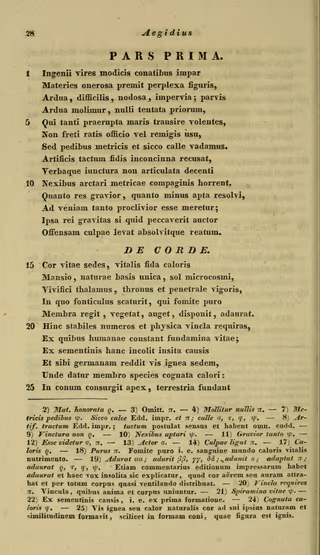
Cor vitae sedes, vitalis fida caloris
Mansio, naturae basis unica, sol microcosmi,
Vivifici thalamus, thronus et penetrale vigoris,
In quo fonticulus scaturit, qui fomite puro
Membra regit, vegetat, auget, disponit, adaurat.
Hinc stabiles numeros et physica vincla requiras,
Ex quibus humanae constant fundamina vitae;
Ex sementinis hanc incolit insita causis
Et sibi germanam reddit vis ignea sedem,
Unde datur membro species cognata calori:
In conum consurgit apex, terrestria fundant
Aedificantque basim, sursum leviora feruntur.—
Effreni rapitur motu, nunc surgit in *arsim*
Nunc adversa *thesis* ipsum premit aemula centri.
Continuo motu res fervida posset aduri
Deficeret traheretque sui dispendia motus,
Sed pulmo madidus, crudique humoris alumnus,
Multis distinctus cameris fovet ignea cordis
Blando concepti spiraminis ora flabello. —
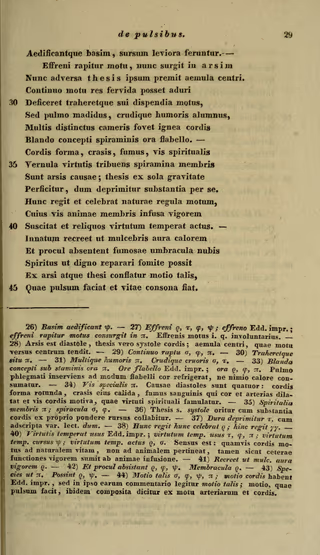
Cordis forma, crasis, fumus, vis spiritualis
Vernula virtutis tribuens spiramina membris
Sunt arsis causae; thesis ex sola gravitate
Perficitur, dum deprimitur substantia per se.
Hunc regit et celebrat naturae regula motum,
Cuius vis animae membris infusa vigorem
Suscitat et reliquos virtutum temperat actus. —
Innatum recreet ut mulcebris aura calorem
Et procul absentent fumosae umbracula nubis
Spiritus ut digno reparari fomite possit
Ex arsi atque thesi conflatur motio talis,
Quae pulsum faciat et vitae consona fiat.