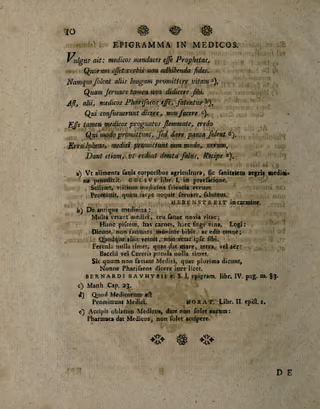
EPIGRAMMA IN MEDICOS.

Poet
Christian Tobias Ephraim Reinhard
Book
Medicus poeta , 1762
Form
Not identifiable from book
Open the page in the book
The page this poem fills. Each opens in the Medicus poeta reader.

Hover or tap a word to see its match.

EPIGRAM ON PHYSICIANS.

The common folk say that physicians are lying Prophets,

In whose words no trust should be placed.

For they are wont to promise long life to others a),

Which nevertheless they have not learned to preserve for themselves.

Yet others confess that physicians are Pharisees b),

Who are accustomed to say, and not to do c).

Nevertheless, I believe physicians are sprung from a lineage

Who only promise, but are wont to give little d).

I gladly err: physicians not only promise, but

Also give, so that lost health may return, a recipe e).

Vulgus ait: medicos mendaces esse Prophetas,

Quorum esset verbis non adhibenda fides.

Namque solent aliis longam promittere vitam a),

Quam seruare tamen non didicere sibi.

Ast, alii, medicos Pharisaeos esse, fatentur b),

Qui consueuerunt dicere, non facere c).

Esse tamen medicos prognatos stemmate, credo

Qui modo promittunt, sed dare pauca solent d).

Erro lubens, medici promittunt non modo, verum,

Dant etiam, vt redeat demta salus, Recipe e).
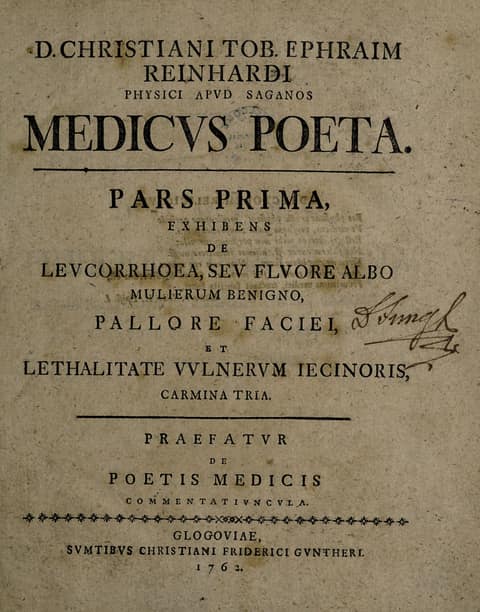
Title page of Medicus poeta
Title page of Medicus poeta , 1762

About this text

Provenance

This edition uses the Wellcome Collection copy, catalogued as _Medicus poeta. Pars prima, exhibens de leucorrhoea, pallore faciei, et lethalitate vulnerum jecinoris, carmina tria_ (b30503395). Scans 1 to 4 are the front cover and flyleaves with handwritten notes. Scan 5 is the title page. Scans 75 to 80 are blank leaves and the back cover.

Rights

The work is in the public domain by age. Wellcome Collection marks this copy with Public Domain Mark 1.0. Credit Wellcome Collection. Poet Doctor is a non-commercial site.

Original scans: Wellcome Collection ( Public Domain Mark 1.0 ).

Historian’s note. This text records the medicine of its own time, and later evidence has replaced most of it. It is not medical advice. We read it as history, and we ask what, if anything, connects it to medicine today. More on how we read old medical books