Hover or tap a word to see its match.
Part 1
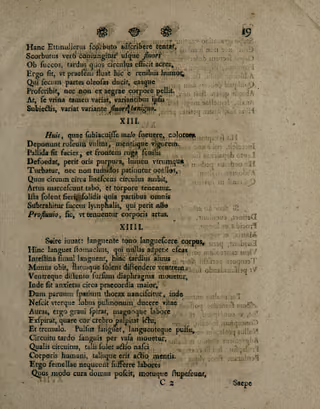
It is useful to know: as the tone languishes, the body languishes,
Hence the stomach languishes, which desires no food,
The intestines languish at the same time, hence the bowels more slowly
Perform their duty, and flatulence is wont to distend the belly:
And when the belly is distended, the diaphragm is moved upwards,
Thence arises a greater anxiety around the praecordia,
While the thorax obtains little space, thence
Neither lobe of the lungs knows how to draw the vital
Air, therefore she breathes with heavy labour, and with great labour
Breathes out, wherefore the heart palpitates with a frequent
And trembling beat. The pulse languishes, and as the pulse languishes,
The blood is moved through the vessels in a slow circulation.
Such as the circulation is, such an action is wont to be born
Of the human body, and such will be the action of the mind.
Therefore the poor women cannot endure the labours
Which the mere care of the house demands, and they are stupefied by movement,
Scire iuuat: languente tono langueſcere corpus,
Hinc languet ſtomachus, qui nullas adpetit eſcas
Inteſtina ſimul languent, hinc tardius aluus
Munus obit, flatusque ſolent diſtendere ventrem:
Ventreque diſtento ſurſum diaphragma mouetur,
Inde fit anxietas circa praecordia maior,
Dum paruum ſpatium thorax nanciſcitur, inde
Neſcit vterque lobus pulmonum ducere vitae
Auras, ergo graui ſpirat, magnoque labore
Exſpirat, quare cor crebro palpitat ictu,
Et tremulo. Pulſus languet, languenteque pulſu,
Circuitu tardo ſanguis per vaſa mouetur.
Qualis circuitus, talis ſolet actio naſci
Corporis humani, talisque erit actio mentis.
Ergo femellae nequeunt ſufferre labores
Quos modo cura domus poſcit, motuque ſtupeſcunt,
Part 2
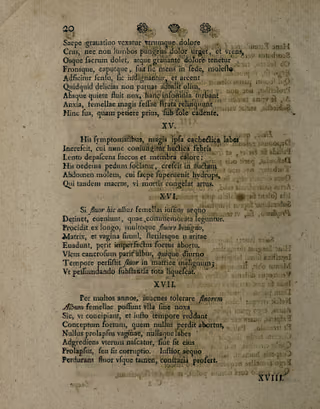
Often both legs are vexed by a heavy
Pain, and a piercing and burning pain also presses upon the loins,
And the sacrum aches, and the forehead and head are held
By a heavy pain; thus the mind in its own seat is affected
By a troublesome sensation; thus they are indignant, and ward off
Whatever once brought no small delights.
The night flows by without rest; anxious sleeplessness
Disturbs it; hence the young women leave their beds
More weary than when they sought them earlier, beneath the setting sun.
Saepe grauatiuo vexatur vtrumque dolore
Crus, nec non lumbos pungens dolor urget, et vrens,
Osque ſacrum dolet, atque grauante dolore tenetur
Fronsque, caputque, ſua ſic mens in ſede, moleſto
Adficitur ſenſu, ſic indignantur, et arcent
Quidquid delicias non paruas adtulit olim.
Absque quiete fluit nox, hanc inſomnia turbant
Anxia, femellae magis feſſae ſtrata relinquunt
Hinc ſua, quam petiere prius, ſub ſole cadente.