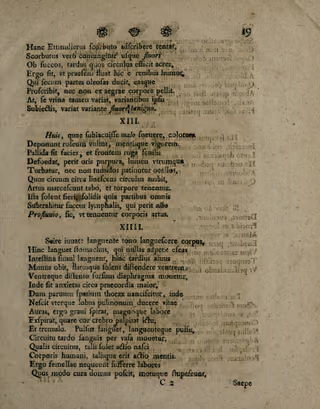
XIII.

Poet
Christian Tobias Ephraim Reinhard
Book
Medicus poeta , 1762
Form
Not identifiable from book
Open the page in the book
The page this poem fills. Each opens in the Medicus poeta reader.

Hover or tap a word to see its match.

XIII.

Those who are accustomed to have been subject to this evil lay aside

The rosy colour of their countenance, and the vigour of their mind.

The face becomes pale, and a senile wrinkle disfigures

The forehead, the purple of the lips perishes, both eyes

Are clouded, and they also suffer from swollen eyes,

Around which a livid circle encompasses,

The limbs waste away with decay, and are held by torpor.

These things are accustomed to happen, because all the lymphatic

Juice is withdrawn from the solid parts, which perishes in the white

Flux, so that the limbs of the body are attenuated.

Huic, quae subiacuisse malo sueuere, colorem

Deponunt roseum vultus, mentisque vigorem.

Pallida fit facies, et frontem ruga senilis

Defoedat, perit oris purpura, lumen vtrumque

Turbatur, nec non tumidos patiuntur ocellos,

Quos circum circa liuescens circulus ambit,

Artus marcescunt tabo, et torpore tenentur.

Ista solent fieri, solidis quia partibus omnis

Subtrahitur succus lymphalis, qui perit albo

Profluuio, sic, vt tenuentur corporis artus.
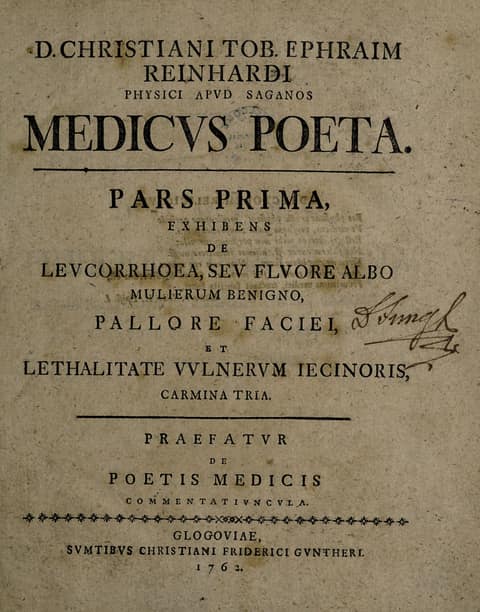
Title page of Medicus poeta
Title page of Medicus poeta , 1762

About this text

Provenance

This edition uses the Wellcome Collection copy, catalogued as _Medicus poeta. Pars prima, exhibens de leucorrhoea, pallore faciei, et lethalitate vulnerum jecinoris, carmina tria_ (b30503395). Scans 1 to 4 are the front cover and flyleaves with handwritten notes. Scan 5 is the title page. Scans 75 to 80 are blank leaves and the back cover.

Rights

The work is in the public domain by age. Wellcome Collection marks this copy with Public Domain Mark 1.0. Credit Wellcome Collection. Poet Doctor is a non-commercial site.

Original scans: Wellcome Collection ( Public Domain Mark 1.0 ).

Historian’s note. This text records the medicine of its own time, and later evidence has replaced most of it. It is not medical advice. We read it as history, and we ask what, if anything, connects it to medicine today. More on how we read old medical books