Hover or tap a word to see its match.
Part 1
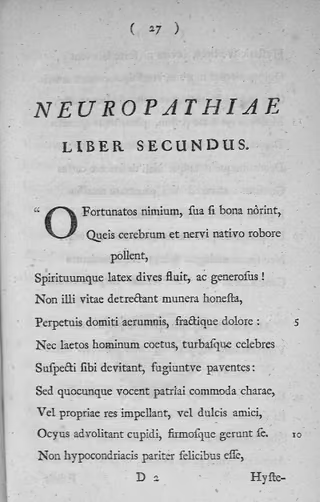
“O too fortunate, if they but knew their own blessings,
Those whose brain and nerves are strong with native vigor,
And in whom the fluid of the spirits flows rich and generous!
They do not shirk the honorable duties of life,
Subdued by perpetual hardships, and broken by grief:
Nor do they, distrustful of themselves, shun the joyful
Assemblies of men and crowded throngs, or flee in terror:
But wherever the interests of their dear country call,
Or their own affairs, or those of a sweet friend impel them,
Swiftly they fly thither, eager, and bear themselves firmly.
For the hypochondriac to be equally happy,
“O Fortunatos nimium, ſua ſi bona nôrint,
Queis cerebrum et nervi nativo robore pollent,
Spirituumque latex dives fluit, ac generoſus!
Non illi vitae detrectant munera honeſta,
Perpetuis domiti aerumnis, fractique dolore:
Nec laetos hominum coetus, turbaſque celebres
Suſpecti ſibi devitant, fugiuntve paventes:
Sed quocunque vocent patriai commoda charae,
Vel propriae res impellant, vel dulcis amici,
Ocyus advolitant cupidi, firmoſque gerunt ſe.
Non hypocondriacis pariter felicibus eſſe,
Part 2
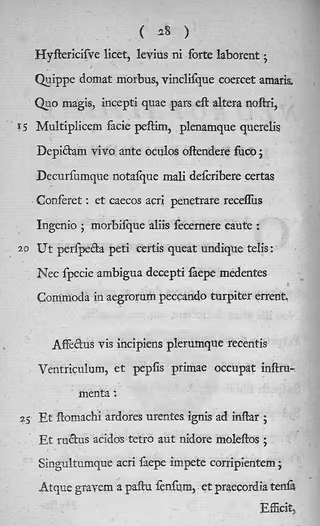
or hysteric, unless by chance they suffer more lightly;
For the disease subdues them, and binds them in bitter chains.
Wherefore all the more—which is the second part of our undertaking—
Will it be useful to display before the eyes a plague manifold in form, and full of complaints,
Depicted in living color;
And to describe the course and the sure marks of the evil:
And to penetrate its dark recesses with keen
Intellect; and cautiously to separate it from other diseases:
So that, once thoroughly examined, it may be assailed on all sides with sure weapons:
And healers, not often deceived by an ambiguous appearance,
May not shamefully err by sinning against the welfare of the sick.
The incipient force of the recent affection mostly
Seizes the stomach, and the instruments of the first pepsis
:
And heats of the stomach burning like fire;
And belchings troublesome with an acid or foul savor;
And a hiccup often seizing with a sharp onset;
And a heavy sensation after food, and tense praecordia
Hyſtericiſve licet, levius ni forte laborent ;
Quippe domat morbus, vincliſque coercet amaris.
Quo magis, incepti quae pars eſt altera noſtri,
Multiplicem facie peſtim, plenamque querelis
Depictam vivo ante oculos oſtendere fuco ;
Decurſumque notaſque mali deſcribere certas
Conferet : et caecos acri penetrare receſſus
Ingenio ; morbiſque aliis ſecernere caute :
Ut perſpecta peti certis queat undique telis :
Nec ſpecie ambigua decepti ſaepe medentes
Commoda in aegrorum peccando turpiter errent.
Affectus vis incipiens plerumque recentis
Ventriculum, et pepſis primae occupat inſtru-
menta :
Et ſtomachi ardores urentes ignis ad inſtar ;
Et ructus acidos tetro aut nidore moleſtos ;
Singultumque acri ſaepe impete corripientem ;
Atque gravem a paſtu ſenſum, et praecordia tenſa
Part 3
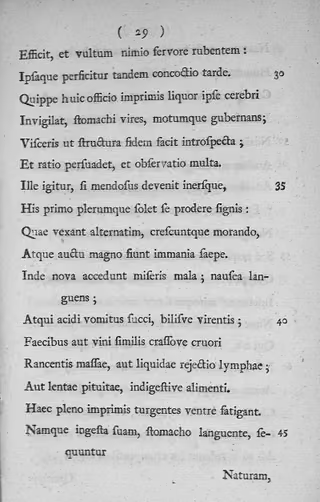
causes, and a face reddening with excessive heat:
and digestion itself is at length accomplished slowly.
Indeed, over this function above all the fluid of the brain itself
watches, governing the powers and motion of the stomach;
as the inspected structure of the organ confirms;
and reason persuades, and much observation.
That fluid, therefore, if it has become faulty and sluggish,
is usually wont at first to betray itself by these signs:
which harass by turns, and grow by lingering,
and by great increase often become monstrous.
Thence new evils befall the wretched sufferers; a languishing
nausea;
and the vomiting of an acid juice, or of greenish bile;
or the throwing up of a rancid mass like the lees of wine or thick
gore, or of liquid lymph;
or of tenacious phlegm, or of undigested food.
These things especially weary those who are swollen with a full belly.
For the things ingested, when the stomach languishes, follow
their own
Efficit, et vultum nimio fervore rubentem :
Ipſaque perficitur tandem concoctio tarde.
Quippe huic officio imprimis liquor ipſe cerebri
Invigilat, ſtomachi vires, motumque gubernans;
Viſceris ut ſtructura fidem facit introſpecta ;
Et ratio perſuadet, et obſervatio multa.
Ille igitur, ſi mendoſus devenit inerſque,
His primo plerumque ſolet ſe prodere ſignis :
Quae vexant alternatim, creſcuntque morando,
Atque auctu magno fiunt immania ſaepe.
Inde nova accedunt miſeris mala ; nauſea lan-
guens ;
Atqui acidi vomitus ſucci, biliſve virentis ;
Faecibus aut vini ſimilis craſſove cruori
Rancentis maſſae, aut liquidae rejectio lymphae ;
Aut lentae pituitae, indigeſtive alimenti.
Haec pleno imprimis turgentes ventre fatigant.
Namque ingeſta ſuam, ſtomacho languente, ſe-
quuntur
Part 4
nature, less subdued by the concoctive powers;
and lingering in the heat of the moist place, they contract
acidity; or they putrefy; or like glue
they grow viscid, giving rise to sluggish mucus:
at length noxious to the viscera, and refusing to be conquered;
and increased by the manifold juice, which the viscera pour forth
as an aid to pepsis, and a useful ferment of the chyle,
“they are cast out, and carried forth from the mouth in masses;
the nerves, namely, and the fluid of the brain being irritated.
Yet neither does the disease allow the fasting to be at rest:
for sharp gnawings of the stomach, and gripes often
infest them; and sounding winds with a strange murmur
roll themselves now here, now there, through the whole abdomen.
Which unless, their bonds being loosened, and their prison burst,
they escape slipping out silently, or bellowing hoarsely,
often cause dreadful anguish, and dire pains
by distending the chyle-making tube, and pressing the neighboring parts;
and seem to threaten sudden death.
But when these break forth, the sick return to themselves;
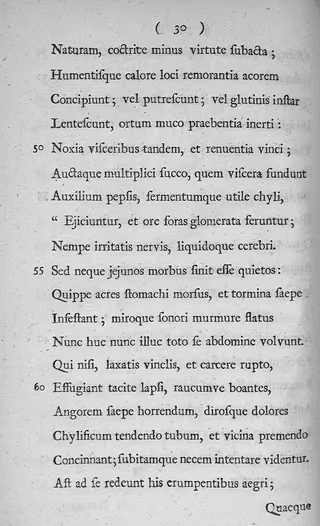
Naturam, coctrice minus virtute ſubacta ;
Humentiſque calore loci remorantia acorem
Concipiunt ; vel putreſcunt ; vel glutinis inſtar
Lenteſcunt, ortum muco praebentia inerti :
Noxia viſceribus tandem, et renuentia vinci ;
Auctaque multiplici ſucco, quem viſcera fundunt
Auxilium pepſis, fermentumque utile chyli,
“ Ejiciuntur, et ore foras glomerata feruntur ;
Nempe irritatis nervis, liquidoque cerebri.
Sed neque jejunos morbus ſinit eſſe quietos :
Quippe acres ſtomachi morſus, et tormina ſaepe
Infeſtant ; miroque ſonori murmure flatus
Nunc huc nunc illuc toto ſe abdomine volvunt.
Qui niſi, laxatis vinclis, et carcere rupto,
Effugiant tacite lapſi, raucumve boantes,
Angorem ſaepe horrendum, diroſque dolores
Chylificum tendendo tubum, et vicina premendo
Concinnant ; ſubitamque necem intentare videntur.
Aſt ad ſe redeunt his erumpentibus aegri ;
Part 5
And the hope that had just now been extinguished in them shines forth again.
There are some who are scarcely ever hungry, or delighted
By the pleasant and sweet taste of any food:
But a far greater number desires more than is right;
And, too keen, greedily gulps down snatched morsels;
Burdening the stomach with ingested food that is scarcely to be subdued.
Some a foul hunger, and like the canine one,
Torments, and it barks for the frequent relief of eating:
Yet these same people digest what they have taken no more successfully;
Accumulating crude humours as fuel for the disease.
Finally, with the disease prevailing, the faculty of the stomach
Is disturbed in every way, and lies prostrate and languishes;
And the remaining instruments of the first pepsis grow exhausted.
Meanwhile, the contagion of the foul disease
Begins to infect the brain, and to invade the seats of the nerves;
Later or sooner, according as these either are strong in vigour,
Or, formed with too loose a structure, waver.
Moreover, sometimes, though more rarely, the horrid plague
Quaeque ipſis fuerat modo ſpes extincta relucet.
Sunt qui vix unquam eſuriunt, gratove alimenti
Ullius delectantur, dulcique ſapore :
At numerus longe major plus appetit aequo ;
Correptaſque avide bolos nimis ingerit acer ;
Ventriculum ingeſtis onerans aegre ſubigendis.
Nonnullos obſcoena fames, ſimiliſque caninae
Macerat, et cerebrum latrat lenimen edendi :
Aſt aſſumpta coquunt nihilo felicius iidem ;
Humores crudos cumulantes pabula morbi.
Denique ventriculi, morbo dominante, facultas
Omnimodis perturbatur, proſtrataque languet ;
Et primae pepſis reliqua inſtrumenta fatiſcunt.
Interea cerebrum tetri contagio morbi
Incipit inficere, et nervorum invadere ſedes;
Serius, aut citius, prout haec, vel robore pollent,
Vel laxa nimium compagine creta vacillant.
Quin et nonnunquam, ſed rarius, horrida labes.
Part 6
leaving the stomach untouched, attacks the very head precipitately.
This sometimes happens to boys, for in them the stomach is more robust,
And at the same time the pulpy mass of the brain is weaker;
And for these unfortunate ones, their tender years
Are overspread with an untimely gloom.
Yet in all those whose head is injured first,
The stomach is at length infected, and the aforementioned
Signs of the evil grow stronger, if the dire contagion continues to worsen:
And in a wholly similar manner, those who happen to suffer in the stomach
At the beginning, as the disease increases, have their very brain
Assailed, and the shaken citadel of the soul totters.
In these matters, however, it is necessary to recognize this:
That not all the signs of the affection are present in any single person,
Neither those already recounted, nor those which follow to be described hereafter.
For just as when a fierce tempest has fallen upon a dense forest,
And buffets the oaks with a raging whirlwind;
Some, torn up by the roots, are overthrown:
Ventriculo intacto praeceps caput impetit ipſum.
Hoc pueris, nam ventriculus robuſtior ollis,
Debiliorque ſimul moles pulpoſa cerebri,
Accidit interdum; et teneri infelicibus anni
Intempeſtiva nigredine ſuffunduntur.
At quibus eſt primo laeſum caput, omnibus ipſis
Ventriculus tandem inficitur, memorataque gliſ-
cunt
Signa mali, ſi dira lues crudeſcere pergat :
Conſimilique modo ſtomacho qui forte laborant
Principio, his ipſum, morbo creſcente, cerebrum
Oppugnatur, et arx animae concuſſa labaſcit.
Illud in his vero rebus cognoſcere oportet,
Haud uni cuiquam affectûs ſigna omnia adeſſe
Tradita jam, nec quae poſt deſcribenda ſequuntur.
Nam veluti ſylvae denſae cum ſaeva procella
Incubuit, vexatque furenti turbine quercus ;
Nonnullae evulſae radicitus exturbantur :
Part 7
Slender trunks and decayed timbers are broken;
And some lose their lowest branches, and others their topmost;
Not all the damaged ones have the same appearance,
Even though the same rushing north wind has struck them all;
Not otherwise does the fierce force of the disease not infest
And torture every suffering body in the same ways:
But according as this or that part stands weaker in them,
And according to the varied degree of the affection, and the remote causes,
It puts on a varied appearance, and the victorious pestilence
Marches on, accompanied by a varied troop of ills.
Moreover, the first signs of the disease beginning to attack the brain
Are generally a movement of the mind swifter than is right;
And meditation more frequent than usual; anxiety;
And the disturbed equability of their native disposition,
While, to be sure, at one time they seem dull and morose;
At another time the very same persons spontaneously become affable, and pleasant, and talkative;
And they captivate the ears and minds of men
With unexpected witticisms and varied charm.
Franguntur trunci graciles, carioſaque ligna;
Atque imos aliae ramos, aliaeque ſupernos
Amittunt; facies laeſis non omnibus una,
Idem aquilo quamvis percuſſerit incitus omnes;
Haud aliter morbi fera vis non corpora quaeque
Infeſtat, torquetque modis patientia eiſdem:
Sed prout haec ipſis pars, illave debilior ſtat,
Proque gradu affectûs vario, cauſiſque remotis,
Induitur ſpeciem variam, variaque malorum
Incedit peſtis victrix comitante caterva.
Prima autem morbi cerebrum petere incipientis
Signa fere mentis motus velocior aequo;
Crebrior et ſolito meditatio; ſollicitudo;
Indolis et turbata aequabilitas nativae,
Nunc hebetes, et moroſi dum nempe videntur;
Nunc faciles iidem, et jucundi ſponte, loquaceſque
Evadunt; hominumque aures capiunt, animoſque
Haud expectatis ſalibus, varioque lepore.
Part 8
And the other things, which in the former part of my undertaking I taught
To belong to those furnished with weaker nerves and brain,
And to render them susceptible to the dire disorder,
Creep in with slow steps, and by minute degrees.
Often, grieving within himself in his mind, the patient now ponders
Many sad things; now, rejoicing, the same man revolves pleasant ones;
Both groundless; yet to him who revolves them, they seem disguised
With a flattering semblance of reason and of truth.
Or changed a little later, he chides himself;
And condemns his empty fears and vain joys.
Sometimes there enter the mind of the unwilling wretches
Many absurd things, and many obscene, and many dreadful
things;
Nor are they able to blot them out from the mind, and promptly expel them;
And they grieve heavily that their mind is filled with such things.
Moreover, these strike them so violently
At times, that they fear lest either their tongue, impelled
suddenly,
Caeteraque, incepti docui quae in parte priore
Debilioribus inſtructis nervis, cerebroque
Competere, et dirae opportunos reddere labi,
Paſſibus inſerpunt lentis, gradibuſque minutis.
Saepe animo ſecum moerens nunc cogitat aeger
Triſtia multa; idem gaudens nunc volvit amoena;
Utraque inania; ſed quae volventi rationis,
Et blanda veri ſpecie fucata videntur.
Aut paulo poſt mutatus ſeſe increpat ipſum;
Atque metus damnat vacuos, et gaudia vana.
Nonnumquam invitis miſeris mentem ingredi-
untur
Multa abſurda, et multa obſcoena, horrendaque
multa;
Nec delere valent animo, atque expellere prompte;
Et graviter moerent ſibi mentem implerier iſtis.
Quinetiam haec ipſos feriunt adeo violenter
Interdum, ut metuant ne aut lingua impulſa
repente
Part 9
betray their disordered thoughts, and the tumults of their brain;
Or foolish motions and actions of the body follow.
That likewise is very frequent, namely that in the minds of these
A predominant fear of some particular thing settles;
Which however they not rarely keep silent about, and conceal in shame;
Since shame attends the disease: and when the former is overcome,
Another, no less anxious, swiftly invades.
Moreover, to the healthy, the subjects and causes of the fears,
At which the wretches turn pale, seem to be ridiculous:
Wherefore the more they strive to hide the inmost feelings of their mind.
Then indeed pains of the head of every kind very often
Vex them; not rarely fierce in the very crown,
While the seat of the occiput stiffens with icy cold:
The ears ring with a dreadful sound: and blackish spots
Very like flies; or a mist like a cloud;
Or red appearances of things, and flashing flames
Flit before the eyes: the motor fibers of either eyelid
And of the lips twitch with a tremulous impulse:
Turbatos prodat ſenſus, cerebrique tumultus;
Corporis aut ſtolidi motus, et facta ſequantur.
Illud item valde crebrum, quod ſcilicet horum
Praedominans cujuſdam animis metus inſideat rei;
Quem tamen haud raro reticent, celantque pu-
dentes;
Quippe pudor morbum ſequitur: victoque priore,
Ocyus invadit nihilominus anxius alter.
Argumenta autem ſanis, cauſaeque timorum,
Queis miſeri pallent, deridicula eſſe videntur :
Quo magis occultare ſtudent animi intima ſenſa.
Tum vero capitis vexant perſaepe dolores
Omnimodi; ſummo non raro in vertice ſaevi,
Dum riget occipitis glaciali frigore ſedes:
Horriſonae ſtrident aures: maculaeque nigrantes
Perſimilis muſcis; caligove nubis ad inſtar ;
Aut rubrae rerum ſpecies, flammaeque coruſcae
Obvolitant oculis : ſaliunt palpebrae utriuſque
Motrices tremulo labrorumque impete fibrae:
Part 10
And the veins throb more fervently in either temple.
Sometimes vertigo terrifies more sharply, and threatens a fall,
Whereby all things seem to whirl around:
Or the vain fear of an apoplectic disease strikes them down.
Often, when least expecting it, as if assailed by magic art,
The fluid of the encephalon fails; the wretched patient
Scarcely feels his own body, and at any moment seems
Helplessly about to rush into death, and the gaping underworld:
Nor, though struggling, is he able by reason to withstand
The empty terrors of the mind, and vain specters;
At the same time, with a wonderful mobility, the unstable mind
Of the wretch is twisted hither and thither, and wherever turned,
Is weighed down by black grief, and a pursuing horror.
No sadder evil than that befalls mortals,
Nor any more intolerable; scarcely do the fierce torments
Of gout equal it; scarcely the exquisite punishments
Of criminals, or the rending violence of a hard childbirth.
For indeed the props of the soul totter, threatening a fall,
And there perishes for a time that by which all evils are
endured,
Fervidiuſque micant utroque in tempore venae.
Acrius interdum terret, lapſumque minatur
Vertigo, qua gyrari res quaeque videntur :
Attonitive metus morbi percellit inanis.
Saepe inopinanti, magica velut arte petito,
Delinquit liquor encephali ; miſerabilis aeger
Vix proprium ſentit corpus, jam jamque videtur
In lethum ruiturus inops, orcumque patentem :
Nec ratione valet certans obſiſtere contra
Terrores animi vacuos, et inania ſpectra ;
Mobilitate ſimul mira huc torquetur et illuc
Inſtabilis miſero mens, et quocunque relata
Deprimitur moerore nigro, atque horrore ſequaci.
Triſtius haud illo mortalibus accidit ullum,
Intolerabiliuſque malum ; vix ſaeva podagrae
Tormenta aequantur ; vix exquiſita reorum
Supplicia, aut duri lacerans violentia partus.
Quippe animae titubant lapſum minitantia fulcra,
Et perit ad tempus, per quod mala quaeque fe-
runtur,
Part 11
the steady office of the spirits, and the power of the brain.
More often these graver effects of the disease strike
tender maidens, and torment their fair breasts:
And attacks at times mild, at times violent,
called hysteric by physicians, often invade
with no order observed, because the liquor
of the encephalon is disturbed, and driven hither and thither in uncertain motions;
pressing on like the sacred disease, which the more severe
they are seen to be, the more perfectly they themselves resemble.
These the fierce force of the disease, raging within the body
and continually increased, excites; or a suddenly arisen
passion of the mind, and causes arriving from without;
the nerves and the liquid of the brain being suddenly struck.
Finally, in some, though few, a relentless taint
covers the brain as with a cloud; enveloping in a certain
darkness the internal senses, and the theater of the mind.
Then the soul suffers an eclipse, and dulled by the disease
becomes less conscious of itself; then life, obscured,
seems to present the appearance of a perpetual dream.
Spirituum ſtabile officium, cerebrique poteſtas.
Saepius haec morbi graviora effecta puellas
Percellunt teneras, et candida pectora torquent :
Inſultuſque alias mites, alias violenti,
Hyſterici medicis dicti nullo ordine ſaepe
Servato invadunt, turbato nempe liquore
Encephali, incertiſque huc illuc motibus acto ;
Morbi inſtar ſacri urgentes, quem quo graviores
Conſpiciuntur, eo referunt perfectius ipſi.
Hos intra corpus graſſans vis effera morbi
Excitat aucta ſubinde ; animive repente coortus
Affectus, cauſaeque extrinſecus advenientes ;
Percuſſis ſubito nervis, liquidoque cerebri.
Denique nonnullis, paucis tamen, improba labes
Nube velut cerebrum obducit ; caligine ſenſus
Involvens quadam internos, mentiſque theatrum.
Tunc anima eclipſim patitur, morboque hebetata
Conſcia fit minus ipſa ſui ; tunc vita videtur
Perpetui inſomnî ſpeciem obſcurata referre.
Part 12
If by chance this evil, being milder, has not yet struck deep
Roots, owing its origin to feeble causes,
It quickly vanishes of its own accord; or is driven away by the healing art;
Or at least, remitting, it leaves lucid intervals:
Sometimes, however, it is drawn out into numerous years,
Perpetual, untamed, and as the disease increases,
Growing.
These are perceived as the primary signs
Of the growing distemper; which, not sated with the heap of evils,
Still presses on, and urges the weary with fresh vigor.
For when by enduring it has become established, and the sick
Have now yielded their vanquished hands, and the foul contagion
Has spread itself through all the ill-nourished nerves,
Countless hardships and sharp pains
Torment the wretched, and feed equally upon their minds and bodies;
And imitate almost every species of disease.
Hence the head is attacked as if by a stroke of apoplexy:
Hence too the nerves, their tender structure broken,
Hoc ſi forte malum levius nondum egerit altas
Radices, cauſis referens imbellibus ortum,
Vaneſcit cito ſponte ; medentumve arte fugatur ;
Lucida vel ſaltem facit intervalla remittens:
Interdum vero in numeroſos ducitur annos
Perpetuum, indomitum, pro morbique augmine
creſcens.
Haec adoleſcentis primaria percipiuntur
Signa luis ; quae non cumulo ſatiata malorum
Inſtat adhuc, feſſoſque urget virtute recenti.
Quippe ubi durando fuerit firmata, manuſque
Jam victas dederint aegri, et contagio tetra
Per male nutritos nervos ſe extenderit omnes,
Innumerae miſeros aerumnae, acreſque dolores
Divexant, pariterque animos et corpora paſcunt ;
Et cunctas ferme ſpecies morborum imitantur.
Hinc petitur caput attoniti velut impete morbi:
Hinc etiam nervi, tenera compagine fracta,
Part 13
Are loosened, denying sensation and motion to the limbs.
Hence a sluggish torpor upon the man, and creeping in
Like lethargy, makes him indulge in soft rest.
Hence the sight is darkened, or utterly at times
Fails, and sometimes is exercised too acutely.
Hence a very great abundance of liquid saliva
Continuously moistens the mouth, as if the turbulent force of mercury had penetrated:
And the taste is variously impaired in the vitiated mouth.
Moreover, the very teeth, wonderful to relate,
The taint no less harasses, and racks with pain.
More often a spasm ascending from the abdomen itself,
With the spirits wonderfully rolled together, is borne on high,
And counterfeits a globe pressing the jaws and
throat;
And choking, constricts so strongly, that scarcely
Can the poor wretches swallow, or breathe.
This rarely happens to males, often to girls.
Solvuntur, ſenſum membris motumque negantes.
Hinc homini ignavus torpor, ſimiliſque veterno
Obrepens molli facit indulgere quieti.
Hinc obſcuratur viſus, prorſuſve ſubinde
Deficit, interdum nimis exercetur acutus.
Hinc liquidae os uſque humectat permagna ſa-
livae
Copia, mercurii ſeu turbida vis penetraſſet:
Et guſtus varie vitiato laeditur ore.
Quinetiam dentes ipſos, mirabile dictu,
Non minus exagitat labes, torquetque dolore.
Saepius aſcendens ipſo ex abdomine ſpaſmus
Spiritibus mire glomeratis, fertur in altum,
Mentiturque globum fauces gutturque pre-
mentem;
Atque angens adeo conſtringit fortiter, ut vix
Deglutire queant, aut reſpirare miſellae.
Hoc maribus raro contingit, ſaepe puellis.
Part 14
Springing from no other roots, a dry cough
Shakes the panting chest: and asthma, constricting
the lungs,
Halts for a time the alternating draws of breath.
Often, with a chill fear of one's life, the sick heart palpitates,
And trembling, batters the obstructing ribs with a
frequent impulse;
Or, with suspended beats, brings on a fainting of the spirit.
Besides the things mentioned above, there assail the abdomen
Many effects of the malady: a wandering heat, and vehement
Pulsations of the greatly agitated, and trembling tumults
Of the viscera; and especially of the stomach, which like a
drum
Very often swells, stretched tight; very often with monstrous
pain is racked: and the lower belly too
Sometimes is inflated, swelling, and resists when pressed;
Sometimes is felt as if emptied and absent.
Nor does almost any part exist in the ample chamber
Non aliis naſcens radicibus arida tuſſis
Pectora anhela quatit: pulmonemque aſthma
coarctans
Alternos aurae tractus pro tempore ſiſtit.
Saepe metu gelido capitis cor palpitat aegrum,
Et tremulum obſtantes crebro arietat impete
coſtas;
Deliquiumve animae ſuſpenſis ictibus infert.
Abdomen praeter ſupra memorata laceſſunt
Multa effecta mali: fervor vagus, et vehementes
Valde agitatorum pulſus, tremulique tumultus
Viſcerum; et imprimis ſtomachi qui tympani ad
inſtar
Contentus perſaepe tumet; perſaepe dolore
Immani torquetur: et inferior quoque venter
Interdum inflatur turgens, preſſuſque reſiſtit;
Interdum quaſi depletus ſentitur et abſens.
Nec pars ulla fere camera conſiſtit in ampla
Part 15
of the chyle-making belly, which manifold pains do not
sometimes infest; namely, sharp or dull;
fixed, or wandering hither and thither in uncertain course;
mild, or torturing the wretched with cruel gripes.
Yet much more often than the rest are those regions affected,
which lie hidden beneath the ribs, called the hypochondria;
the left especially, with a continual pain infesting it.
Whence the deceived common folk think the spleen has swollen.
But that which is by far the most dreadful occupies the whole
winding of the bent colon, and shows the reality by its name.
And not rarely continued throughout for days,
and prostrating the spirits wonderfully, at length remitting
everything,
it tinges the overspread body with a greenish yellowness.
More rarely does this happen to males, often to girls.
Sometimes the bowel is loosened, and casts down most fluid matter,
and produces a diarrhoea debilitating the sick in the highest degree:
sometimes, greatly hardened, it retains the faeces;
or labors in vain efforts of evacuating.
Chylifici ventris, quam non quandoque dolores
Multimodi infeſtant; pungentes nempe hebeteſve;
Fixi, aut incerto huc illuc errore vagantes;
Mites, vel miſeros cruciantes tormine ſaevo.
At multo reliquis loca ſaepius afficiuntur,
Quae coſtis ſubjecta latent hypochondria dicta;
Laevum praecipue, jugi infeſtante dolore.
Deceptum unde putat vulgus tumuiſſe lienem.
Qui vero longe diriſſimus occupat omnem
Inflexi tortum coli, et rem nomine monſtrat.
Inque dies toto non raro continuatus,
Proſternenſque animos mire, tandem omne re-
mittens,
Obductum viridi corpus flavedine tingit.
Rarius hoc maribus contingit, ſaepe puellis.
Solvitur interdum, et fluidiſſima dejicit alvus,
Datque diarrhoeam ſumme aegros debilitantem:
Interdum faeces valde indurata coercet;
Aut nixus exercendi molitur inanes.
Part 16
Sometimes too the most savage disorder attacks the flesh of the kidneys,
Torturing it, and retaining the urine,
And offers to the unwary the appearance of true nephritis:
Yet more often, gliding in a clear little stream,
The urine is discharged, poured forth suddenly with great force;
Namely, while the roused violence of the heightened disease rages,
And the fluid of the brain is driven on, swept by an unbridled impulse.
Hence also, although rarely, the bladder is afflicted;
And it suffers the same things, while physicians marvel, as if
A stone with its congealed orb were pressing upon it when full.
Moreover, in most patients the back is tortured
Very often; or, struck, is convulsed by trembling spasms:
Sometimes an icy cold is felt in the same place.
Then furthermore, the external parts without distinction
Are felt as if pricked by needles, with a tingling pain;
As is observed by him who is renowned throughout the whole world,
Hippocrates, the star of Cos, and prince of healers:
Nonnunquam et renum carnem ſaeviſſima labes
Aggreditur, torquens ipſam, urinamque retentans,
Et ſpeciem incautis verae nephritidis offert:
Saepius at pellucidulo labentia rivo
Lotia redduntur, magna vi fuſa repente;
Nimirum exaucti dum vis furit incita morbi,
Effraenique agitur cerebri liquor impete raptus.
Hinc etiam quamquam raro veſica laborat;
Atque eadem patitur, medicis mirantibus, ac ſi
Urgeret gravidam concreto calculus orbe.
Quinetiam pleriſque aegris dorſum excruciatur
Saepius; aut ſpaſmis tremulis convellitur ictum:
Interdum gelidum frigus ſentitur ibidem.
Tum porro externae nullo diſcrimine partes
Tanquam acubus pungi, cum titillante dolore
Percipiuntur; ut obſervat toto inclytus orbe
Hippocrates, Coum ſidus, princepſque medentum:
Part 17
Whose oracles, committed to truth-telling pages,
So long as the mortal race of men, and the bitter
Dominion of diseases shall endure, will ever be renowned with praise.
Moreover, frequent tossing and wandering twitchings
Plague the various joints; and painful spasms;
And fixed, monstrous pains devoid of spasms;
And hard swellings, resistant to the touch:
And the extremities often grow cold like a corpse.
Furthermore, the black pestilence very often takes away sleep,
Or renders it brief, or all too imperfect, and not at all deep;
Sending troubled dreams,
Which with terrifying power suddenly shake off slumber
From the stricken, and grip their trembling hearts:
Whether friends long dead are beheld;
Or the grim faces of monsters, and horrible spectres:
Or a pit receives them fallen with headlong weight :
Veridicis cujus mandata oracula chartis,
Dum mortale hominum genus, et durabit acerbum
Morborum imperium, ſemper laudata cluebunt.
Nec non et varios artus jactatio crebra,
Subſultuſque vagi infeſtant; ſpaſmique dolentes;
Spaſmiſque expertes fixi, immaneſque dolores;
Ad tactumque reſiſtentes, durique tumores:
Membraque ſaepe algent extrema cadaveris inſtar.
Praeterea ſomnos adimit perſaepe, breveſve
Aut imperfectos nimium, minimeque profundos
Efficit atra lues; inſomnia turbida mittens,
Terrifica quae percuſſis virtute ſoporem
Excutiunt ſubito, ſtringuntqne trementia corda:
Dudum defuncti ſeu conſpiciantur amici;
Monſtrorumve truces vultus, horrendaque ſpectra:
Vel fovea excipiat devexo pondere lapſos:
Part 18
Or armed men press hard upon them, and threaten death:
Or the nightmare miserably weighs down the entangled.
The leaping artery generally with a weaker
And rapid pulse beats the fingers of the examiner, if the
Disease itself by growing should have struck deep roots:
Sometimes, strongly excited, it rages with frequent strokes;
Just as if a hectic fever were feeding upon the wasting patient:
Moreover, it sometimes imitates an intermittent one,
And with alternate rigors and heats the manifold
Plague presses on; and sometimes, though more rarely, it
Simulates a continual, dry, hot, and ma-
lignant one:
To such a degree does it, being diverse, put on various shapes.
Broken by so many and so great evils, the miserable patient
Utterly despairs of recovering: he mourns, overwhelmed
By bitter hardships: consumed in both body and mind,
He wastes away: the strength languishes in his exhausted body:
Armative homines inſtent, mortemque minentur:
Aut miſerabiliter premat incubus indupeditos.
Debiliore fere ſaliens arteria pulſu,
Et celeri digitos palpantis verberat, ipſe
Morbus radices ſi creſcendo egeret altas:
Interdum crebris furit ictibus incita valde;
Tabentem veluti depaſceret hectica febris:
Quinetiam intermittentem nonnunquam imitatur,
Alterniſque rigoribus et fervoribus inſtat
Multiplex peſtis; quandoque, at rarius, ipſa
Continuam ſimulat, ſiccam calidam atque ma-
lignam:
Uſque adeo induitur varias diverſa figuras.
Tot tantiſque malis fractus miſerabilis aeger
Deſperat prorſus revaleſcere: moeret amaris
Obrutus aerumnis: corpuſque animumque pereſus
Carpitur: effoeto languent in corpore vires:
Part 19
And a ghastly emaciation invades him: his brawny limbs,
And especially his legs, grow thin; a wan appearance
Deforms his countenance; the sad lights of his eyes
Do not retain their wonted splendour and sparkling
fires.
His temper and manners are strangely changed; and the man
Becomes fickle, inconstant, querulous, morose, bitter;
Or despondent with an overly humble and yielding mildness;
Suspicious likewise, and driven by vain fears;
And in ordinary matters more compassionate than is right;
(For indeed all things move a weak and
childish mind)
And impatient of any delay; restless;
Or groaning with depressed spirits, sad and sluggish.
Gradually increasing, a forgetfulness of things done grows apace:
And his presence of mind is disturbed by any cause whatever.
He thinks constantly against his will, and wearying his swift
Mind, turns it in vain now hither, now thither;
Horridaque invadit macies : artuſque toroſi,
Cruraque praecipue gracileſcunt; lurida vultum
Deformat ſpecies ; oculorum lumina moeſta
Non retinent ſolitum ſplendorem igneſque mi-
cantes.
Ingenium, et mores mire mutantur; homoque
Fit levis, inconſtans, querulus, moroſus, acerbus ;
Deſpondenſve humili nimis, et leni bonitate ;
Suſpicioſus item, vaniſque timoribus actus ;
Et vulgaribus in rebus miſerantior aequo ;
(Omnia quippe movent animum imbellem, et
puerilem)
Impatienſque morae cujuſvis ; irrequietus ;
Spiritibuſve gemens depreſſis moeſtus inerſque.
Paulatim creſcens factorum oblivio gliſcit :
Turbaturque animi quavis praeſentia cauſa.
Cogitat aſſidue invitus, mentemque fatigans
Velocem nunc huc nunc torquet inaniter illuc ;
Part 20
For his ideas are unstable, and no actions follow.
He cannot steadfastly endure any labors
of body or mind: nay, even alluring pleasure,
which all others earnestly desire, and eagerly pur-
sue,
agitating his tender mind, harms it, and leaving behind a sad
languor, punishes him, bought at the price of too great a pain.
And thus, if help is not given by the medical art,
torpid and useless in most affairs, he spends
his years; hating crowds, and seeking leisure as the
sole solace of his injured, anxious mind:
in vain, since the darts of the cruel disease
perpetually pierce and vex his sickly breast.
Yet this point in these matters must not be concealed,
namely, that a disease full of hardships, and rough with a varied
aspect of evils, nevertheless to very many patients
certain advantages, and those indeed not to be despised, with itself
Inſtabiles etenim ideae, neque facta ſequntur.
Non ullos poſſit conſtans perferre labores
Corporis aut animi : quin illecebroſa voluptas,
Quam reliqui exoptant omnes, cupidique ſe-
quuntur,
Mentem agitans laedit teneram, triſtemque re-
linquens
Languorem plectit, magno nimis empta dolore.
Atque adeo, ſi non medica ſuccurritur arte,
Torpens et pleriſque in rebus inutilis annos
Tranſigit ; exoſus turbas, atque otia laeſae
Unica ſollicitae anquirens ſolatia mentis :
Nequicquam, quoniam truculenti ſpicula morbi
Perpetuo fodicant aegrum vexantia pectus.
Illud in his vero rebus non diſſimulandum,
Scilicet aerumnis plenum, variaque malorum
Squalentem facie morbum quaedam tamen aegris,
Nec ſpernenda quidem, permultis commoda ſecum
Part 21
brings with it, and mingles dark pains with good things.
Indeed, it wonderfully sharpens the intellect, and grants to the mind
to see with a sagacious gaze; and to penetrate the hidden
recesses of things, scarcely to be explored otherwise:
and almost to cross human boundaries in knowing.
Yet wisdom certainly costs the wretched dearly.
Moreover, it renders most of the sick better,
keeping them from foul disgraces, struck with dread
of punishment; or fearing the wounds of a damaged reputation;
or, what is chief of all, the gripes of a wicked
mind, shuddering at an internal nemesis, and pursuing furies:
since their soft hearts grow tender through the disease itself.
Furthermore, it keeps them safe from raging diseases,
and scarcely suffers any to be associated with itself,
itself presenting all too well the compendia of all ruin.
Finally, it wards off and delays old age, sluggish with icy
decay; for it is contrary to it,
sharpening both mind and senses, and relaxing the fibres,
Apportare, boniſque atros miſcere dolores.
Nempe acuit mire ingenium, obtutuque ſagaci
Cernere largitur menti ; rerumque latentes
Vix explorandos aliter penetrare receſſus:
Humanaſque fere metas tranſire ſciendo.
At magno certe miſeris ſapientia conſtat.
Quinetiam pleroſque aegros reddit meliores,
Flagitiis arcens faedis, formidine poenae
Perculſos ; famaeve timentes vulnera laeſae ;
Vel, quod praecipuum eſt, ſceleroſae tormina
mentis
Internam horrentes nemeſim, furiaſque ſequaces:
Quippe ipſis morbo teneraſcunt mollia corda.
Incolumes porro a morbis graſſantibus ipſos
Praeſtat, et aegre nullum patitur ſibi conſociari,
Cunctarum ipſe nimis referens compendia labum.
Denique torpentem gelido marcore ſenectam
Arcet protelans ; quippe eſt contrarius illi,
Mentemque ſenſuſque acuens fibraſque relaxans
Qui
Part 22
And keeps open the slender tubes of the nerves,
Which are compacted by old age, and when closed, offer resistance.
To such a degree does the eternal and benign Creator of things
Often extend certain consolations in straitened circumstances,
So that mortals may be able to endure harsh pains;
And worship Him as both Lord and Father.
And out of evils He strikes forth good by His wise counsel.
Exileſque tubos nervorum ſervat apertos
Qui ſenio compinguntur, clauſique reſiſtunt.
Uſque adeo aeternus rerum ſator, atque benignus
Anguſtis ſaepe in rebus ſolatia quaedam
Porrigit, ut duros valeant perferre dolores
Mortales; ipſumque colant dominumque pa-
tremque.
Excuditque malis bona conſilio ſapienti.