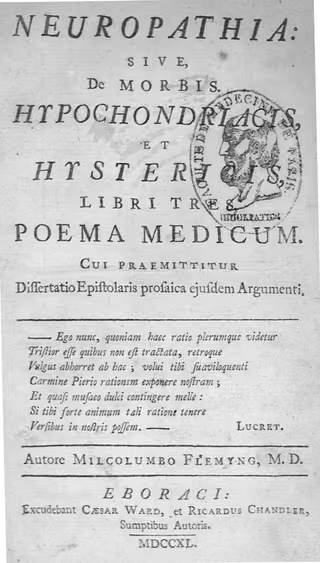
Neuropathia: sive de morbis hypochondriacis et hystericis libri tres, poema medicum: Malcolm Flemyng's Latin poem on the hypochondriac and hysteric diseases
By Malcolm Flemyng · Published 1740 · Latin with English translation · BIU Santé, Université Paris Cité, via Internet Archive
Historian’s note. This text records the medicine of its own time, and later evidence has replaced most of it. It is not medical advice. We read it as history, and we ask what, if anything, connects it to medicine today.
Historian’s note. This text records the medicine of its own time, and later evidence has replaced most of it. It is not medical advice. We read it as history, and we ask what, if anything, connects it to medicine today. More on how we read old medical books
Neuropathia: sive de morbis hypochondriacis et hystericis libri tres, poema medicum
Malcolm Flemyng's Latin poem on the hypochondriac and hysteric diseases
By Malcolm Flemyng, 1740. The edition has the page scans, the Latin text, and an English translation.
Malcolm Flemyng wrote this Latin poem in three books on the hypochondriac and hysteric diseases. He treats them as one disease, which physicians call hypochondriac in men and hysteric in women. A prose letter to the physician Peter Shaw comes before the poem. In it Flemyng says that he had some of the disease’s worse symptoms himself, and that he had studied it for twelve years and more. He chose verse because no one had yet treated the subject in verse, and because verse fixes each precept more deeply in the reader’s mind. The prose letter explains points that the poem states briefly, and defends the opinions in which Flemyng differs from other writers.
The letter follows the doctrine of Willis, which Sydenham and Boerhaave also accepted. The brain secretes a very fine fluid, the animal spirits, which flows through the hollow nerves and causes all sensation and movement. Flemyng argues at length against the author of a treatise on “the English disease”, who rejected the animal spirits. He dates the letter at Kingston upon Hull, 1 June 1738. In a note to the reader he says that both parts were finished, and partly with the printer, before the death of Hermann Boerhaave, his teacher. Boerhaave had seen much of the poem in its rough state and had approved it in a letter. The first book of the poem calls on Pallas and announces a Latin poem on a disease that often torments the British. The book was printed at York in 1740 at the author’s expense.
Malcolm Flemyng is listed with the physician-poets in this library.
| Date | Place | Work | Notes |
|---|---|---|---|
| Ancient Rome | De rerum natura By Lucretius | Flemyng’s title page quotes seven lines of Lucretius. In them the poet says that his doctrine seems harsh to those who have not studied it, so he sets it out in sweet verse, touched with the honey of the Muses, to hold the reader’s mind. Book III of the Neuropathia opens by naming Lucretius as the example that Flemyng follows. | |
| 1740 | York | Neuropathia: sive de morbis hypochondriacis et hystericis libri tres, poema medicum By Malcolm Flemyng | Printed by Caesar Ward and Richard Chandler at the author’s expense. The prose letter to Peter Shaw, dated Kingston upon Hull, 1 June 1738, comes before the three books of the poem. A list of corrections to the prose letter and the poem ends the book. |
Illustrations
3 illustrations. Each opens its page in the reader, zoomed to the picture.
Poems
4 poems, sorted by title.