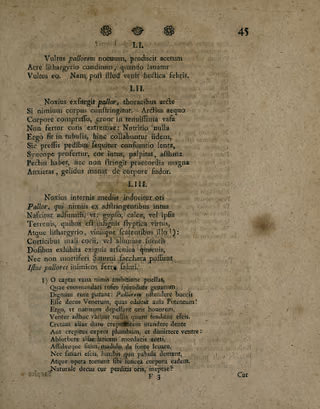
LII.

Poet
Christian Tobias Ephraim Reinhard
Book
Medicus poeta , 1762
Form
Not identifiable from book
Open the page in the book
The page this poem fills. Each opens in the Medicus poeta reader.

Hover or tap a word to see its match.

LII.

A noxious pallor arises if the body is bound

too tightly by bodices. When the body is compressed

more tightly than is proper, the blood is not carried

into the finest vessels of the outermost skin: Therefore

no nutrition takes place in the little tubes, and hence they collapse;

thus with halting steps a slow consumption follows,

syncope is brought on, the heart palpitates within, asthma

holds the chest, and great anxiety constricts

the praecordia, while a cold sweat flows from the body.

Noxius exsurgit pallor, thoracibus arcte

Si nimium corpus constringitur. Arctius aequo

Corpore compresso, cruor in tenuissima vasa

Non fertur cutis extremae: Nutritio nulla

Ergo fit in tubulis, hinc collabuntur iidem,

Sic pressis pedibus sequitur consumtio lenta,

Syncope profertur, cor intus, palpitat, asthma

Pectus habet, nec non stringit praecordia magna

Anxietas, gelidus manat de corpore sudor.
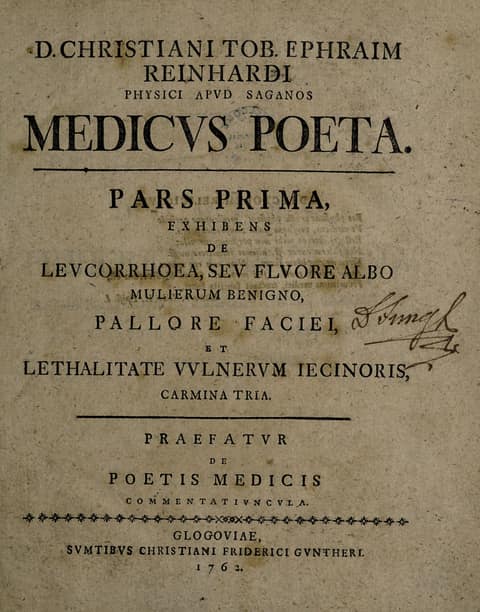
Title page of Medicus poeta
Title page of Medicus poeta , 1762

About this text

Provenance

This edition uses the Wellcome Collection copy, catalogued as _Medicus poeta. Pars prima, exhibens de leucorrhoea, pallore faciei, et lethalitate vulnerum jecinoris, carmina tria_ (b30503395). Scans 1 to 4 are the front cover and flyleaves with handwritten notes. Scan 5 is the title page. Scans 75 to 80 are blank leaves and the back cover.

Rights

The work is in the public domain by age. Wellcome Collection marks this copy with Public Domain Mark 1.0. Credit Wellcome Collection. Poet Doctor is a non-commercial site.

Original scans: Wellcome Collection ( Public Domain Mark 1.0 ).

Historian’s note. This text records the medicine of its own time, and later evidence has replaced most of it. It is not medical advice. We read it as history, and we ask what, if anything, connects it to medicine today. More on how we read old medical books