XXII.

Poet
Christian Tobias Ephraim Reinhard
Book
Medicus poeta , 1762
Form
Not identifiable from book
Open the page in the book
The pages this poem fills. Each opens in the Medicus poeta reader.

Hover or tap a word to see its match.

Part 1

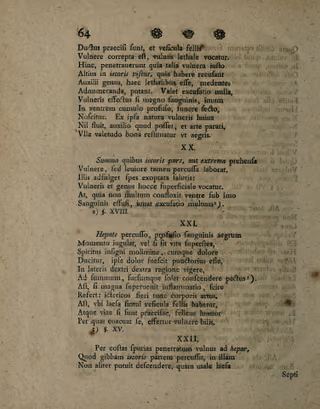
A wound that has penetrated through the false ribs to the liver,

Which has struck the convex part of the liver, into it

Could in no other way descend, than with the badly injured

Per coſtas ſpurias penetratum vulnus ad hepar,

Quod gibbam iecoris partem percuſſit, in illam

Non aliter potuit deſcendere, quam male laeſa

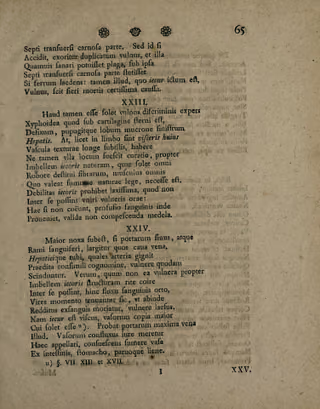
Part 2

fleshy part of the transverse septum. But if that

Happens, a double wound arises, and although

That blow could have been healed, if the injuring steel

Had stopped right beneath the fleshy part

Of the transverse septum: nevertheless, that wound by which

The liver was struck, is known to become the most certain cause of death.

Septi tranſuerſi carnoſa parte. Sed id ſi

Accidit, exoritur duplicatum vulnus, et illa

Quamuis ſanari potuiſſet plaga, ſub ipſa

Septi tranſuerſi carnoſa parte ſtetiſſet

Si ferrum laedens: tamen illud, quo iecur ictum eſt,

Vulnus, ſcit fieri mortis certiſſima cauſſa.
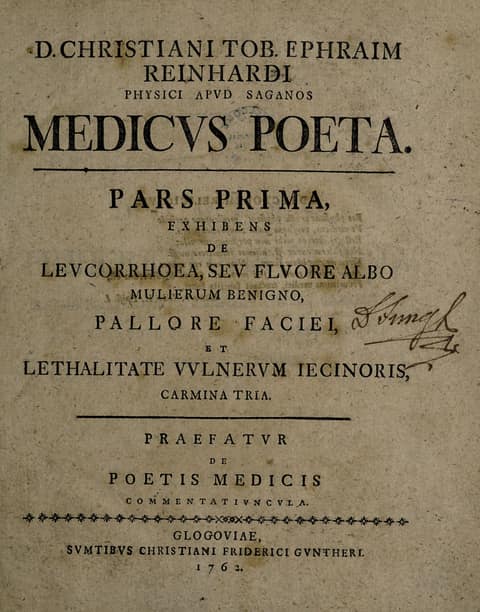
Title page of Medicus poeta
Title page of Medicus poeta , 1762

About this text

Provenance

This edition uses the Wellcome Collection copy, catalogued as _Medicus poeta. Pars prima, exhibens de leucorrhoea, pallore faciei, et lethalitate vulnerum jecinoris, carmina tria_ (b30503395). Scans 1 to 4 are the front cover and flyleaves with handwritten notes. Scan 5 is the title page. Scans 75 to 80 are blank leaves and the back cover.

Rights

The work is in the public domain by age. Wellcome Collection marks this copy with Public Domain Mark 1.0. Credit Wellcome Collection. Poet Doctor is a non-commercial site.

Original scans: Wellcome Collection ( Public Domain Mark 1.0 ).

Historian’s note. This text records the medicine of its own time, and later evidence has replaced most of it. It is not medical advice. We read it as history, and we ask what, if anything, connects it to medicine today. More on how we read old medical books