Hover or tap a word to see its match.
Part 1
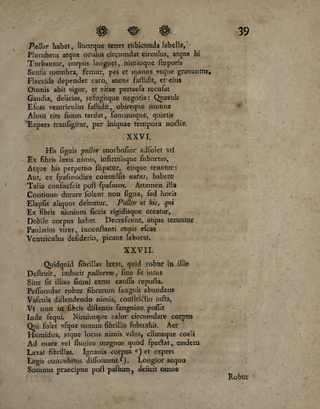
Whatever relaxes the fibrils, whatever destroys the strength
In them, induces pallor, whether its cause be laid up
Within or at the same time without.
Abundant blood ruins the strength of the fibres
By distending the small vessels too much, so that a proper
Constriction cannot thence follow in the fibres distended
With blood. And excessive heat, which is continually wont
To surround the body, withdraws tone from the fibrils. Humid
Air, and a place too wet, and a climate of the sky
Which looks toward the sea or great rivers, relaxes
The same fibrils. Sloth e) and lawless
Coition dissolve the body f). Sleep longer than is right,
Especially after a meal, casts down all
Quidquid fibrillas laxat, quid robur in illis
Deſtruit, inducit pallorem, ſiue ſit intus
Siue ſit illius ſimul extus cauſſa repoſta.
Peſſumdat robur fibrarum ſanguis abundans
Vaſcula diſtendendo nimis, conſtrictio iuſta,
Vt non in fibris diſtentis ſanguine poſſit
Inde ſequi. Nimiusque calor circumdare corpus
Qui ſolet vſque tonum fibrillis ſubtrahit. Aer
Humidus, atque locus nimis vdus, climaque coeli
Ad mare vel fluuios magnos quod ſpectat, easdem
Laxat fibrillas. Ignauia corpus e) et expers
Legis concubitus diſſoluunt f). Longior aequo
Somnus praecipue poſt paſtum, deiicit omne
Part 2
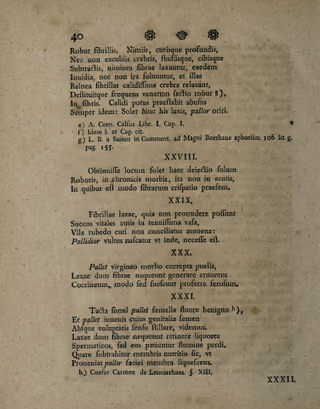
strength from the little fibres. By excessive and profound cares,
as well as frequent watchings, studies, and the withholding
of food, the fibres are relaxed too much; these same
are loosened by envy as well as anger, and frequent
very hot baths relax those little fibres,
and frequent venesection destroys the strength g)
in the fibres. The abuse of warm drink will always
produce the same effect: Hence, when these are lax, pallor is wont to arise.
e) Aulus Cornelius Celsus Libr. I. Cap. I.
f) Idem l. et Cap. cit.
g) L. B. a Suiten in Comment. on the Great Herman Boerhaave's aphorism. 106 lit. g. pag. 155.
Robur fibrillis. Nimiis, curisque profundis,
Nec non excubiis crebris, ſtudiisque, cibisque
Subtractis, nimium fibrae laxantur, eaedem
Inuidia, nec non ira ſoluuntur, et illas
Balnea fibrillas calidiſſima crebra relaxant,
Deſtituitque frequens venarum ſectio robur g),
In fibris. Calidi potus praeſtabit abuſus
Semper idem: Solet hinc his laxis, pallor oriri.
e) A. Corn. Celſus Libr. I. Cap. I.
f) Idem l. et Cap. cit.
g) L. B. a Suiten in Comment. ad Magni Boerhaue aphoriſm. 106 lit. g. pag. 155.