§. XXXXIII.

Poet
Christian Tobias Ephraim Reinhard
Book
Medicus poeta , 1762
Form
Not identifiable from book
Open the page in the book
The pages this poem fills. Each opens in the Medicus poeta reader.

Hover or tap a word to see its match.

Part 1

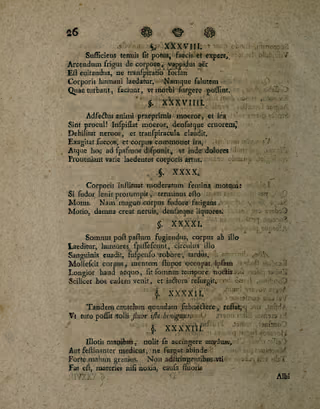
§. XXXXIII.

Let the physician not gird himself to treat the disease

With unwashed hands, or hastily, lest from thence perchance

A graver evil arise. It is not lawful to use astringents,

Unless the noxious matter, the cause of the fluor

Illotis manibus, nolit ſe accingere morbum,

Aut feſtinanter medicus, ne ſurgat abinde

Forte malum grauius. Non adſtringentibus vti

Fas eſt, materies niſi noxia, cauſa fluoris

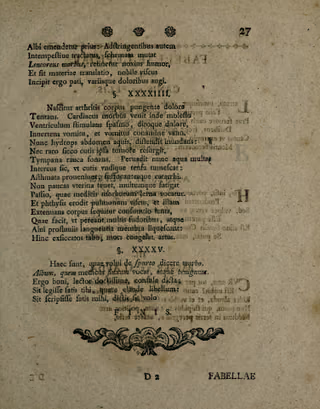
Part 2

be corrected first: But if treated untimely

With astringents, leucorrhoea changes

Its forms, the noxious humour is retained,

And a metastasis of matter occurs, a noble organ

Therefore begins to suffer, and be tormented by various pains.

Albi emendetur prius: Adſtringentibus autem

Intempeſtiue tractatus, ſchemata mutat

Leucoreus morbus, retinetur noxius humor,

Et fit materiae translatio, nobile viſcus

Incipit ergo pati, variisque doloribus angi.
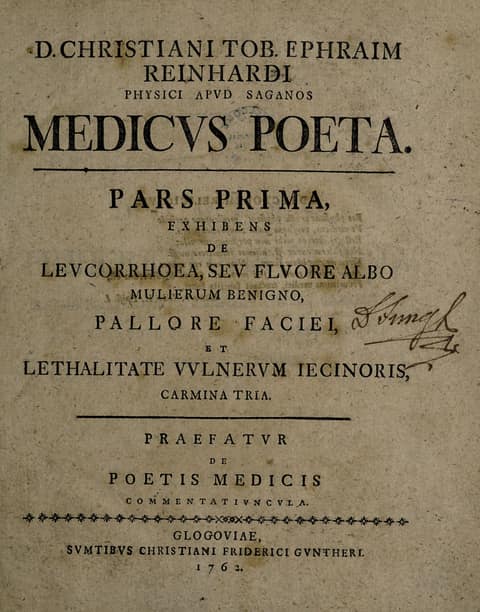
Title page of Medicus poeta
Title page of Medicus poeta , 1762

About this text

Provenance

This edition uses the Wellcome Collection copy, catalogued as _Medicus poeta. Pars prima, exhibens de leucorrhoea, pallore faciei, et lethalitate vulnerum jecinoris, carmina tria_ (b30503395). Scans 1 to 4 are the front cover and flyleaves with handwritten notes. Scan 5 is the title page. Scans 75 to 80 are blank leaves and the back cover.

Rights

The work is in the public domain by age. Wellcome Collection marks this copy with Public Domain Mark 1.0. Credit Wellcome Collection. Poet Doctor is a non-commercial site.

Original scans: Wellcome Collection ( Public Domain Mark 1.0 ).

Historian’s note. This text records the medicine of its own time, and later evidence has replaced most of it. It is not medical advice. We read it as history, and we ask what, if anything, connects it to medicine today. More on how we read old medical books