Hover or tap a word to see its match.
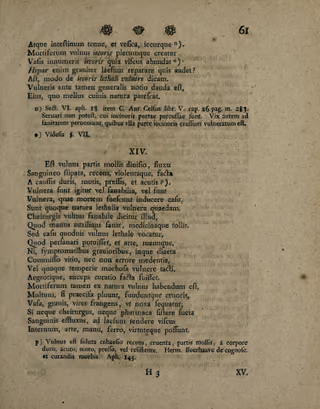
XIV.
A wound is a division of a soft part, attended by a bloody
Flow, recent, and violent, made
By hard, moved, pressed, and sharp causes p).
Wounds are therefore either curable, or they are
Wounds which are wont to induce death by accident,
And certain wounds are also lethal by nature.
By surgeons that wound is called curable,
Which an aiding hand heals, and medicine removes.
But any wound is called lethal by accident,
Which could have been thoroughly healed, both by art and by hand,
Had not the cure been made doubtful by graver symptoms,
And by a fault committed in diet, as well as by the error of the healer,
Or also by a morbid constitution of the one touched by the wound
And of the sick person.
Nevertheless, a wound must be held mortal by nature,
If severed vessels rain down and pour forth much gore,
So that a grave harm, breaking the strength, follows,
If neither the surgeon, nor drugs wont to stay
The outflows of blood, can reach the injured internal viscus
By art, hand, iron, and virtue.
Est vulnus partis mollis diuisio, fluxu
Sanguineo stipata, recens, violentaque, facta
A caussis duris, motis, pressis, et acutis p).
Vulnera sunt igitur vel sanabilia, vel sunt
Vulnera, quae mortem suescunt inducere casu,
Sunt quoque natura lethalia vulnera quaedam.
Cheirurgis vulnus sanabile dicitur illud,
Quod manus auxilians sanat, medicinaque tollit.
Sed casu quoduis vulnus lethale vocatur,
Quod persanari potuisset, et arte, manuque,
Ni, symptomatibus grauioribus, inque diaeta
Commisso vitio, nec non errore medentis,
Vel quoque temperie morbosa vulnere tacti,
Aegrotique, anceps curatio facta fuisset.
Mortiferum tamen ex natura vulnus habendum est,
Multum, si praecisa pluunt, funduntque cruoris,
Vasa, grauis, vires frangens, vt noxa sequatur,
Si neque cheirurgus, neque pharmaca sistere sueta
Sanguinis effluxus, ad laesum tendere viscus
Internum, arte, manu, ferro, virtuteque possunt.