Hover or tap a word to see its match.
Part 1
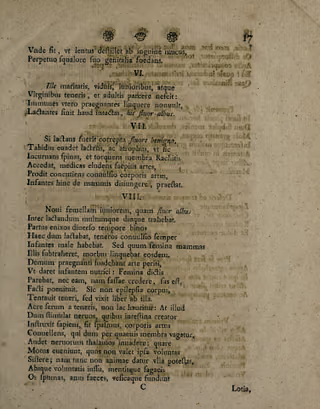
VIII.
I knew a younger woman, whom fluor albus
During nursing afflicted much and long.
While she was nursing two offspring brought forth at different times,
Convulsion always afflicted the tender
Infants badly. But when the woman withdrew the breasts
From them, the disease left those same ones.
At length those skilled in the art advised her, when pregnant,
That she should give the infant to a wet-nurse: the woman obeyed
Their words, nor did she—for it is right to believe one who confesses—
Repent of the deed. Thus epilepsy did not assail the body
Of the tender one, but he lived free from it.
An acrid serum, not milk, is drunk by the tender ones: but while
That stimulates the nerves, with which the wise Creator
Has furnished the intestines, a spasm arises, convulsing
The limbs of the body, which, while it wanders through every member,
Dares to invade the chambers of the nerves: wherefore
Movements occur which the will itself is unable
To check; for then no power is given to the soul;
Without the command of the will and of the sagacious mind,
The mouth pours forth foam, the anus feces, and the bladder
Noui femellam iuniorem, quam fluor albus
Inter lactandum multumque diuque trahebat.
Partus enixos diuerſo tempore binos
Haec dum lactabat, teneros conuulſio ſemper
Infantes male habebat. Sed quum femina mammas
Illis ſubtraheret, morbus linquebat eosdem.
Demum praegnanti ſuadebant arte periti,
Vt daret infantem nutrici: Femina dictis
Parebat, nec eam, nam faſſae credere, fas eſt,
Facti poenituit. Sic non epilepſia corpus,
Tentauit teneri, ſed vixit liber ab illa.
Acre ſerum a teneris, non lac hauritur: At illud
Dum ſtimulat neruos, quibus inteſtina creator
Inſtruxit ſapiens, fit ſpaſmus, corporis artus
Conuellens, qui dum per quaeuis membra vagatur,
Audet neruorum thalamos inuadere: quare
Motus eueniunt, quos non valet ipſa voluntas
Siſtere; nam tunc non animae datur vlla poteſtas,
Absque voluntatis iuſſu, mentisque ſagacis
Os ſpumas, anus faeces, veſicaque fundunt
Part 2
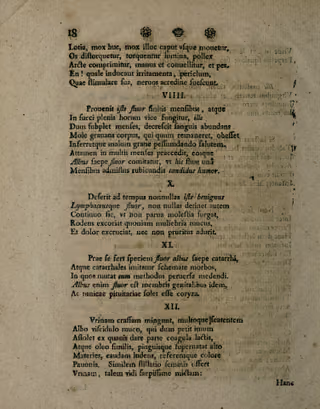
urine, now hither, now thither the head is constantly moved,
the mouth is distorted, the eyes are rolled, the thumb
is tightly clenched, and both hand and foot are convulsed.
Behold! what peril irritants induce,
which are wont to stimulate the nerves with their acrimony.
Lotia, mox huc, mox illuc caput vſque mouetur,
Os diſtorquetur, torquentur lumina, pollex
Arcte comprimitur, manus et conuellitur, et pes.
En ! quale inducant irritamenta, periclum,
Quae ſtimulare ſua, neruos acredine ſueſcunt.