Hover or tap a word to see its match.
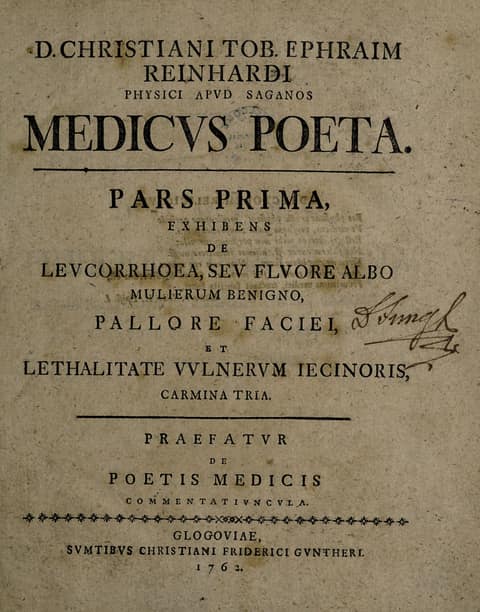
Part 1
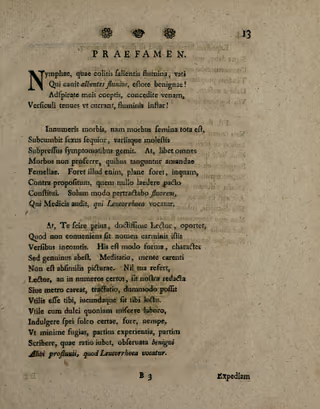
PREFACE.
Nymphs, who inhabit the leaping streams, to the bard
Who sings of whitening rivers, be kind!
Favour my undertakings, grant a poetic vein,
So that my slender verses may run, like a river!
To innumerable diseases, for woman is altogether a disease,
The weaker sex succumbs, and weighed down by various
Troublesome symptoms, groans. Yet, I am pleased not to set forth
All the diseases by which lovely women
Are touched. For that would be, plainly would be, I say,
Contrary to my purpose, since I have resolved in no way
To offend that sex. I shall treat only of the flux
Which is heard of among Physicians, which is called leucorrhoea.
Yet, you must know beforehand, most learned Reader,
That the name of poem is not fitting for these
Unpolished verses. They have only the form, but the genuine
Character is absent. The meditation is not unlike
A picture lacking a mind. It matters nothing to you,
Reader, whether our treatise is reduced to fixed measures,
Or whether it lacks metre, provided it can
Be useful to you, and be pleasant for you to read.
Since I labour to mingle the useful with the sweet,
I am wont to indulge in the sure hope that, indeed,
You will by no means shun the observations of the benign
White flux, which is called leucorrhoea, which partly experience,
And partly reason bids me to write.
Nymphae, quae colitis ſalientia flumina, vati
Qui canit albentes fluuios, eſtote benignae!
Adſpirate meis coeptis, concedite venam,
Verſiculi tenues vt currant, fluminis inſtar!
Innumeris morbis, nam morbus femina tota eſt,
Subcumbit ſexus ſequior, variisque moleſtis
Subpreſſus ſymptomatibus gemit. At, libet omnes
Morbos non proferre, quibus tanguntur amandae
Femellae. Foret illud enim, plane foret, inquam,
Contra propoſitum, quem nullo laedere pacto
Conſtitui. Solum modo pertractabo fluorem,
Qui Medicis audit, qui Leucorrhoea vocatur.
At, Te ſcire prius, doctiſſime Lector, oportet,
Quod non conueniens ſit nomen carminis iſtis
Verſibus incomtis. His eſt modo forma, character
Sed genuinus abeſt. Meditatio, mente carenti
Non eſt abſimilis picturae. Nil tua refert,
Lector, an in numeros certos, ſit noſtra redacta
Siue metro careat, tractatio, dummodo poſſit
Vtilis eſſe tibi, iucundaque ſit tibi lectu.
Vtile cum dulci quoniam miſcere laboro,
Indulgere ſpei ſoleo certae, fore, nempe,
Vt minime fugias, partim experientia, partim
Scribere, quae ratio iubet, obſeruata benigni
Albi profluuii, quod Leucorrhoea vocatur.
Part 2
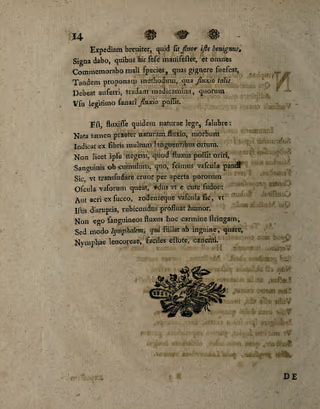
I shall briefly explain what that benign flux is,
I shall give the signs by which it manifests itself, and I shall
Recount all the kinds of ill which it is wont to beget,
Finally I shall propose the method by which such a discharge
Ought to be removed, I shall hand down the medicines, by whose
Lawful use the discharge may be cured.
To have flowed indeed by nature's law, is wholesome:
Yet a discharge born contrary to nature, indicates
A disease arisen from deeply languishing fibres.
Although I myself may not deny, that a flux can arise,
On account of an accumulation of blood, whereby we know the small vessels are stretched
So that blood is able to transude through the open mouths
Of the pores of the vessels, like wet sweat from the skin:
Or from an acrid juice, gnawing the small vessels so that,
When these are burst asunder, a ruddy humour flows forth.
I shall not touch upon bloody fluxes in this poem,
But only the lymphatic one, which drips from the groin, wherefore,
Nymphs of leucorrhoea, be indulgent to the singer.
Expediam breuiter, quid ſit fluor iſte benignus,
Signa dabo, quibus hic ſeſe manifeſtet, et omnes
Commemorabo mali ſpecies, quas gignere ſueſcat,
Tandem proponam methodum, qua fluxio talis
Debeat auferri, tradam medicamina, quorum
Vſu legitimo ſanari fluxio poſſit.
Eſt, fluxiſſe quidem naturae lege, ſalubre:
Nata tamen praeter naturam fluxio, morbum
Indicat ex fibris multum languentibus ortum.
Non licet ipſe negem, quod fluxus poſſit oriri,
Sanguinis ob cumulum, quo, ſcimus vaſcula pandi
Sic, vt transſudare cruor per aperta pororum
Oſcula vaſorum queat, vdus vt e cute ſudor:
Aut acri ex ſucco, rodenteque vaſcula ſic, vt
Iſtis disruptis, rubicundus profluat humor.
Non ego ſanguineos fluxus hoc carmine ſtringam,
Sed modo lymphalem, qui ſtillat ab inguine, quare,
Nymphae leucoreae, faciles eſtote, canenti.
Part 3
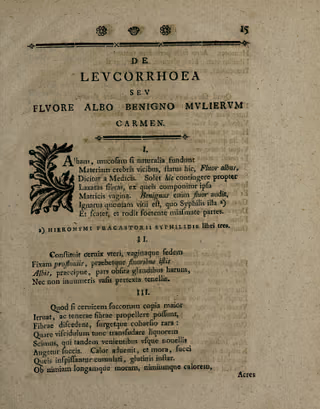
ON
LEUCORRHOEA
OR
THE BENIGN FLUOR ALBUS OF WOMEN
A POEM.
I.
If the genital parts pour forth a white, mucous
matter at frequent intervals, this condition is called fluor albus
by physicians. This usually happens on account of
relaxed fibres, out of which the vagina of the womb itself
is composed. Indeed, it is called a benign flux,
because it is free of the taint with which that syphilis a)
abounds, and gnaws the parts with a fetid miasma.
a) Girolamo Fracastoro's Syphilis in three books.
II.
The neck of the uterus and the vagina constitute a fixed
seat for the discharges, and a part of them, covered with glands
and interwoven with innumerable delicate vessels, furnishes a seat
especially for those white fluxes.
III.
But if a greater abundance of juices rushes into the neck
than the tender fibres are able to propel,
the fibres will part, and a loose cohesion will arise:
Wherefore we know that a somewhat viscid fluid then
transudes, which at length is increased as fresh juices
continually arrive. Heat supervenes, and delay, by which
the accumulated juices are thickened, like glue.
On account of the excessive and long delay, and the excessive heat,
I.
Albam, mucoſam ſi naturalia fundunt
Materiam crebris vicibus, ſtatus hic, Fluor albus,
Dicitur a Medicis. Solet hic contingere propter
Laxatas fibras, ex queîs componitur ipſa
Matricis vagina. Benignus enim fluor audit,
Ignarus quoniam vitii eſt, quo Syphilis illa a)
Et ſcatet, et rodit foetente miaſmate partes.
a) HIERONYMI FRACASTORII SYPHILIDIS libri tres.
II.
Conſtituit ceruix vteri, vaginaque ſedem
Fixam profluuiis, praebetque fluoribus iſtis
Albis, praecipue, pars obſita glandibus harum,
Nec non innumeris vaſis pertexta tenellis.
III.
Quod ſi ceruicem ſuccorum copia maior
Irruat, ac tenerae fibrae propellere poſſunt,
Fibrae diſcedent, ſurgetque cohaeſio rara:
Quare viſcidulum tunc transſudare liquorem
Scimus, qui tandem venientibus vſque nouellis
Augetur ſuccis. Calor aduenit, et mora, ſucci
Queis inſpiſſantur cumulati, glutinis inſtar.
Ob nimiam longamque moram, nimiumque calorem,
Part 4
the humours become acrid, and also tenacious with viscosity.
Having become acrid, they attempt to corrode
the fine fibres of the womb: Very many evils, cancer and ulcer,
arise, and hectic fever also sprouts forth.
Acres euadunt, nec non lentore tenaces
Humores. Acres facti perrodere tentant
Fibrillas vteri: Mala plurima, cancer, et vlcus,
Proueniunt, nec non propullulat hectica tabes.