Hover or tap a word to see its match.
Part 1
BOOK SEVEN
ON THE PASSIONS OF THE MIND.
The twofold part of man arises from a diverse origin;
The one, sublime, draws its beginning from heaven, the other from earth;
The latter dies, the former endures, knowing nothing of death.
If these parts remain joined in an allied bond,
Man lives, and is healthy if their harmony stands firm:
But if their union is dissolved, life departs;
If they are thrown into disorder, disease flies in with a dense host.
These fixed laws the ruler of the heaven-dwellers once established
In wondrous order, when by his supreme power
He founded the human race, and joined the soul with the body.
He commanded that minds without a body should be able
To exercise their rule over the body, and to stir up movements.
The mind commands; behold, a light breeze enters the nerves
Dispersed in a vast array, the mass of fibers is moved,
And lifts great weights with a small contraction.
At the will of the mind the limbs, suddenly roused, are drawn;
The hand strikes, the foot runs, the tongue trembles,
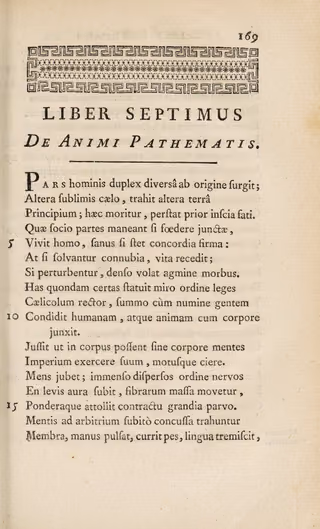
PARS hominis duplex diversâ ab origine ſurgit;
Altera ſublimis cælo , trahit altera terrâ
Principium ; hæc moritur , perſtat prior inſcia fati.
Quæ ſocio partes maneant ſi fœdere junctæ ,
Vivit homo , ſanus ſi ſtet concordia firma :
At ſi ſolvantur connubia , vita recedit ;
Si perturbentur , denſo volat agmine morbus.
Has quondam certas ſtatuit miro ordine leges
Cælicolum rector , ſummo cùm numine gentem
Condidit humanam , atque animam cum corpore
junxit.
Juſſit ut in corpus poſſent ſine corpore mentes
Imperium exercere ſuum , motuſque ciere.
Mens jubet ; immenſo diſperſos ordine nervos
En levis aura ſubit , fibrarum maſſa movetur ,
Ponderaque attollit contractu grandia parvo.
Mentis ad arbitrium ſubitò concuſſa trahuntur
Membra, manus pulſat, currit pes, lingua tremiſcit,
Part 2
And the throat produces sounds with varied modulation.
There is no delay: bullets propelled by gunpowder do not so quickly
Cleave the thin air in their flight.
No less does the body move the ethereal mind with varied impulse,
And the subject part impels the ruling part.
Behold, a sharp point strikes the slender nerves and pulpy threads
Of the skin and tears them apart with a dreadful wound;
The anxious mind perceives the torments of savage pain,
Often lies languid, and, unequal to such great pains,
Faints away, as the fibers are torn apart by the hostile point.
If, on the contrary, moderate pleasure tickles the bodily fibers
And external organs of sense with a gentle
Shock, joys bathe the peaceful mind,
Which previously lay oppressed and languishing with grief;
With such tight bonds does the mind cling to the body!
To uncover these slender ties and obscure bonds, and to lay open
The mysteries of things, the mortal race once
Tried in vain; hidden from our mind,
This structure of the soul lies concealed, and always will lie concealed.
And now long-celebrated systems collapse; to us
Remains only ignorance of such great things.
Come then, let my Muse leave the secret recesses
Of nature, and turning aside from the obscure path, let her celebrate
The empire of the mind, and how much the passions can, alas,
Too greatly dissolve the exhausted strength of the body.
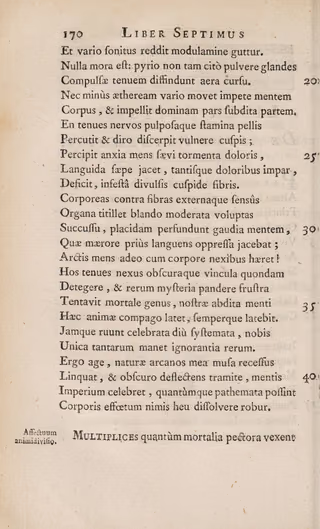
Et vario ſonitus reddit modulamine guttur.
Nulla mora eſt: pyrio non tam citò pulvere glandes
Compulſæ tenuem diffindunt aera curſu.
Nec minùs ætheream vario movet impete mentem
Corpus , & impellit dominam pars ſubdita partem.
En tenues nervos pulpoſaque ſtamina pellis
Percutit & diro diſcerpit vulnere cuſpis ;
Percipit anxia mens ſævi tormenta doloris ,
Languida ſæpe jacet, tantiſque doloribus impar ,
Deficit, infeſtâ divulſis cuſpide fibris.
Corporeas contra fibras externaque ſenſûs
Organa titillet blando moderata voluptas
Succuſſu, placidam perfundunt gaudia mentem ,
Quæ mærore priùs languens oppreſſa jacebat ;
Arctis mens adeo cum corpore nexibus hæret !
Hos tenues nexus obſcuraque vincula quondam
Detegere , & rerum myſteria pandere fruſtra
Tentavit mortale genus , noſtræ abdita menti
Hæc animæ compago latet, ſemperque latebit.
Jamque ruunt celebrata diù ſyſtemata , nobis
Unica tantarum manet ignorantia rerum.
Ergo age , naturæ arcanos mea muſa receſſus
Linquat , & obſcuro deflectens tramite , mentis
Imperium celebret , quantùmque pathemata poſſint
Corporis effœtum nimis heu diſſolvere robur.