Hover or tap a word to see its match.
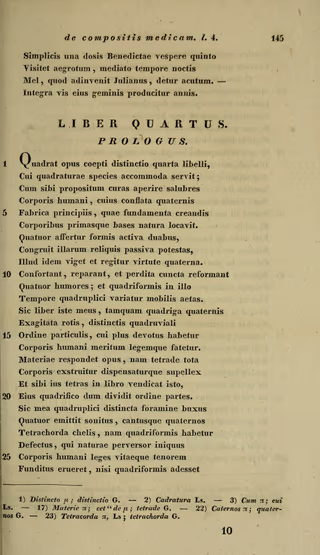
The fourth division of the undertaken book squares the work,
To which the fitting form of a square serves;
Since its purpose is to reveal the healthful cures
Of the human body, whose fabric is forged
From four principles, which nature has established
As the foundations and first bases for creating bodies.
It is presented in four forms, active in two,
A passive power corresponds to the rest of them,
That same thing thrives and is governed by a fourfold virtue.
The four humors comfort, repair, and reform
All lost things; and in it the fourfold
Mobile age is varied by a fourfold season.
Thus this book of mine, like a chariot
Driven by four wheels, with parts distinguished
In a four-way order, to which he who is considered more devoted
Confesses the merit and law of the human body.
The work corresponds to the material, for by a whole tetrad
The equipment of the body is built and dispensed
And the tetrad claims its right in this book,
While it divides its parts in a fourfold order.
Thus my boxwood pipe, pierced with a fourfold hole,
Emits four sounds, and the tetrachord of the lyre
Fourfold songs, for the defect is held to be fourfold,
Which, as an unjust perverter of nature,
Would utterly uproot the laws of the human body
And the course of life, unless a fourfold were present
Grace, which the prudence of the medical art suggests,
foresightedly repressing failings with a fourfold medicament.
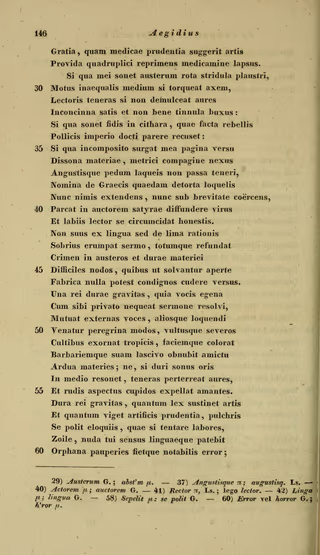
If any creaking wheel of my wagon sounds harsh,
if an uneven motion twists the middle axle,
if the rather unharmonious and not well-tinkling boxwood pipe
does not soothe the tender ears of the reader:
if any string sounds on the lyre, which having become rebellious
refuses to obey the command of the learned thumb:
if my page should arise in disordered verse
dissonant to the material, not having suffered to be held
by the bond of metrical structure and the narrow snares of poetic feet,
distorting certain names from Greek expressions,
now extending them too much, now confining them under brevity,
let the reader spare to diffuse the poison of satire against the author
and let him circumcise himself with honest lips.
Let his speech break forth soberly, not from his tongue but from the file of reason,
and let him cast back the entire
blame onto the harsh and difficult knots
of the hard material, to plainly resolve which
no craft can forge worthy verses.
The sole gravity of the hard matter, because it is destitute of a voice,
since it cannot be explained by its own private speech,
borrows external words, and, like a foreigner, hunts for
other modes of speaking, and adorns its severe countenances
with figurative dress; and the arduous material colors its face
and clouds its own barbarity in a playful cloak;
lest, if the sound of a harsh mouth
should resound in the midst, it might terrify tender ears,
and its rough appearance might drive away eager lovers.
The hard gravity of the matter, as much as the law of the art sustains
and as much as the prudence of the craftsman thrives,
polishes itself with beautiful eloquence; which if you should labor to attempt,
O Zoilus, the bare and orphaned poverty of your sense and tongue
will lie exposed, and your error will become notable;
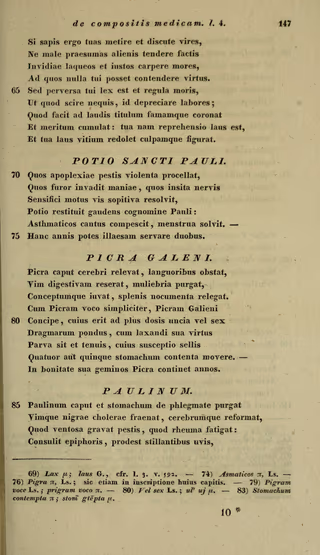
If you are wise, therefore, measure and examine your strengths,
Lest you wrongly presume to stretch for the deeds of others
The snares of envy, and to criticize just customs,
Towards which no virtue of yours could strive.
But the law and rule of your custom is perverse,
So that what you are unable to know, you labor to depreciate;
Which contributes to a title of praise and crowns fame
And accumulates merit: for your reprehension is praise,
And your praise smells of vice and shapes a fault.
Quadrat opus coepti distinctio quarta libelli,
Cui quadraturae species accommoda servit;
Cum sibi propositum curas aperire salubres
Corporis humani, cuius conflata quaternis
Fabrica principiis, quae fundamenta creandis
Corporibus primasque bases natura locavit.
Quatuor affertur formis activa duabus,
Congruit illarum reliquis passiva potestas,
Illud idem viget et regitur virtute quaterna.
Confortant, reparant, et perdita cuncta reformant
Quatuor humores; et quadriformis in illo
Tempore quadruplici variatur mobilis aetas.
Sic liber iste meus, tamquam quadriga quaternis
Exagitata rotis, distinctis quadruviali
Ordine particulis, cui plus devotus habetur
Corporis humani meritum legemque fatetur.
Materiae respondet opus, nam tetrade tota
Corporis exstruitur dispensaturque supellex
Et sibi ius tetras in libro vendicat isto,
Eius quadrifico dum dividit ordine partes.
Sic mea quadruplici distincta foramine buxus
Quatuor emittit sonitus, cantusque quaternos
Tetrachorda chelis, nam quadriformis habetur
Defectus, qui naturae perversor iniquus
Corporis humani leges vitaeque tenorem
Funditus erueret, nisi quadriformis adesset
Gratia, quam medicae prudentia suggerit artis
Provida quadruplici reprimens medicamine lapsus.
Si qua mei sonet austerum rota stridula plaustri,
Motus inaequalis medium si torqueat axem,
Lectoris teneras si non démulceat aures
Inconcinna satis et non bene tinnula buxus:
Si qua sonet fidis in cithara, quae facta rebellis
Pollicis imperio docti parere recuset:
Si qua incomposito surgat mea pagina versu
Dissona materiae, metrici compagine nexus
Angustisque pedum laqueis non passa teneri,
Nomina de Graecis quaedam detorta loquelis
Nunc nimis extendens, nunc sub brevitate coërcens,
Parcat in auctorem satyrae diffundere virus
Et labiis lector se circumcidat honestis.
Non suus ex lingua sed de lima rationis
Sobrius erumpat sermo, totumque refundat
Crimen in austeros et durae materiei
Difficiles nodos, quibus ut solvantur aperte
Fabrica nulla potest condignos cudere versus.
Una rei durae gravitas, quia vocis egena
Cum sibi privato nequeat sermone resolvi,
Mutuat externas voces, aliosque loquendi
Venatur peregrina modos, vultusque severos
Cultibus exornat tropicis, faciemque colorat
Barbariemque suam lascivo obnubit amictu
Ardua materies; ne, si duri sonus oris
In medio resonet, teneras perterreat aures,
Et rudis aspectus cupidos expellat amantes.
Dura rei gravitas, quantum lex sustinet artis
Et quantum viget artificis prudentia, pulchris
Se polit eloquiis, quae si tentare labores,
Zoile, nuda tui sensus linguaèque patebit
Orphana pauperies fietque notabilis error;
Si sapis ergo tuas metire et discute vires,
Ne male praesumas alienis tendere factis
Invidiae laqueos et iustos carpere mores,
Ad quos nulla tui posset contendere virtus.
Sed perversa tui lex est et regula moris,
Ut quod scire nequis, id depreciare labores;
Quod facit ad laudis titulum famamque coronat
Et meritum cumulat: tua nam reprehensio laus est,
Et tua laus vitium redolet culpamque figurat.