Hover or tap a word to see its match.
Thus wrote the epistle of the great
Hippocrates; to King Ptolemy thus did he instruct.
The whole globe of the world here is composed of four
Seeds: water, and earth, together with air and fire,
That is, the moist, the cold, the dry, and the hot.
The body of man itself consists also of these same four,
Blood, and phlegm, and yellow bile, and black.
Phlegm is like water, but wholly fiery is
Yellow bile, blood is airy, black bile
Tastes of earth; thus the world and man are alike.
And dry and hot is the bile that is called yellow,
Phlegm is opposite to this; but blood is hot and moist,
Against this fights the thoroughly contrary black bile,
And these same elements exude various tastes.
Phlegm tastes salty, but livid bile is sharp,
Black bears a harsh taste, blood rejoices in sweetness.
Again, these seeds have various seats: the hiding places
Of the heart hold blood, and the spirit surrounds them;
The liver holds yellow bile, the spleen black, the brain phlegm.
But from the heart every great vein takes blood.
And each artery marks heavy movements by its pulse,
And the liver supplies red humors to the heart,
Thus never, with allied faith and allied heat,
does this forsake that, for neither is fiery heat able
to live without matter, nor to produce anything:
Part of mankind laughs, part is saddened, and that one
is foolish, this one is wise; come, command the causes, I shall speak.
Those who burn with pure blood, they joyfully
and flourishingly sing songs, and excel in a beautiful body.
Anger, fury, and freckles mark those whom cerulean bile
possesses; black bile shapes one as sluggish, sad, and timid:
But those who abound in pituita or watery phlegm,
are full of chills and spit, under a pale color.
Why are men wise, why are they esteemed for a mindful memory?
The temperament of the brain is the cause, lest it be more than is proper
cold, or hot. For if it should be completely cold,
a profound forgetfulness of all things is born.
Why does the suffering arise, which is called phrenitis by the Greeks?
For the fires of the intestines send forth,
and a vapor ascends to the brain, the moisture perishes, and the man himself
becomes senseless: wherefore let medicine be prepared:
But make haste, ready with a cooling sprinkling,
you must protect the brain by the nostrils or another part.
But if it is lethargy, for this disease too
belongs to the brain, when cold humor overabounds,
Use then hot things, and with these bind the brain.
From here arises another plague, paralysis by its Achaean
name, but the fiery plague often seizes the lip or the eye,
and the whole middle of the face; help frequently
through the nostrils, and drive out the hot vapors from there:
Or prudently apply cauteries near the ears,
Whatever malady comes into the brain, it draws
Its beginnings from the stomach, just as the putrid ulcers
Schinodes, and toothache, ophthalmia, branchus reveal this,
And staphyle, and dyspnea, and perischinia harmful to the neck.
The head retains five sutures, but to find it
Solid of a single suture and sound in the temple is possible.
But come, tell why that man has curly hair,
This one straight, and why the skull is bare in others.
If there is heat in the brain, he bears curly hair.
This one combs straight hair, if in him humor superabounds.
If the head is dry, baldness occurs, ugly and useless
To many; blue bile gives yellow hair.
But I read that five kinds of baldness are noted,
These are broad, short, thick, and hairy, and let us call
One the middle; a swollen lung makes these distinctions.
Now the threefold digestion must be told to you, the liver takes
This up, and the first is where of blood is created the very
Prosthesis, the heart will be its seat; take the second,
This nourishes the parts of the body, the liver, from here is generated
Saffron bile. But the spleen takes the dry part from the body.
From there the melancholic chymus is made, but the stomach itself
Moistens the brain, then the origin of phlegma appears.
The third concoction that remains, the juice is made
Upwards in the stomach itself, then the lowest gate
Of the ventricle is opened, and the dregs of the food pass from there, and seek
The lower parts of the belly: but the belly from above
Softens the phlegma on account of too rough foods, but
The urine passing through the kidneys descends, and enters
The parts of the bladder itself. Drawing from here and there,
The five senses of a human are sight, touch, and the very
Taste, smell, and also hearing: this last depends on fire,
Touch on earth, sight on the aether,
Air grants smell, a moist substance taste.
Who will deny that the soul has five powers?
It thinks, feels, remembers these or those things.
Again it forms opinions, it turns over the phantasms of things:
But since the body of man itself is composed
Of these seven various parts, let us declare them also:
Nerve, vein, flesh, and also artery, blood,
Cartilage, nail, hair, humor, fat, marrow,
Skin, and phlegm, along with pneuma, make up the whole of men.
All these evacuate and expel filth for men:
Sweat, spit, ears, bowels, bladder, and Venus,
And vomit, eyes, nose, the hair itself, and pores;
For women, two are added to these: menses and milk.
We say that milk and the seed of a man are from blood.
Blood comes out if the breast feels pain.
Please tell how many vertebrae there are in a man's back.
Twice twelve; the side fortifies the chest with as many ribs.
The gums and mouth are armed with four times eight teeth;
The front part with simple ones, the back part itself holds
The molars. Five palms measure the stomach,
And the intestine encompasses thirteen ells.
Perhaps you wish to know the names of the fingers, I will tell them
In order: they are thumb, index, middle, and ring,
With the little finger. But the nail is dry and cold.
Come now, there are four seasons of the solar year:
Spring, summer, autumn, winter. The seasons of spring are moist
But hot, and because of this, blood abounds.
Summer indeed is dry, and burns intensely with much heat.
For this reason dark blue bile is increased in us,
When autumn mixes cold seasons with dry:
Black bile is increased, as well as sanies and watery blood.
Winter produces phlegm, which is cold and wet.
Thus the elements rule in the four different parts
Of the year, the seasons among themselves along with our body,
Therefore it is necessary to observe the solar
Course, and the temperament of which any sick person consists,
And thus to apply healing remedies to the limbs.
If a youth falls ill in spring, then blood abounds.
Hence there is need to draw blood by puncturing the veins.
If it is pleurisy, at first light you should empty
Two or three veins, before the contracted
Illness grows strong, or the strength of the body
Is weakened: this purgation is of much benefit to all.
If you desire to know what times are best
To cut veins, I will relate them: as soon as February
Has passed the middle part of its month, begin: again
After the tenth day of September the times urge it,
Until December itself has reached the end
Of the solstice. But if summer forces you to take to bed,
Remember to purge yourself immediately, good man, believe me.
I am now tired, spare me; I will tell you the rest
Tomorrow, and I will explain the good nourishments of life.
And in what month it is permitted to consume each food.
And if it happens that you cut veins, what
Blue, green, and black blood, and the other humors
Signify, I will write the prognostics of life and death,
As you please, as is agreeable: but, venerable master,
I surrender myself to your judgment; live well, and farewell.
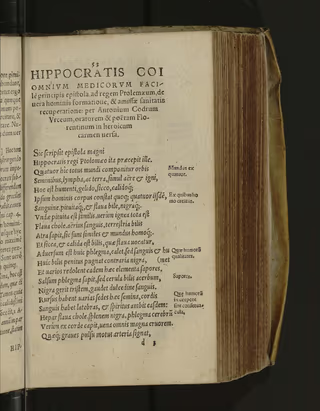
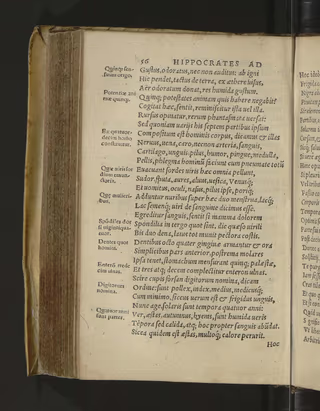
Sic ſcripſit epiſtola magni
Hippocratis regi Ptolomæo ita præcepit ille.
Quatuor hîc totus mundi componitur orbis
Seminibus, lympha, ac terra, ſimul aëre & igni,
Hoc eſt humenti, gelido, ſicco, calidoq́;
Ipſum hominis corpus conſtat quoq; quatuor ijſdẽ,
Sanguine, pituitaq́;, & flaua bile, nigraq́;.
Vndæ pituita eſt ſimilis, uerùm ignea tota eſt
Flaua chole, aërius ſanguis, terreſtria bilis
Atra ſapit, ſic ſunt ſimiles & mundus homoq́;.
Et ſicca, & calida eſt bilis, quæ flaua uocatur,
Aduerſum eſt huic phlegma, calet, ſed ſanguis & hu-
Huic bilis penitus pugnat contraria nigra,
met
Et uarios redolent eadem hæc elementa ſapores.
Salſum phlegma ſapit, ſed cerula bilis acerbum,
Nigra gerit triſtem, gaudet dulcedine ſanguis.
Rurſus habent uarias ſedes hæc ſemina, cordis
Sanguis habet latebras, & ſpiritus ambit eaſdem:
Hepar flaua chole, ſplenem nigra, phlegma cerebrũ
Verùm ex corde capit, uena omnis magna cruorem.
Quæq́; graues pulſu motus arteria ſignat,
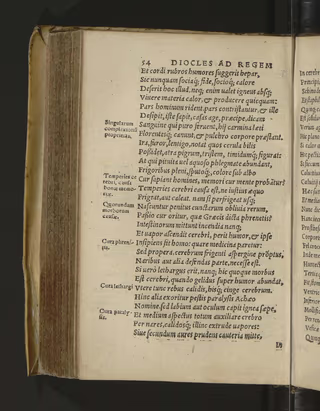
Et cordi rubros humores ſuggerit hepar,
Sic nunquam ſociaq́; fide, ſocioq́; calore
Deſerit hoc illud, neq; enim ualet igneus abſq;
Viuere materia calor, & producere quicquam:
Pars hominum rident, pars contriſtantur, & ille
Deſipit, iſte ſapit, caſas age, præcipe, dicam
Sanguine qui puro feruent, hij carmina læti
Florentesq́; canunt, & pulchro corpore præſtant.
Ira, furor, lentigo, notat quos cerula bilis
Poßidet, atra pigrum, triſtem, timidumq́; figurat:
At qui pituita uel aquoſo phlegmate abundant,
Frigoribus pleni, ſputoq́;, colore ſub albo
Cur ſapiant homines, memori cur mente probātur?
Temperies cerebri cauſa eſt, ne iuſtius æquo
Frigeat, aut caleat. nam ſi perfrigeat uſq;
Naſcuntur penitus cunctarum obliuia rerum,
Paßio cur oritur, quæ Græcis dicta phrenetis?
Inteſtinorum mittunt incendia nanq;
Et uapor aſcendit cerebri, perit humor, & ipſe
Inſipiens ſit homo: quare medicina paretur:
Sed propera, cerebrum frigenti aſpergine prõptus,
Naribus aut alia defendas parte, neceſſe eſt.
Si uerò lethargus erit, nanq; hic quoque morbus
Eſt cerebri, quando gelidus ſuper humor abundat,
Vtere tunc rebus calidis, hisq; cinge cerebrum.
Hinc alia exoritur peſtis paralyſis Achæo
Nomine, ſed labium aut oculum capit ignea ſæpe,
Et medium aſpectus totum auxiliare crebro
Per nares, calidosq́; illinc extrude uapores:
Siue ſecundum aures prudens cauteria mitte,
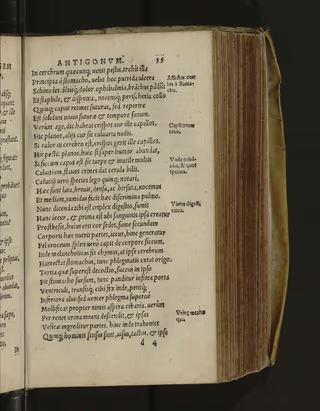
In cerebrum quæcunq; uenit peſtis, trahit illa
Principia à ſtomacho, uelut hoc putrida ulcera
Schinodes, dẽtisq́; dolor ophthalmia, brãchus pãdũt
Et ſtaphile, & diſpnœa, nocensq́; periſchinia collo
Quinq; caput retinet ſuturas, ſed reperire
Eſt ſolidum unius ſuturæ & tempore ſanum.
Verùm age, dic habeat criſpos cur ille capillos,
Hic planos, alijs cur ſit caluaria nudis.
Si calor in cerebro eſt, criſpos gerit ille capillos.
Hic pectit planos, huic ſi ſuper humor abundat,
Si ſiccum caput eſt, fit turpe & inutile multis
Caluitium, flauos crines dat cerula bilis.
Caluitij uerò ſpecies lego quinq; notari,
Hæc ſunt lata, breuis, denſa, ac hirſuta, uocemus
Et mediam, tumidus facit hæc diſcrimina pulmo.
Nunc dicenda tibi eſt triplex digeſtio, ſumit
Hanc iecur, & prima eſt ubi ſanguinis ipſa creatur
Proſtheſis, huius erit cor ſedes, ſume ſecundam
Corporis hæc nutrit partes, iecur, hinc generatur
Fel croceum. ſplen uerò capit de corpore ſiccum.
Inde melancholicus fit chymus, at ipſe cerebrum
Humectat ſtomachus, tunc phlegmatis extat origo.
Tertia quæ ſupereſt decoctio, ſuccus in ipſo
Fit ſtomacho ſurſum, tunc panditur infima porta
Ventriculi, tranſitq́; cibi fex inde, petitq́;
Inferiora alui: ſed uenter phlegma ſupernè
Mollificat propter nimis aſpera cibaria, uerùm
Per renes urina means deſcendit, & ipſas
Veſicæ ingreditur partes. hinc inde trahentes
Quinq; hominis ſenſus ſunt, uiſus, tactus, & ipſe
Guſtus, odoratus, nec non auditus: ab igni
Hic pendet, tactus de terra, ex æthere uiſus,
Aër odoratum donat, res humida guſtum.
Quinqꝫ poteſtates animam quis habere negabit?
Cogitat hæc, ſentit, reminiſcitur iſta uel illa.
Rurſus opinatur, rerum phantaſmata uerſat:
Sed quoniam uarijs his ſeptem partibus ipſum
Compoſitum eſt hominis corpus, dicamus & illas
Neruus, uena, caro, necnon arteria, ſanguis,
Cartilago, unguis, pilus, humor, pingue, medulla,
Pellis, phlegma hominũ faciunt cum pneumate totũ
Euacuant ſordes uiris hæc omnia pellunt,
Sudor, ſputa, aures, aluus, ueſica, Venusq́;
Et uomitus, oculi, naſus, pilus ipſe, poriq́;
Adduntur nuribus ſuper hæc duo menſtrua, lacq́;
Lac ſemenq́; uiri de ſanguine dicimus eſſe.
Egreditur ſanguis, ſentit ſi mamma dolorem
Spondilia in tergo quot ſint, dic quæſo uirili
Bis duo dena, latus tot munit pectora coſtis.
Dentibus octo quater gingiuæ armantur & ora
Simplicibus pars anterior, poſtrema molares
Ipſa tenet, ſtomachum menſurant quinqꝫ paleſtæ,
Et tres atqꝫ decem complectitur enteron ulnas.
Scire cupis forſan digitorum nomina, dicam
Ordine: ſunt pollex, index, medius, medicusq́;
Cum minimo, ſiccus uerum eſt & frigidus unguis,
Nunc age, ſolaris ſunt tempora quatuor anni:
Ver, æſtas, autumnus, hyems, ſunt humida ueris
Tẽpora ſed calida, atqꝫ hoc propter ſanguis abũdat.
Sicca quidem eſt æſtas, multoq́; calore perurit.
Hoc ideò in nobis augetur cerula bilis,
Frigida cum ſiccis autumnus tempora miſcet:
Nigra chole augetur, ſanies & aquoſa cruenta.
Pituitam producit hyems, quæ friget & humet.
Sic elementa regunt diuerſis quatuor anni
Partibus, inter ſe cum corpore tempora noſtro,
Solarem idcircò circunſpectare neceſſe eſt
Curſum, & temperiem qua conſtat quilibet æger,
Sicq́; ſalutares membris adhibere medelas.
Si uerè ægreſcat iuuenis, tunc ſanguis abundat.
Hinc opus eſt uenis punctis haurire cruorem.
Si pleuritis erit, uel prima luce, duabus
Vel tribus euacues uenas, concepta priuſquam
Paſsio conualeat, uel uirtus debilitetur
Corporis: hæc multum prodeſt purgatio cunctis.
Tempora ſi cupias, quæ ſint incidere uenas
Optima ſcire, feram, media Februarius ut iam
Parte ſui menſis deceſſerit incipe: rurſus
Poſt decimam lucem Septembris tempora ſuadent,
Donec ad extremum peruenerit ipſe December
Solſtitij. ſed ſi cubare coëgerit æſtas,
Te purgare ſtatim, bone uir, mihi crede, memento
Iam feſſus ſum, parce mihi, reſtantia dicam
Cras tibi, & abſoluam uitæ bona nutrimenta.
Et quo quenq́; cibum liceat conſumere menſe.
Et ſi contigerit uenas incidere, ſanguis
Quid uenetus, uiridisq́;, nigerq́;, alijq́; humores
Significent, uitæ & mortis prognoſtica ſcribam
Vt libet, ut gratum eſt: uerùm uenerande magiſter,
Arbitrio me trado tuo, benè uiue, ualeq́;.