Hover or tap a word to see its match.
Although you, in your homeland, after wars and heavy toils,
May spend gentle leisure in secure circumstances.
And, mighty in eloquence, and enriched by prosperous fortunes,
You may illuminate the deeds of Caesar with your writings.
And let the Viadrus, while it glides past irrigated gardens,
Halt its marveling waters at your songs.
Yet not, as I believe, from your mindful heart in so many years
Has the care for the Euganean soil slipped away, Sabinus.
But the longing remains, and the sweet image of the old places
Still clings to your eyes.
And now you seem to travel the Medoacus, now with a swift ship
To navigate the Adriatic sea in your accustomed manner.
Now the waters of Aponus smoking with sulfur come to mind,
And the temples nearest to the Antenorean ridges.
And gentle Arquatum rejoicing in the healthful Zephyr,
And the fields which the Pluicus waters with its clear streams.
Add so many outstanding souls, so many shining hearts
Of poets, which flourish in your constant mind.
Now Bembus presents himself to you, now Frastorius, closest to the gods,
Equal to Bembus in his honor.
And Naugerius of pure speech along with Flaminius,
Each a refined master of the untouched lyre.
And Molsa girt with myrtle, whom in the abode of the pious
Nurturing Love feeds with inexhaustible nectar.
And others, with whom you once used to go here as a companion
To the Aonian mountains and the Castalian grove.
Perhaps even among these things you have a mutual care for me,
And you ask what I do, sitting on the Venetian shore.
Namely, here I contemplate the deaths and births of things,
And from what causes all things flow in their order.
And I learn whatever the sea produces for medical uses,
And whatever the kindly earth produces in its all-bearing bosom.
Often it is pleasing to avoid the sun under a cool shade,
And to speak much about plants and trees.
But the fortunate Ilyacus especially delights me,
And the plane tree, planted by your hands, Bembo.
For Bembo, not unmindful of his homeland, once
Transplanted the plane tree from your fields, Sicilian Enna.
Often it is pleasing to traverse the Venetian lagoons with a light oar,
Often it is pleasing to spend whole days in the countryside.
And to find relief from the heat in the grass, wherever perhaps
A tall laurel unfolds its fragrant foliage.
There I greet Arquatum, from whatever cliff,
And I venerate your ashes, revered Petrarch.
Then at the same time we descend to the warm waters of Aponus,
And it is not irksome to carry asphodel home in the evening.
From here I draw out the departing night (as long as it is) with a song,
While sleep keeps watch before the closed doors.
With songs I console the misfortunes both of my homeland and my own,
Often wiping my sorrowful eyes with my hand.
Thus the flower of my life, thus my sweet youth is plucked,
It slips away, and secretly flees with a silent foot.
Meanwhile, however, Love presses on, nor has this plague
And ruin retreated, driven from my bones.
Nor has reason been able to overcome the cruel flames,
Although it has chosen a place in the highest citadel.
Therefore I endured, in the first flower of youth,
To follow the harsh camps in a difficult time.
I saw the limits of the Ocean, and the distant shore
Where the strait separates Libya from our world.
Wearied, I overcame a thousand crises of affairs,
Often I bore heavy heat, often cold.
The fires of Cupid alone I cannot overcome,
Nor can I be stronger than my own desires.
Go far away, Muses, and farewell, laurels and ivy,
which Hutten brought to my fatherland before me.
Poems are of no profit, not even if Phoebus
should dictate to me such as the dying swan sings.
Nor do the healing waters of Aponus cure my wounds,
nor any herb which flourishes on the Euganean hills.
It is enough to have sung these things under the tender shade of the myrtle,
cease now, Erato, from more; Sabinus, farewell.
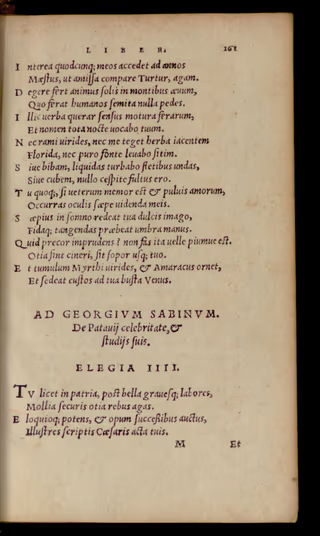
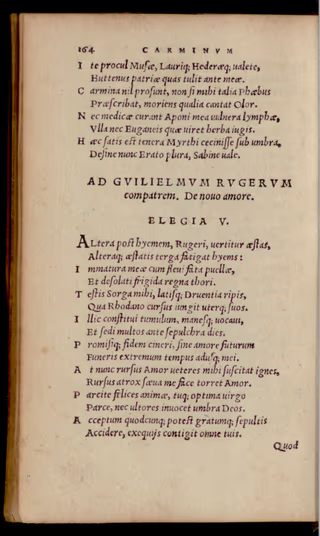
Tv licet in patria, poſt bella graueſq; labores,
Mollia ſecuris otia rebus agas.
Eloquioq; potens, & opum ſucceßibus auctus,
Illuſtres ſcriptis Cæſaris acta tuis.
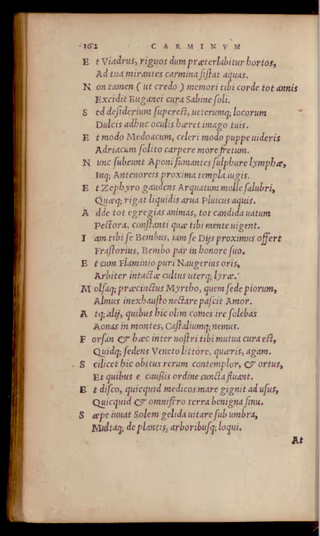
Et Viadrus, riguos dum præterlabitur hortos,
Ad tua mirantes carmina ſiſtat aquas.
Non tamen (ut credo) memori tibi corde tot annis
Excidit Euganei cura Sabine ſoli.
Sed deſiderium ſupereſt, ueterumq; locorum
Dulcis adhuc oculis hæret imago tuis.
Et modo Medoacum, celeri modo puppe uideris
Adriacum ſolito carpere more fretum.
Nunc ſubeunt Aponi fumantes ſulphure lymphæ,
Inq; Antenoreis proxima templa iugis.
Et Zephyro gaudens Arquatum molle ſalubri,
Quæq; rigat liquidis arua Pluicus aquis.
Adde tot egregias animas, tot candida uatum
Pectora, conſtanti quæ tibi mente uigent.
Iam tibi ſe Bembus, iam ſe Dijs proximus offert
Fraſtorius, Bembo par in honore ſuo.
Et cum Flaminio puri Naugerius oris,
Arbiter intactæ cultus uterq; lyræ.
Molſaq; præcinctus Myrtho, quem ſede piorum,
Almus inexhauſto nectare paſcit Amor.
Atq; alij, quibus hic olim comes ire ſolebas
Aonas in montes, Caſtaliumq; nemus.
Forſan & hæc inter noſtri tibi mutua cura eſt,
Quidq; ſedens Veneto littore, quæris, agam.
Scilicet hic obitus rerum contemplor, & ortus,
Et quibus e cauſis ordine cuncta fluant.
Et diſco, quicquid medicos mare gignit ad uſus,
Quicquid & omnifero terra benigna ſinu.
Sæpe iuuat Solem gelida uitare ſub umbra,
Multaq; de plantis, arboribuſq; loqui.
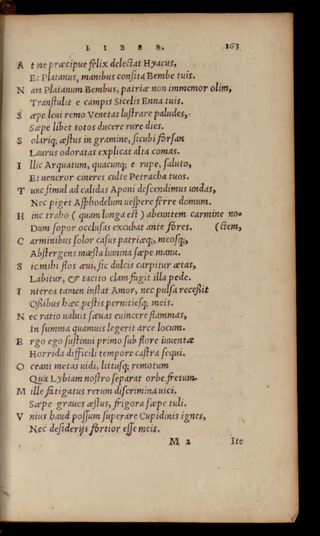
At me præcipue felix delectat Ilyacus,
Et Platanus, manibus conſita Bembe tuis.
Nam Platanum Bembus, patriæ non immemor olim,
Tranſtulit e campis Sicelis Enna tuis.
Sæpe leui remo Venetas luſtrare paludes,
Sæpe libet totos ducere rure dies.
Solariq; æſtus in gramine, ſicubi forſan
Laurus odoratas explicat alta comas.
Illic Arquatum, quacunq; e rupe, ſaluto,
Et ueneror cineres culte Petrarcha tuos.
Tunc ſimul ad calidas Aponi deſcendimus undas,
Nec piget Aſphodelum ueſpere ferre domum.
Hinc traho (quam longa eſt) abeuntem carmine no-
Dum ſopor occluſas excubat ante fores.
ctem,
Carminibus ſolor caſus patriæq;, meoſq;,
Abſtergens mœſta lumina ſæpe manu.
Sic mihi flos æui, ſic dulcis carpitur ætas,
Labitur, & tacito clam fugit illa pede.
Interea tamen inſtat Amor, nec pulſa receßit
Oßibus hæc peſtis pernicieſq; meis.
Nec ratio ualuit ſæuas euincere flammas,
In ſumma quamuis legerit arce locum.
Ergo ego ſuſtinui primo ſub flore iuuentæ
Horrida difficili tempore caſtra ſequi.
Oceani metas uidi, littuſq; remotum
Qua Lybiam noſtro ſeparat orbe fretum.
Mille fatigatus rerum diſcrimina uici,
Sæpe graues æſtus, frigora ſæpe tuli.
Vnius haud poſſum ſuperare Cupidinis ignes,
Nec deſiderijs fortior eſſe meis.
I te procul Muſæ, Lauriq; Hederæq; ualete,
Huttenus patriæ quas tulit ante meæ.
C armina nil proſunt, non ſi mihi talia Phæbus
Præſcribat, moriens qualia cantat Olor.
N ec medicæ curant Aponi mea uulnera lymphæ,
Vlla nec Euganeis quæ uiret herba iugis.
H æc ſatis eſt tenera Myrthi ceciniſſe ſub umbra,
Deſine nunc Erato plura, Sabine uale.