Hover or tap a word to see its match.
Dire contagions creep through the Euganean city,
It is time to leave the glassy waters of the Medoacus.
Whether the dog of Erigone pollutes the tainted breezes,
Or the lake, and the soil rich with many a swamp.
Or whether the South wind has brought the seeds of the plague,
eluding our senses, from the putrid, infected ground.
The cause lies hidden, but the fierce pestilence grows worse by the hour:
mad, alas, is whoever remains in the city of Padua.
You too, why do you delay to escape the perilous hazards
while you may, and to depart safely in swift flight?
Not, however, so that you abandon your mistress, spurning devotion,
nor let your loyalty fall, slipping through excessive fear.
It will be shameful for an undeserving girl to weep because of you,
who has entrusted to you every right over her own soul.
You are not cruel in this, nor is it right for me to believe so much,
so greatly is it fitting for poets to be loyal.
Therefore, whether you skirt the lake of Benacus, green with citron trees
and myrtle, where a better breeze warms it.
Or the banks of the Athesis, where the Italian land ends,
or yours, Abdua, or yours, Timavus.
Or if it pleases you to wander the cities of the two-named Eridanus,
or to travel the long path of the winding Tiber.
Wherever your feet shall lead you, wherever your will,
let her be your companion, and let her hang upon your neck.
Nor let a rough cabin in the secluded woods be vile to you,
provided everything is safe from the unclean pestilence.
The home of the Aonides holds me, and the renowned fatherland of Poets,
Felsina, the sole confidant of my sadness.
Felsina, which the Rhenus glides through with a gentle stream,
noble among the waters born of the Apennines.
Bright peace dwells here, nor is any land more wholesome,
while the thirsty Lion bakes the parched fields.
But for me there is no rest, neither when he hides himself in the waves,
nor when the Sun returns in the morning with turned steeds.
Now the new moon has shone nine times in the serene sky,
While my weary eyes lack the gift of sleep.
Cruel Love does not harm me, nor does the scorching air,
Nor dreadful poisons swallowed by a careless hand.
You have broken my studies and my play, you have broken
All the joys of life by your death, O Stibarus.
I call to witness the honored spirits, and the recent shade,
And whatever gods and souls see my grief:
That I have felt such great sorrow at no funeral,
Not even when my brother was covered by the cold earth.
Nor when the black day, its light extinguished,
Carried off my aged parents (forgive me, devotion).
Now my thin veins grow pale, my blood drained away,
And all the moisture of my body departs into tears.
And no less does fever feed upon my burning limbs,
And parches my panting mouth with continuous thirst.
Nor does it help to fill the sky with groans, nor do any
Vows move the gods as my spirit fails.
Whenever therefore, struck by the fate of your friend,
You sorrowfully set foot in the city of Felsina.
Come to the tomb yourself, I pray, and greet my shade,
And do not deny flowery garlands and roses to my ashes.
Then you may say to our companions, sighing from the depths of your chest,
"For him, longing was the cause of death."
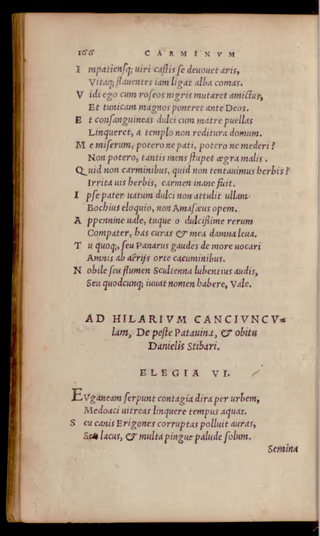
EVganeam ſerpunt contagia dira per urbem,
Medoaci uitreas linquere tempus aquas.
Seu canis Erigones corruptas polluit auras,
Seu lacus, & multa pingue palude ſolum.
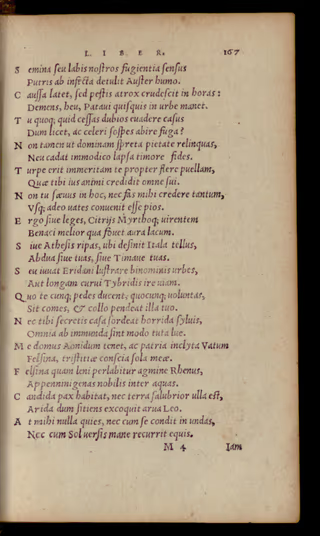
Semina ſeu labis noſtros fugientia ſenſus
Putris ab infecta detulit Auſter humo.
Cauſſa latet, ſed peſtis atrox crudeſcit in horas:
Demens, heu, Pataui quiſquis in urbe manet.
Tu quoq; quid ceſſas dubios euadere caſus
Dum licet, ac celeri ſoſpes abire fuga?
Non tamen ut dominam ſpreta pietate relinquas,
Neu cadat immodico lapſa timore fides.
Turpe erit immeritam te propter flere puellam,
Quæ tibi ius animi credidit omne ſui.
Non tu ſæuus in hoc, nec fas mihi credere tantum,
Vſq; adeo uates conuenit eſſe pios.
Ergo ſiue leges, Citrijs Myrthoq; uirentem
Benaci melior qua fouet aura lacum.
Siue Atheſis ripas, ubi deſinit Itala tellus,
Abdua ſiue tuas, ſiue Timaue tuas.
Seu iuuat Eridani luſtrare binominis urbes,
Aut longam curui Tybridis ire uiam.
Quo te cunq; pedes ducent, quocunq; uoluntas,
Sit comes, & collo pendeat illa tuo.
Nec tibi ſecretis caſa ſordeat horrida ſyluis,
Omnia ab immunda ſint modo tuta lue.
Me domus Aonidum tenet, ac patria inclyta Vatum
Felſina, triſtitiæ conſcia ſola meæ.
Felſina quam leni perlabitur agmine Rhenus,
Appenninigenas nobilis inter aquas.
Candida pax habitat, nec terra ſalubrior ulla eſt,
Arida dum ſitiens excoquit arua Leo.
At mihi nulla quies, nec cum ſe condit in undas,
Nec cum Sol uerſis mane recurrit equis.
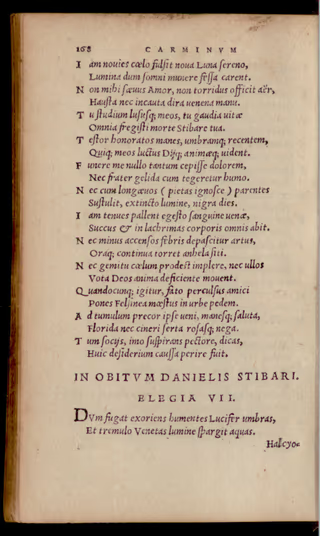
I am nouies cœlo fulſit noua Luna ſereno,
Lumina dum ſomni munere feſſa carent.
N on mihi ſæuus Amor, non torridus officit aër,
Hauſta nec incauta dira uenena manu.
T u ſtudium luſuſq; meos, tu gaudia uitæ
Omnia fregiſti morte Stibare tua.
T eſtor honoratos manes, umbramq; recentem,
Quiq; meos luctus Dijq; animæq; uident.
F unere me nullo tantum cepiſſe dolorem,
Nec frater gelida cum tegeretur humo.
N ec cum longæuos (pietas ignoſce) parentes
Suſtulit, extincto lumine, nigra dies.
I am tenues pallent egeſto ſanguine uenæ,
Succus & in lachrimas corporis omnis abit.
N ec minus accenſos febris depaſcitur artus,
Oraq; continua torret anhela ſiti.
N ec gemitu cœlum prodeſt implere, nec ullos
Vota Deos anima deficiente mouent.
Q uandocunq; igitur, fato perculſus amici
Pones Felſinea mœſtus in urbe pedem.
A d tumulum precor ipſe ueni, maneſq; ſaluta,
Florida nec cineri ſerta roſaſq; nega.
T um ſocijs, imo ſuſpirans pectore, dicas,
Huic deſiderium cauſſa perire fuit.