Hover or tap a word to see its match.
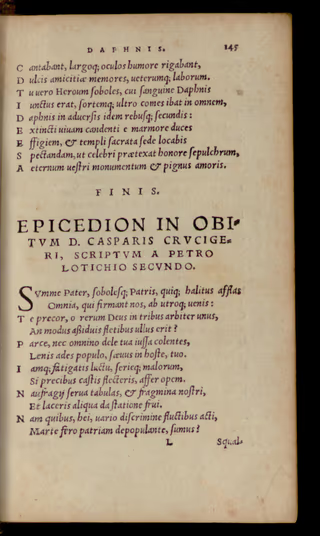
Highest Father, and offspring of the Father, and you, Breath, who blow upon
All things, who strengthen us, coming from both:
I pray to you, O God, the one judge of things in three,
Will there be any limit to the constant weeping?
Spare us, and do not entirely destroy those who observe your commands,
Be gentle to the people, fierce against your enemy.
And now to those wearied by grief and a succession of evils,
If you are swayed by chaste prayers, bring help.
Save the planks and fragments of our shipwreck,
And allow our shattered remains to enjoy some anchorage.
For by what waves, alas, in varied peril are we driven,
While fierce Mars devastates the fatherland?
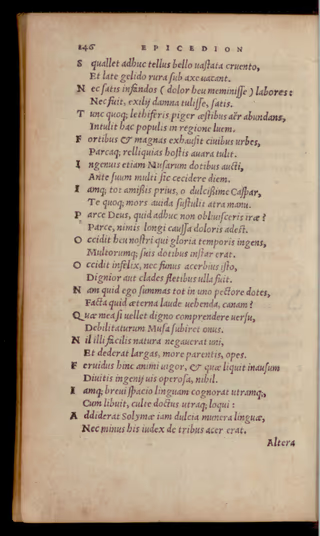
The earth still lies desolate, ravaged by bloody war,
and far and wide the fields lie empty beneath the freezing sky.
Nor was it enough to have endured unspeakable toils (alas, the pain of remembering!):
nor was it enough to have borne the losses of exile.
Then too the sluggish air, teeming with deadly heat,
brought pestilence to the peoples in this region.
And it emptied great cities of their strong citizens,
and greedy Fate took what the enemy left behind.
Even those enriched by the noble gifts of the Muses,
many thus fell before their time.
And now, with so many already lost, O sweetest Caspar,
dark death has carried you off as well with its greedy hand.
Spare us, God, why do you not yet forget your anger?
Spare us, the cause of too enduring a grief is here.
He has fallen, alas, who was the immense glory of our time,
and who by his endowments was the equal of many.
Ill-fated he has fallen, and no death was more bitter than that,
nor was any disaster more deserving of tears.
For why should I sing of so many supreme gifts in a single breast,
why of deeds to be extolled with eternal praise?
If my Muse should wish to encompass these in worthy verse,
she would take up a burden that would break her strength.
To him alone favorable nature had denied nothing,
and had bestowed abundant wealth, like a parent.
Hence the fervent vigor of his mind, and the active power
of his rich intellect, which left nothing unattempted.
And already in a short time he had mastered both languages,
skilled at speaking elegantly in both, whenever it pleased him:
He had already added the sweet gifts of the language of Jerusalem,
and he was no less a keen judge of these three.
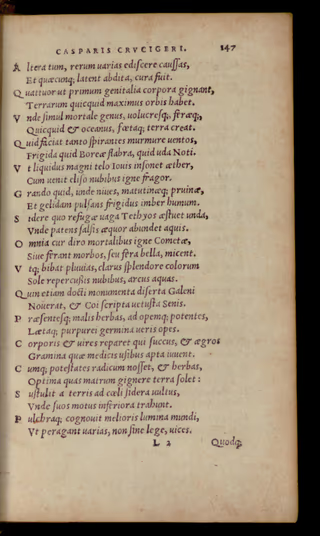
Then another care was to learn the varied causes of things,
And whatever lies hidden and concealed.
How the four generative bodies first bring forth
Whatever the vast globe of the earth contains.
Whence at once the mortal race, and birds, and wild beasts,
And whatever the ocean and the fruitful earth create.
What makes the winds blow with so great a roar,
What the cold blasts of Boreas, what the wet of Notus.
How the clear aether resounds with the weapon of great Jupiter,
When the crash comes as fire is struck from the clouds.
What hail is, whence the snows, and morning frosts,
And the cold rain beating the icy ground.
By what star the wandering wave of retreating Tethys swells,
Whence the open sea abounds with salty waters.
Why comets flash upon all things with a fire dire to mortals,
Whether they bring diseases or savage wars.
And how the bow, bright with the splendor of colors,
Drinks up the rain waters when the sun reflects off the clouds.
Furthermore, he knew the eloquent monuments of learned Galen,
And the ancient writings of the Old Man of Cos.
And herbs efficacious for ailments, and potent for aid,
And the joyous sprouts, the wealth of purple spring.
And what juice restores the strengths of the body, and what
Grasses suited for medical uses aid the sick.
And when he had learned the powers of roots, and the herbs
Which the earth, best of mothers, is wont to produce:
He raised his face from the earth to the stars of heaven,
Whence the things below draw their motions.
And he learned the beautiful lights of the better world,
How they perform their varied changes, not without law.
And which star shines in a space nearer to the earth,
Which stands forth, and is further away from the solid ground.
What the measure of years is, why the parts of the year are four,
Why the path of the sun is cut obliquely.
How the shorter shadow of dew-bringing night prolongs the day,
When Phoebus is nearer to the North.
How Titan lies hidden, concealed by dense darkness,
When his envious sister obstructs her brother's steeds.
And how the moon decreases as she seeks the sun, how she enlarges her orb,
When she leaves her brother behind with swift horses,
How her brightness is obscured by a pitch-black shadow,
When Phoebus makes his journey on the opposite path.
And which stars scatter auspicious fires for mortals,
Advantageous to one being born, and in what place.
What the Dog Star, or the Hyades, might stir up, what watery Orion,
And the Kid, washed in the whirlpool of western water.
Nor was knowing the stars, privy to the fates,
Merely a rest for his mind and a sweet pleasure:
But it pleased him more to know the Creator, and that there is
A mighty God who rules the work of this world.
And who moderates the stars, and confines them within fitting bounds,
And takes care lest anything stray too far.
Therefore the ardor of his resolute heart was to perceive
More closely the Creator and parent of things.
And he burned with a pious love for heavenly doctrine,
(Ah, how great a thing it is to be able to please the true God.)
Without delay, he knew whatever the prophetic Prophets sang,
And every kind of writing concerning the faith.
When, suddenly loathing impious madness,
He sincerely aided the work of Religion.
And he fed with the word the eager sheep, redeemed
by the death of Christ, piously performing his holy duty,
And no less in the harsh time of a protracted war,
he remained ever-watchful in his duty.
And when the sweet Muses had departed from this city,
and the learned crowd had followed the Pierian goddesses:
He soothed heavy cares, offering consolation,
and said, "The wrath of God is bent by prayers."
Moreover, such was the eloquence in his soothing words,
as was the grace of Nestorian honey.
Why should I speak of how he brought help to you,
great Luther, as you translated the oracles of the ancient prophets?
How he had been a judge of the language of Jerusalem, outstanding in sharpness,
with the dexterity of his judgment?
Then even when cruel death had carried you away,
he published the writings left behind, clearing away their dust.
And so that future descendants might read them published,
he bore the great burden of a long labor.
Add his pious morals, lacking any shameful stain,
and his steadfast faith with noble dignity.
Yet what do these things help? What has the richness of his language,
or the known practice of medical aid profited him now?
And to have noted the laws of nature and the spheres of the revolving sky,
and all the stars of the starry heaven?
Does his body, now empty of its sweet soul, lie any less
consumed by death in the cold tomb?
Did he fall any less (O Fates!) in his better years,
scarcely counting nine completed lustra of life?
But the eternal glory (rejoice, buried spirits!)
which the gifts of his genius produced, remains.
And posterity, never unmindful of Caspar,
will read the published writings concerning holy Religion.
And when long age has reduced his body to ashes,
he will live and be the glory of the succeeding age.
Receiving now the joyful due rewards of a pious life,
he dwells in the abodes which the blessed throng inhabits.
And snatched from so great a whirlwind of wretched affairs,
in his better part he now enjoys God.
Because, with failing breath, he asked for Him alone,
he kept saying that it was sweet for him to die at His command.
And he was already cherishing his joys with a tranquil heart,
and was joyful with a breast empty of cares.
Often it pleased him to hear the daughters he must leave behind
adoring your divinity, O kind Christ.
Often, too, his paternal cheeks were wet with tears,
and pious love for his offspring forced him to weep.
Nevertheless, and although sick with exhausted strength,
with a placid mind he summoned himself to his accustomed work,
And he was accustomed to investigate the position of the sky and the rays,
and the restless stars with exact observations.
And when he held your volume in his hands, O Ptolemy,
having scrutinized the abodes to which he was about to go,
Lachesis stood by, and said, "You know all things outside;
the inner hall of heaven now lies open to you."
She spoke, and snatched him from the earth, and placed him above,
releasing the soul, as commanded, from the body, its home.
There now he knows the stars of ever-shining Olympus,
and all things which lay hidden before.
And he beholds the offspring of God, and the venerable majesty,
and worships among the holy ancestors.
O happy one, now that this frame of the body is dissolved,
O soul, received into the abode of the heavenly vault.
Now rest is secured for you. Farewell, sweetest Caspar,
and may your bones rest in peaceful abodes.
Tears and groans await us; have pity on your people,
O God, and be a sweet comfort to the wretched.
Behold, your Church begs for aid in uncertain times,
and without You she has no one to protect her.
Behold, overwhelmed by evils, and bereft of such a protector,
she weeps, and says, "Alas, what will become of wretched me?"
Grant at last, most gentle Father, that she,
exhausted by all misfortunes, may enjoy the citadel of her heavenly homeland.
S Vmme Pater, ſoboleſq; Patris, quiq; halitus afflas
Omnia, qui firmant nos, ab utroq; uenis:
T e precor, o rerum Deus in tribus arbiter unus,
An modus aßiduis fletibus ullus erit?
P arce, nec omnino dele tua iuſſa colentes,
Lenis ades populo, ſæuus in hoſte tuo.
I amq; fatigatis luctu, ſerieq; malorum,
Si precibus caſtis flecteris, affer opem.
N aufragij ſerua tabulas, & fragmina noſtri,
Et laceris aliqua da ſtatione frui.
N am quibus, hei, uario diſcrimine fluctibus acti,
Marte fero patriam depopulante, ſumus?
Squallet adhuc tellus bello uaſtata cruento,
Et late gelido rura ſub axe uacant.
Nec ſatis infandos ( dolor heu meminiſſe ) labores:
Nec fuit, exilij damna tuliſſe, ſatis.
Tunc quoq; lethiferis piger æſtibus aër abundans,
Intulit hac populis in regione luem.
Fortibus & magnas exhauſit ciuibus urbes,
Parcaq; relliquias hoſtis auara tulit.
Ingenuis etiam Muſarum dotibus aucti,
Ante ſuum multi ſic cecidere diem.
Iamq; tot amiſsis prius, o dulciſsime Caſpar,
Te quoq; mors auida ſuſtulit atra manu.
Parce Deus, quid adhuc non obliuiſceris iræ ?
Parce, nimis longi cauſſa doloris adeſt.
Occidit heu noſtri qui gloria temporis ingens,
Multorumq; ſuis dotibus inſtar erat.
Occidit infelix, nec funus acerbius iſto,
Dignior aut clades fletibus ulla fuit.
Nam quid ego ſummas tot in uno pectore dotes,
Facta quid æterna laude uehenda, canam?
Quæ mea ſi uellet digno comprendere uerſu,
Debilitaturum Muſa ſubiret onus.
Nil illi facilis natura negauerat uni,
Et dederat largas, more parentis, opes.
Feruidus hinc animi uigor, & quæ liquit inauſum
Diuitis ingenij uis operoſa, nihil.
Iamq; breui ſpacio linguam cognorat utramq;,
Cum libuit, culte doctus utraq; loqui :
Addiderat Solymæ iam dulcia munera linguæ,
Nec minus his iudex de tribus acer erat.
Altera tum, rerum uarias ediſcere cauſſas,
Et quæcunq; latent abdita, cura fuit.
Quattuor ut primum genitalia corpora gignant,
Terrarum quicquid maximus orbis habet.
Vnde ſimul mortale genus, uolucreſq; feræq;
Quicquid & oceanus, fœtaq; terra creat.
Quid faciat tanto ſpirantes murmure uentos,
Frigida quid Boreæ flabra, quid uda Noti.
Vt liquidus magni telo Iouis inſonet æther,
Cum uenit eliſo nubibus igne fragor.
Grando quid, unde niues, matutinæq; pruinæ,
Et gelidam pulſans frigidus imber humum.
Sidere quo refugæ uaga Tethyos æſtuet unda,
Vnde patens ſalſis æquor abundet aquis.
Omnia cur diro mortalibus igne Cometæ,
Siue ferant morbos, ſeu fera bella, micent.
Vtq; bibat pluuias, clarus ſplendore colorum
Sole repercuſſis nubibus, arcus aquas.
Quin etiam docti monumenta diſerta Galeni
Nouerat, & Coi ſcripta uetuſta Senis.
Præſenteſq; malis herbas, ad opemq; potentes,
Lætaq; purpurei germina ueris opes.
Corporis & uires reparet qui ſuccus, & ægros
Gramina quæ medicis uſibus apta iuuent.
Cumq; poteſtates radicum noſſet, & herbas,
Optima quas matrum gignere terra ſolet :
Suſtulit a terris ad cœli ſidera uultus,
Vnde ſuos motus inferiora trahunt.
Pulchraq; cognouit melioris lumina mundi,
Vt peragant uarias, non ſine lege, uices.
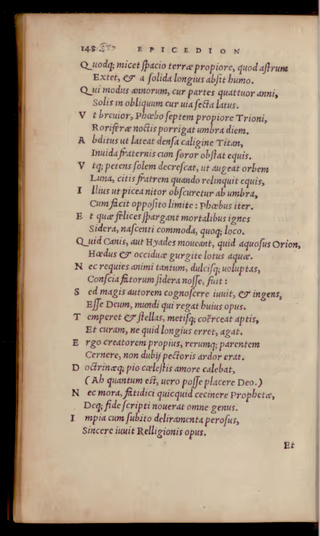
Quodq; micet ſpacio terræ propiore, quod aſtrum
Extet, & a ſolida longius abſit humo.
Qui modus annorum, cur partes quattuor anni,
Solis in obliquum cur uia ſecta latus.
Vt breuior, Phœbo ſeptem propiore Trioni,
Roriferæ noctis porrigat umbra diem.
Abditus ut lateat denſa caligine Titan,
Inuida fraternis cum ſoror obſtat equis.
Vtq; petens ſolem decreſcat, ut augeat orbem
Luna, citis fratrem quando relinquit equis,
Illius ut picea nitor obſcuretur ab umbra,
Cum facit oppoſito limite: Phœbus iter.
Et quæ felices ſpargant mortalibus ignes
Sidera, naſcenti commoda, quoq; loco.
Quid Canis, aut Hyades moueant, quid aquoſus Orion,
Hœdus & occiduæ gurgite lotus aquæ.
Nec requies animi tantum, dulciſq; uoluptas,
Conſcia fatorum ſidera noſſe, fuit:
Sed magis autorem cognoſcere iuuit, & ingens,
Eſſe Deum, mundi qui regat huius opus.
Temperet & ſtellas, metiſq; coërceat aptis,
Et curam, ne quid longius erret, agat.
Ergo creatorem propius, rerumq; parentem
Cernere, non dubij pectoris ardor erat.
Doctrinæq; pio cœleſtis amore calebat,
(Ah quantum eſt, uero poſſe placere Deo.)
Nec mora, fatidici quicquid cecinere Prophetæ,
Deq; fide ſcripti nouerat omne genus.
Impia cum ſubito deliramenta peroſus,
Sincere iuuit Relligionis opus.
Et cupidas uerbo pauit, Chriſtiq; redemtas
Morte, pie ſancto munere functus, oues,
Nec minus & duro ſpacioſi tempore belli,
Manſit in officio peruigiluſq; ſuo.
Cumq; receſiſſent hac dulces urbe Camœnæ,
Doctaq; pierias turba ſequuta Deas:
Lenijt ille graues, adhibens ſolatia, curas,
Et precibus, dixit, flectitur ira Dei.
Talis quin etiam blandis facundia dictis,
Qualis Neſtorei gratia mellis, erat.
Quid loquar, ut ueterum uertenti oracula uatum,
Auxilium tulerit, magne Luthere tibi?
Vt ſolymi cenſor ſermonis, acumine præſtans,
Iudicij fuerat dexteritate ſui?
Tunc etiam cum te mors importuna tuliſſet,
Edidit abſterſo ſcripta relicta ſitu.
Vtq; ſequuturi legerent uulgata nepotes,
Suſtinuit longi grande laboris onus.
Adde pios mores, & turpi labe carentes,
Et ſtabilem pulchra cum grauitate fidem.
Quid tamen iſta iuuant? quid nunc opulentia linguæ,
Cognitus aut medicæ profuit uſus opis?
Iuraq; naturæ cœliq; uolubilis orbes,
Aſtraq; ſiderei cuncta notaſſe poli?
Num minus in gelido conſumptus morte ſepulchro,
Nunc animæ dulcis corpus inane iacet?
Num minus ( o parcæ ) melioribus occidit annis,
Vix numerans uitæ luſtra peracta nouem?
At decus æternum ( manes gaudete ſepulti )
Ingenij dotes quod peperere, manet.
Scriptaq; poſteritas, non Caſparis immemor unquam
Edita de ſancta Relligione leget.
Corpus & in cineres cum longa redegerit ætas,
Viuet & ætatis fama ſequentis erit.
Læta piæ capiens nunc debita munera uitæ,
Quas habitat ſedes turba beata, colit.
Raptus & e tanto miſerarum turbine rerum,
Parte ſui fruitur nunc meliore Deo.
Hunc anima ſolum quia deficiente rogabat,
Hoc ſibi dicebat dulce iubente mori.
Et ſua tranquillo iam gaudia corde fouebat,
Et uacuo curis pectore lætus erat.
Sæpe relinquendas natas audire iuuabat,
Numen adorantes Chriſte benigne tuum.
Sæpe genæ lachrymis etiam maduere paternæ,
Et pius in ſobolem flere coëgit amor.
Nec minus, & quamuis defectis uiribus æger,
In ſolitum placida mente uocabat opus,
Rimariq; ſitum cœli radioſq; ſolebat,
Sideraq; exactis irrequieta notis.
Cumq; tuum manibus Ptolemæe uolumen haberet,
Scrutatus ſedes quas aditurus erat,
Aſtitit, & Lacheſis, calles foris omnia, dixit,
Interior cæli nunc patet aula tibi.
Dixit, & eripuit terris, ſuperaq; locauit,
Exoluens animam corpore iuſſa, domo.
Sidera nunc illic fulgentis ſemper Olympi,
Cunctaq; cognoſcit quæ latuere prius.
Progeniemq; Dei, maieſtatemq; uerendam
Aſpicit, & ſanctos inter adorat auos.
C orporis o felix iſta compage ſoluta,
O anima ætherei ſede recepta poli.
I am requies tibi parta, Vale dulciſsime Caſpar,
Et tua pacatis ſedibus oſſa cubent.
N os lachrymæ gemituſq; manent, miſerere tuorum
O Deus, & miſeris dulce leuamen ades.
E n tua poſcit opem dubijs Eccleſia rebus,
Et ſine te nullum qui tueatur, habet.
E n oppreſſa malis, orbataq; præſide tali
Plorat, & Hei miſeræ quid mihi fiet? ait.
D a patrij tandem genitor mitiſsime cœli,
Omnibus exhauſtam caſibus, arce frui.