Hover or tap a word to see its match.
At last, after hard misfortunes, we have reached the walls,
In which you lie, brother, snatched away before your time.
Come, tell me, if you were a friend of the recently living boy,
From where may I learn of his sorrowful tomb?
Or, if it is not burdensome, lead me to the pitiable grave,
So that I may in person bring final gifts to his shades.
Thus I spoke; thus someone replied: "This stone here hides him,"
And he himself mixed his tears with mine.
Hail, little dust buried in a foreign land,
Now dust, but formerly, brother, a friend to the Muses.
Brother, dearer to me than the sweet light of life,
Alas, how quickly are you bereft of the beautiful light of heaven?
You had added four years to seven birthdays,
And already the lyre was dear to your heart, already poetry was yours:
At the time when the fates took away our hope along with you,
And life abandoned your body, and sound your lips.
Your parents could not rejoice in your return,
No work of your rich intellect survives.
Ah, pitiable boy, taken away in your early youth,
Dark death has taken half of me with you.
You were to be the highest glory of the Muses, and one day
Our sweet pride, had it been permitted.
Now you inhabit the Elysian grove and the fortunate retreats,
And, a blessed shade, you dwell in the heavenly homes.
May your rest be tranquil, I pray, and the kindly hope of the pious;
May the host earth rest upon you with no weight.
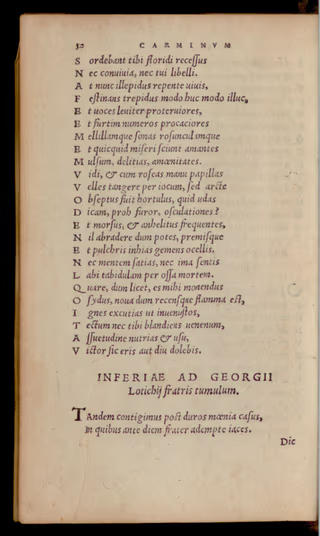
T andem contigimus poſt duros mœnia caſus,
I n quibus ante diem frater adempte iaces.
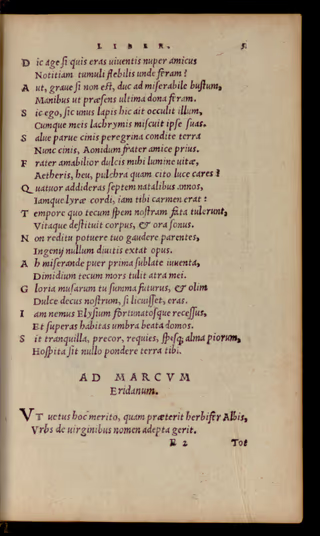
Dic age ſi quis eras uiuentis nuper amicus
Notitiam tumuli flebilis unde feram?
Aut, graue ſi non eſt, duc ad miſerabile buſtum,
Manibus ut præſens ultima dona feram.
Sic ego, ſic unus lapis hic ait occulit illum,
Cumque meis lachrymis miſcuit ipſe ſuas.
Salue parue cinis peregrina condite terra
Nunc cinis, Aonidum frater amice prius.
Frater amabilior dulcis mihi lumine uitæ,
Aetheris, heu, pulchra quam cito luce cares ?
Quatuor addideras ſeptem natalibus annos,
Iamque lyræ cordi, iam tibi carmen erat :
Tempore quo tecum ſpem noſtram fata tulerunt,
Vitaque deſtituit corpus, & ora ſonus.
Non reditu potuere tuo gaudere parentes,
Ingenij nullum diuitis extat opus.
Ah miſerande puer prima ſublate iuuenta,
Dimidium tecum mors tulit atra mei.
Gloria muſarum tu ſumma futurus, & olim
Dulce decus noſtrum, ſi licuiſſet, eras.
Iam nemus Elyſium fortunatoſque receſſus,
Et ſuperas habitas umbra beata domos.
Sit tranquilla, precor, requies, ſpeſq; alma piorum,
Hoſpita ſit nullo pondere terra tibi.