Hover or tap a word to see its match.
Part 1
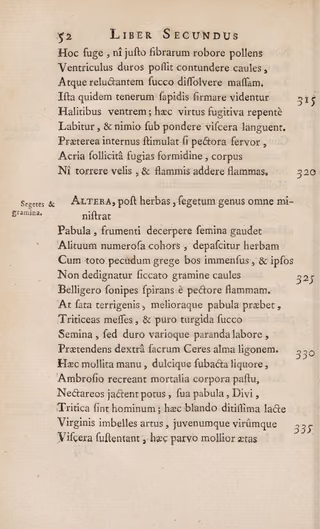
Shun this, unless your stomach, strong with a due vigor of its fibers,
Can crush the tough stalks,
And dissolve the stubborn mass with its juice.
Those indeed seem to strengthen a delicate belly
With their savory exhalations; yet this fleeting virtue suddenly
Slips away, and the viscera languish beneath an excessive weight.
Furthermore, if an internal heat stimulates the chest,
Flee acrid things with anxious dread, unless
You wish to scorch your body, and add flames to flames.
Crops and grasses. After herbs, every kind of crop supplies a second
Nourishment; the numerous troop of birds rejoices
To pluck the seeds of grain; the huge ox, along with
The whole herd of cattle, grazes upon the grass, and the steed,
Breathing flame from its warlike chest, does not disdain
Even the stalks of dried grass.
But bountiful Ceres, holding forth the sacred hoe in her right hand,
Offers sown crops and better nourishment to the earth-born:
Wheaten harvests, and seeds swelling with pure juice,
Yet to be prepared by hard and varied labor.
These, softened by the hand and kneaded with sweet liquid,
Refresh mortal bodies with ambrosial food.
Let the Gods boast of their nectarous drinks, their own nourishment;
Let wheat belong to men; this, most rich in soothing milk,
Sustains the delicate limbs of the maiden, and the viscera
Of youths and men; this, the tenderer age in its small
Hoc fuge , nî juſto fibrarum robore pollens
Ventriculus duros poſſit contundere caules ,
Atque reluctantem ſucco diſſolvere maſſam.
Iſta quidem tenerum ſapidis firmare videntur
Halitibus ventrem; hæc virtus fugitiva repentè
Labitur , & nimio ſub pondere viſcera languent.
Præterea internus ſtimulat ſi pectora fervor ,
Acria ſollicitâ fugias formidine , corpus
Nî torrere velis , & flammis addere flammas.
Segetes & gramina. ALTERA, poſt herbas , ſegetum genus omne miniſtrat
Pabula , frumenti decerpere ſemina gaudet
Alituum numeroſa cohors , depaſcitur herbam
Cum toto pecudum grege bos immenſus , & ipſos
Non dedignatur ſiccato gramine caules
Belligero ſonipes ſpirans è pectore flammam.
At ſata terrigenis , melioraque pabula præbet ,
Triticeas meſſes , & puro turgida ſucco
Semina , ſed duro varioque paranda labore ,
Prætendens dextrâ ſacrum Ceres alma ligonem.
Hæc mollita manu , dulcique ſubacta liquore ,
Ambroſio recreant mortalia corpora paſtu,
Nectareos jactent potus , ſua pabula , Divi ,
Tritica ſint hominum ; hæc blando ditiſſima lacte
Virginis imbelles artus , juvenumque virûmque
Viſcera ſuſtentant , hæc parvo mollior ætas
Part 2
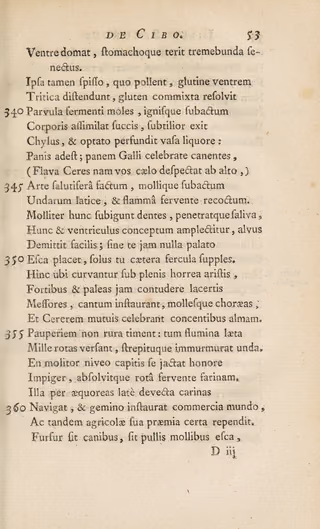
subdues in its belly, and trembling old age grinds in its
stomach.
Yet wheat itself distends the belly with the thick gluten in which
it abounds; a tiny mass of yeast mixed in dissolves
the gluten, and fire assimilates it, once kneaded,
to the juices of the body; a more subtle chyle
comes forth, and bathes the vessels with the desired liquid:
Bread is here; O Gauls, celebrate in song the bread,
(for golden-haired Ceres looks down upon you from high heaven,)
made by a health-bringing art, kneaded with the soft
liquid of the waves, and baked thoroughly in the glowing flame.
The teeth chew it gently, and the saliva penetrates it,
and the stomach embraces it once received, the bowels
easily pass it down; without you now no food pleases
the palate, you alone supply the place of all other dishes.
Hence, when the granaries bend beneath the full ears of grain,
and the reapers with their strong arms have now beaten out
the chaff, they renew their song and gentle dances;
and celebrate nourishing Ceres in mutual harmonies.
The countryside does not fear poverty: then the joyful rivers
turn a thousand wheels, and the water murmurs with a roar.
Behold, the untiring miller boasts of the snowy honor of his head,
and finishes the flour on the glowing wheel.
Carried widely by sea-going keels,
it sails, and renews commerce with the twin world,
and at last repays the farmer his sure rewards.
Let the bran be for the dogs, let it be food for the tender chicks,
Ventre domat , ſtomachoque terit tremebunda ſe-
nectus.
Ipſa tamen ſpiſſo , quo pollent , glutine ventrem
Tritica diſtendunt , gluten commixta reſolvit
Parvula fermenti moles , igniſque ſubactum
Corporis aſſimilat ſuccis , ſubtilior exit
Chylus , & optato perfundit vaſa liquore :
Panis adeſt ; panem Galli celebrate canentes ,
( Flava Ceres nam vos cælo deſpectat ab alto , )
Arte ſalutiferâ factum , mollique ſubactum
Undarum latice , & flammâ fervente recoctum.
Molliter hunc ſubigunt dentes , penetratque ſaliva ,
Hunc & ventriculus conceptum amplectitur , alvus
Demittit facilis ; ſine te jam nulla palato
Eſca placet , ſolus tu cætera fercula ſupples.
Hinc ubi curvantur ſub plenis horrea ariſtis ,
Fortibus & paleas jam contudere lacertis
Meſſores , cantum inſtaurant , molleſque choræas ;
Et Cererem mutuis celebrant concentibus almam.
Pauperiem non rura timent : tum flumina læta
Mille rotas verſant , ſtrepituque immurmurat unda.
En molitor niveo capitis ſe jactat honore
Impiger , abſolvitque rotâ fervente farinam.
Illa per æquoreas latè devecta carinas
Navigat , & gemino inſtaurat commercia mundo ,
Ac tandem agricolæ ſua præmia certa rependit.
Furfur ſit canibus , ſit pullis mollibus eſca ,
Part 3
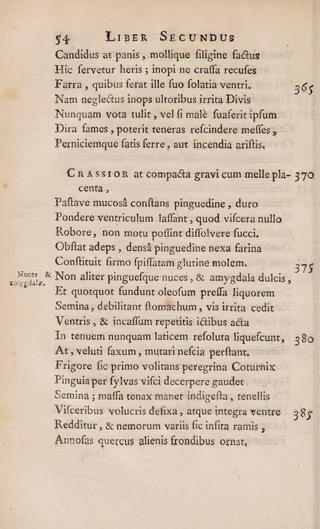
Yet let white bread, made from soft winter wheat,
Here be kept for the masters; do not refuse to the poor man coarse
Meal, wherewith he may bring solace to his belly.
For the neglected poor man has never offered vain prayers
To the avenging Gods, or if dire hunger has ill-advised
Him, he will be able to cut down the tender harvests,
And bring destruction to the sown fields, or fire to the ears of grain.
BUT a coarser cake compacted with heavy
honey,
Or a paste consisting of slimy fat, with a hard
Weight wearies the stomach, because the viscera with no
Strength, and the juices by no motion, can dissolve it.
The grease resists; the flour bound with dense fat
Forms a mass thickened with a firm glue.
Not otherwise do both oily nuts, and the sweet almond,
And whatever seeds when pressed pour forth an oily liquor,
Weaken the stomach; the baffled force of the belly
Yields, and driven in vain by repeated strokes
They never melt dissolved into a thin fluid,
But, like a rock, persist incapable of change.
Thus at the first frost the migrating Quail flying about
Rejoices to pluck through the woods the fatty seeds
Of mistletoe; the tenacious mass remains undigested, fixed
In the tender viscera of the bird, and is discharged whole
From the belly, and thus grafted upon the various branches of the groves,
Adorns the aged oaks with foreign foliage. Nuts & almonds.
Candidus at panis, mollique ſiligine factus
Hîc ſervetur heris; inopi ne craſſa recuſes
Farra, quibus ferat ille ſuo ſolatia ventri.
Nam neglectus inops ultoribus irrita Divis
Nunquam vota tulit, vel ſi malè ſuaſerit ipſum
Dira fames, poterit teneras reſcindere meſſes,
Perniciemque ſatis ferre, aut incendia ariſtis.
CRASSIOR at compacta gravi cum melle pla-
centa,
Paſtave mucosâ conſtans pinguedine, duro
Pondere ventriculum laſſant, quod viſcera nullo
Robore, non motu poſſint diſſolvere ſucci.
Obſtat adeps, densâ pinguedine nexa farina
Conſtituit firmo ſpiſſatam glutine molem.
Non aliter pingueſque nuces, & amygdala dulcis,
Et quotquot fundunt oleoſum preſſa liquorem
Semina, debilitant ſtomachum, vis irrita cedit
Ventris, & incaſſum repetitis ictibus acta
In tenuem nunquam laticem reſoluta liqueſcunt,
At, veluti ſaxum, mutari neſcia perſtant.
Frigore ſic primo volitans peregrina Coturnix
Pinguia per ſylvas viſci decerpere gaudet
Semina; maſſa tenax manet indigeſta, tenellis
Viſceribus volucris defixa, atque integra ventre
Redditur, & nemorum variis ſic inſita ramis,
Annoſas quercus alienis frondibus ornat. Nuces & amygdalæ.
Part 4
Let any prudent man who desires to keep the vigor of his stomach
Intact shun these things; he will not feel gripes of the belly,
And frequent saliva as old age comes on.
Hæc fugiat prudens ſtomachi quicumque vigorem
Intactum ſervare cupit, non tormina ventris
Sentiet, & crebram ſenio veniente ſalivam.