Hover or tap a word to see its match.
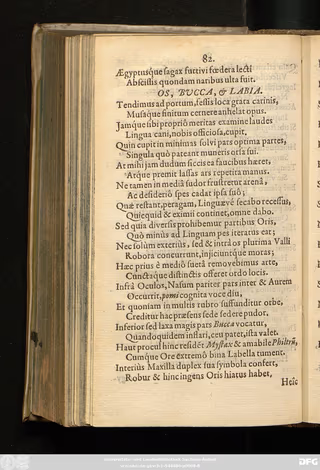
We head for the port, a welcome place for weary ships,
and the Muse pants to see the work finished.
And now the Tongue, dutiful to us, desires deserved praises
to be sung for itself by its own examination.
Indeed, this best part desires to be resolved into its smallest parts,
so that the individual beginnings of its function may be revealed.
But for me, it has long been sticking in my dry throat,
and the repeated art weighs down my weary hands.
Lest, however, my sweat be in vain in the middle of the arena,
and hope itself fail in its desire;
I will complete what remains, or I will dissect the recesses of the Tongue,
and whatever remarkable things it contains, I will present them all.
But because we are hindered by the various parts of the Mouth,
preventing our repeated step from proceeding to the Tongue;
And not only on the outside, but also inside the mouth many stout structures
of a Rampart meet, and impose delays;
We shall first remove these from the way with our accustomed art,
and order will present all things in their distinct places.
Below the Eyes, a part presents itself equally between the Nose and the Ear,
long known by the word "apple",
And since in many people it is suffused with a red circle,
modesty is believed to sit present in this seat.
But the lower and looser part is called the Cheek,
since, as is obvious, it can be inflated.
Not far from here reside the Moustache and the lovely Philtrum,
and at the edge of the Mouth the two Lips swell.
Inside, the double Jaw contributes its share,
and from this the gaping of the Mouth derives its immense strength,
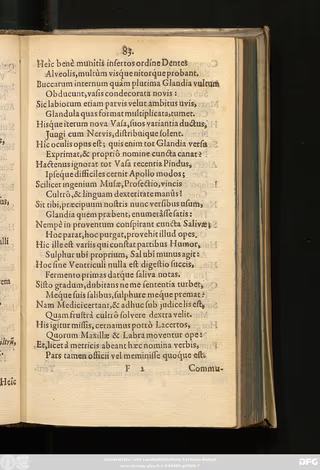
Here, their strength and gleam highly commend the teeth,
Inserted in order into well-fortified sockets.
Very many glands over the inner face of the cheeks
Spread, adorned with new vessels:
Thus also the circumference of the lips, as if with small grapes,
Which the multiplied gland forms, swells.
And to these again new vessels, varying their ducts,
Are customarily joined with nerves and distributed.
Here there is need for eyes; for who so many glands in verse
Could express, and sing of them all by their proper name?
Thus far Pindus is ignorant of so many recent vessels,
And Apollo himself discerns the difficult measures;
Indeed, Dissection, you conquer the genius of the Muse
With the knife, and the tongue with the dexterity of the hand!
Let it be enough for you to have recounted in our present verses
The principal use which the glands offer:
Namely, they all conspire in the production of saliva;
This one prepares, this one purges, that one carries forth the resources.
This is that humor which consists of various parts,
Where sulphur performs its proper role, where salt performs its task:
Without this, there is no digestion by the juices of the stomach,
And saliva imparts the first signs to the ferment.
I halt my step, hesitating lest a theory disturb me,
And oppress me with its salts, and oppress me with its sulphur:
For physicians contend, and the dispute is still before the judge,
Which the right hand would in vain wish to resolve with the knife.
Therefore, with these things dismissed, let us further observe the muscles,
By the aid of which the jaws and lips are moved:
And, although these names depart from metrical words,
It is nevertheless part of our duty even to mention them.
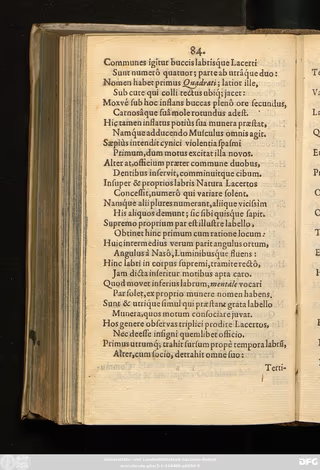
Therefore the muscles common to the cheeks and lips
Are four in number; two on either side:
The first has the name of Quadratus; it is broader,
Which lies everywhere covered beneath the skin of the neck:
And presently beneath this is the second, puffing out the cheeks with a full mouth,
And is round with its fleshy mass.
This one, however, rather performs its functions when inflated,
For every muscle acts by contracting.
Quite often the violence of a cynical spasm strains
The first, while it rouses unusual movements.
But the other, besides the duty common to both,
Serves the teeth, and breaks up the food.
Moreover, Nature has also granted to the lips their own muscles,
Which are accustomed to vary in number.
For some count more, and others in turn
Subtract some from these; thus each is wise in his own way.
A distinguished pair is proper to the upper lip,
Hence it rightly holds the first place:
An intermediate angle produces its true origin,
The angle descending from the nose and the eyes:
From here into the body of the upper lip, by a straight path,
The already mentioned flesh, fit for movements, is inserted.
The pair which moves the lower lip is usually called the mental pair,
Having its name from its proper function.
There are also those which at the same time perform pleasing functions for both lips,
Which delight in uniting their movement.
You observe that these muscles come forth in a threefold kind,
Nor is any lacking a notable function.
The first draws each lip upward near the temples,
The other, with its companion, draws everything downward:
The third wanders around the entire mouth, like a sphincter,
Drawing together the two lips in a virginal manner:
And the vessels suffuse the face with a purple fluid,
And bring favourable signs of beauty.
And that the lips, endowed with such swift sensation, swell,
Is brought about by the abundant offshoot of nerves sent hither.
Furthermore, how many muscles the lower jaw counts,
The continued series now bids to tell.
Behold! I will first present to you the pairs worthy of note,
Five of which the dissecting hand uncovers by art.
The first, with its companion, is called the Crotaphites muscle,
Which, itself the largest, surpasses the rest in strength;
This closes the opened mouth with its sinewy tendon,
When it undertakes to raise its jaw:
The one that follows in order is the first Manſorius,
Which as a grinder is accustomed to inhabit both cheeks:
The third, standing forward, prepared to move the necks,
Is wont to be called Alaris; but the exterior one:
For there is an interior one, the fourth, the other Manſorius,
Which equally raises the jaw, like a wing:
But whenever the fifth draws this, behold, downwards,
The closed mouth soon opens with a changing motion.
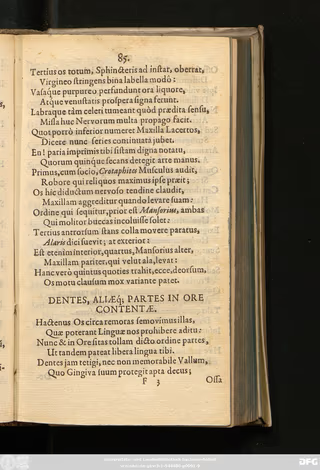
Tendimus ad portum, feſſis loca grata carinis,
Muſaq́ue finitum cernere anhelat opus.
Jamq́ue ſibi propriô meritas examine laudes
Lingua cani, nobis officioſa, cupit.
Quin cupit in minimas ſolvi pars optima partes,
Singula quò pateant muneris orſa ſui.
At mihi jam dudum ſiccis ea faucibus hæret,
Atq́ue premit laſſas ars repetita manus.
Ne tamen in mediâ ſudor fruſtretur arenâ,
Ac deſideriô ſpes cadat ipſa ſuô;
Quæ reſtant, peragam, Linguævé ſecabo receſſus,
Quicquid & eximii continet, omne dabo.
Sed quia diverſis prohibemur partibus Oris,
Quò minùs ad Linguam pes iteratus eat;
Nec ſolùm exteriùs, ſed & intrà os plurima Valli
Robora concurrunt, injiciuntq́ue moras;
Hæc prius è mediô ſuetâ removebimus arte,
Cunctaq́ue diſtinctis offeret ordo locis.
Infrà Oculos, Naſum pariter pars inter & Aurem
Occurrit, pomi cognita voce diu,
Et quoniam in multis rubro ſuffunditur orbe,
Creditur hac præſens ſede ſedere pudor.
Inferior ſed laxa magis pars Bucca vocatur,
Quandoquidem inflari, ceu patet, iſta valet.
Haut procul hinc reſidēt Myſtax & amabile Philtrũ,
Cumq́ue Ore extremô bina Labella tument.
Interiùs Maxilla duplex ſua ſymbola confert,
Robur & hinc ingens Oris hiatus habet,
Heîc benè munitis inſertos ordine Dentes
Alveolis, multùm visq́ue nitorq́ue probant.
Buccarum internum quàm plurima Glandia vultum
Obducunt, vaſis condecorata novis :
Sic labiorum etiam parvis velut ambitus uvis,
Glandula quas format multiplicata, tumet.
Hisq́ue iterum nova Vaſa, ſuos variantia ductus,
Jungi cum Nervis, diſtribuique ſolent.
Hîc oculis opus eſt ; quis enim tot Glandia verſu
Exprimat, & propriô nomine cuncta canat ?
Hactenus ignorat tot Vaſa recentia Pindus,
Ipſeque difficiles cernit Apollo modos ;
Scilicet ingenium Muſæ, Proſectio, vincis
Cultrô, & linguam dexteritate manûs !
Sit tibi, præcipuum noſtris nunc verſibus uſum,
Glandia quem præbent, enumerâſſe ſatis :
Nempè in proventum conſpirant cuncta Salivæ ;
Hoc parat, hoc purgat, provehit illud opes.
Hic ille eſt variis qui conſtat partibus Humor,
Sulphur ubi proprium, Sal ubi munus agit :
Hoc ſine Ventriculi nulla eſt digeſtio ſuccis,
Fermento primas datq́ue ſaliva notas.
Siſto gradum, dubitans ne me ſententia turbet,
Meq́ue ſuis ſalibus, ſulphure meq́ue premat :
Nam Medici certant, & adhuc ſub judice lis eſt,
Quam fruſtrà cultrô ſolvere dextra velit.
His igitur miſſis, cernamus porrò Lacertos,
Quorum Maxillæ & Labra moventur ope :
Et, licet à metricis abeant hæc nomina verbis,
Pars tamen officii vel meminiſſe quoq́ue eſt.
Communes igitur buccis labrisq́ue Lacerti
Sunt numerô quatuor; parte ab utrâque duo:
Nomen habet primus Quadrati; latior ille,
Sub cute qui colli tectus ubiq́; jacet:
Moxvé ſub hoc inflans buccas plenô ore ſecundus,
Carnosâque ſuâ mole rotundus adeſt.
Hic tamen inflatus potiùs ſua munera præſtat,
Namq́ue adducendo Muſculus omnis agit.
Sæpiùs intendit cynici violentia ſpaſmi
Primum, dum motus excitat illa novos.
Alter at, officium præter commune duobus,
Dentibus inſervit, comminuitque cibum.
Inſuper & proprios labris Natura Lacertos
Conceſſit, numerô qui variare ſolent.
Namq́ue alii plures numerant, aliique vicisſìm
His aliquos demunt; ſic ſibi quisque ſapit.
Supremo proprium par eſt illuſtre labello,
Obtinet hinc primum cum ratione locum:
Huic intermedius verum parit angulus ortum,
Angulus à Nasô, Luminibusq́ue fluens:
Hinc labri in corpus ſupremi, tramite rectô,
Jam dicta inſeritur motibus apta caro.
Quod movet inferius labrum, mentale vocari
Par ſolet, ex proprio munere nomen habens.
Sunt & utrique ſimul qui præſtant grata labello
Munera, quos motum conſociare juvat.
Hos genere obſervas triplici prodire Lacertos,
Nec deeſſe inſigni quemlibet officio.
Primus utrumq́; trahit ſurſum propè tempora labrũ,
Alter, cum ſocio, detrahit omne ſuo:
Tertius os totum, Sphincteris ad inſtar, oberrat,
Virgineo ſtringens bina labella modô:
Vaſaque purpureo perfundunt ora liquore,
Atque venuſtatis proſpera ſigna ferunt.
Labraque tàm celeri tumeant quòd prædita ſenſu,
Miſſa huc Nervorum multa propago facit.
Quot porrò inferior numeret Maxilla Lacertos,
Dicere nunc ſeries continuata jubet.
En! paria imprimis tibi ſiſtam digna notatu,
Quorum quinque ſecans detegit arte manus.
Primus, cum ſocio, Crotaphites Muſculus audit,
Robore qui reliquos maximus ipſe præit;
Os hic diductum nervoſo tendine claudit,
Maxillam aggreditur quando levare ſuam:
Ordine qui ſequitur, prior eſt Manſorius, ambas
Qui molitor buccas incoluiſſe ſolet:
Tertius antrorſum ſtans colla movere paratus,
Alaris dici ſuevit; at exterior:
Eſt etenìm interior, quartus, Manſorius alter,
Maxillam pariter, qui velut ala, levat:
Hanc verò quintus quoties trahit, ecce, deorſum,
Os motu clauſum mox variante patet.