Hover or tap a word to see its match.
Thus far we have removed those obstacles around the mouth,
Which could prohibit us from accessing the tongue:
Now I will also remove the parts situated in the mouth in the stated order,
So that finally the free tongue may lie open to you.
I have already touched upon the teeth, as well as the memorable rampart,
By which the apt gum protects its own ornament;
I consider them to be bones of their own kind, nor does the very sense
Of pain disagree, and their softness proves it.
You yourself see thirty-two in number, I believe,
And that the features of any one of these are dissimilar.
For I do not doubt at all that a more mature age
Has brought you the teeth with which we begin to be wise.
But pardon for the jokes! Now let us follow the threads to the goal,
And let us touch upon the rest of the things to be spoken of with a brief pen.
It is not solely the art of the cook to serve the fastidious Palate,
That art also pertains to our measures.
What this means, what that word intends, the matter itself will speak,
If it pleases you to properly note the base of the brain.
Like a couch, this lightly concave part of the mouth rises up,
For this reason there are those who call it the Heaven.
A soft Gland hangs from this foundation of the brain,
To which its shape perhaps gave the name of Uva.
It remains suspended by two tiny muscles,
And to these, behold, a double ligament is bound:
There are those to whom this part formerly seemed suited for voices,
Hence it was often called the plectrum of the voice;
But incorrectly; for when this is injured, the modulations of the voice
Are rarely completely impaired, if the rest are sound:
Why then will it not rather moderate the rushing ingress
Of the air, heavy with coldness?
For such air is accustomed to bring very many damages
To the tender Lung, causing Phthisis by its harshness.
Moreover there is another by no means ignoble use,
Which the Uvula, rejoicing in its prosperity, yields:
For this takes care lest the due amount of consumed drink
Should flow back into the nostrils from the wide open mouth.
With the tongue pressed down, and the opening of the mouth pulled wide,
Now the Fauces lie open to the hands and the eyes.
In this seat presents itself the most reliable base of the Tongue,
Which they therefore not infrequently call the Bone of the Throat;
It consists of various little bones, but that one is larger,
Under which a small part, the Epiglottis, has its location;
Of this you now, (which you know are called the Horns,)
Perceive two processes, and more things worthy to be sung:
However, the names of these are less compliant to the Muse,
And the matter should rather be subjected to your eyes.
Thus also it is a difficult labor to dissect the Muscles,
Which move the said bone, with the tongue in no way resisting.
The greatest part strives to have shown four pairs,
You may find those who will wish to number a fifth.
The first pair rests anteriorly on the shield-like part,
And draws the parts towards the lower regions:
Soon the short one that follows, filled with a fleshy mass,
Lurking beneath the chin, lifts the downward-pressed weights:
But the third ends in the horns of the just-mentioned bone,
And it is round, and slender, and moves it to the sides:
The fourth pair is also slender, but longer than that one,
This draws the part to the side and downwards.
The Muse indeed remembers the numbers, if only she could hold onto the words,
And what old name each Muscle has;
But since many things are incongruous with the Roman lyre,
She abstains from delays that will yield no profit.
It remains that I briefly enumerate, what is the truer utility
Of the bone of the Throat, and the labor of its office?
Namely, as has been said, it establishes the foundations of the Tongue,
Yet it does not entirely lack mobility.
Furthermore, it also marks the exit and origin for many
Muscles both of the tongue and of the larynx.
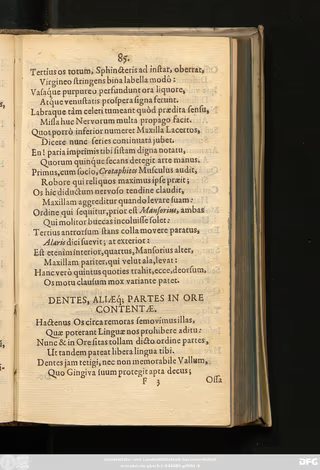
Hactenus Os circa remoras ſemovimus illas,
Quæ poterant Linguæ nos prohibere aditu:
Nunc & in Ore ſitas tollam dictô ordine partes,
Ut tandem pateat libera lingua tibi.
Dentes jam tetigi, nec non memorabile Vallum,
Quo Gingiva ſuum protegit apta decus;
Oſſa ſui generis reor eſſe, nec ipſe doloris
Diſſentit ſenſus, mollitiesque probat.
Ipſe vides numerô triginta, credo, duosque,
Diſſimilesque horum cuilibet eſſe notas.
Namque nihil dubito, tibi quin maturior ætas
Attulerit dentes, queis ſapere incipimus.
Sed ſalibus veniam! nunc metæ fila ſequamur,
Stringamusque brevi cœtera fanda ſtylô.
Ars non ſola coqui eſt, dubio ſervire Palato,
Ad noſtros etiam pertinet illa modos.
Quid ſibi, quid vox iſta velit, res ipſa loquetur,
Si cerebri placeat ritè notare baſin.
Ceu thorus, hæc oris leviter pars concava ſurgit,
Hac ſunt qui Cœlum de ratione vocant.
Mollis ab hoc cerebri fundamine Glandula pendet,
Uvæ cui nomen fortè figura dedit.
Exiguis, binisque manet ſuſpenſa Lacertis,
Hisque ligamentum nectitur, ecce, duplex:
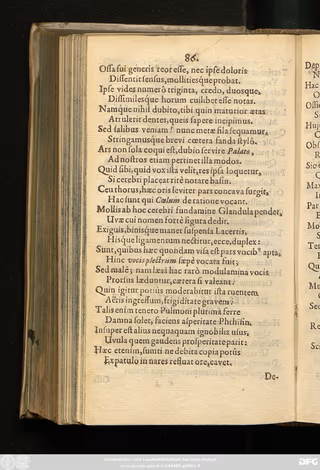
Sunt, quibus hæc quondam viſa eſt pars vocibꝰ apta,
Hinc vocis plectrum ſæpè vocata fuit;
Sed malè; nam læsâ hac rarò modulamina vocis
Prorſus læduntur, cætera ſi valeant:
Quin igitur potiùs moderabitur iſta ruentem
Aëris ingreſſum, frigiditate gravem?
Talis enìm tenero Pulmoni plurima ferre
Damna ſolet, faciens aſperitate Phthiſin.
Inſuper eſt alius nequaquam ignobilis uſus,
Uvula quem gaudens proſperitate parit:
Hæc etenìm, ſumti ne debita copia potûs
Expatulo in nares refluat ore, cavet.
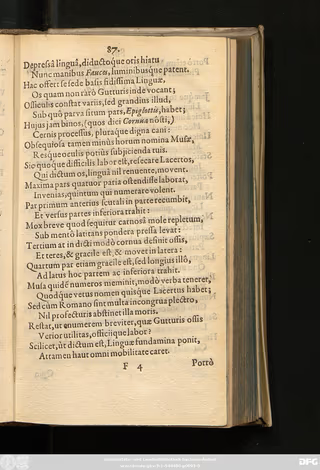
Depreſsâ linguâ, diductóque oris hiatu
Nunc manibus Fauces, luminibúsque patent.
Hac offert ſe ſede baſis fidiſſima Linguæ,
Os quam non rarò Gutturis indè vocant;
Oſſiculis conſtat variis, ſed grandius illud,
Sub quô parva ſitum pars, Epiglottis, habet;
Hujus jam binos, (quos dici Cornua nôſti,)
Cernis proceſſus, pluráque digna cani:
Obſequioſa tamen minùs horum nomina Muſæ,
Résque oculis potiùs ſubjicienda tuis.
Sic quoque difficilis labor eſt, reſecare Lacertos,
Qui dictum os, linguâ nil renuente, movent.
Maxima pars quatuor paria oſtendiſſe laborat,
Invenias, quintum qui numerare volent.
Par primum anterius ſcutali in parte recumbit,
Et verſus partes inferiora trahit:
Mox breve quod ſequitur carnosâ mole repletum,
Sub mentô latitans pondera preſſa levat:
Tertium at in dicti modò cornua deſinit oſſis,
Et teres, & gracile eſt, & movet in latera:
Quartum par etiam gracile eſt, ſed longius illô,
Ad latus hoc partem ac inferiora trahit.
Muſa quidẽ numeros meminit, modò verba teneret,
Quódque vetus nomen quísque Lacertus habet;
Sed cùm Romano ſint multa incongrua plectro,
Nil profecturis abſtinet illa moris.
Reſtat, ut enumerem breviter, quæ Gutturis oſſis
Verior utilitas, officiíque labor?
Scilicet, ùt dictum eſt, Linguæ fundamina ponit,
Attamen haut omni mobilitate caret.
Porrò etiam Muſclis tùm Linguæ, tùmque Laryngis,
Pluribus egreſſum, principiumq́ue notat.