Hover or tap a word to see its match.
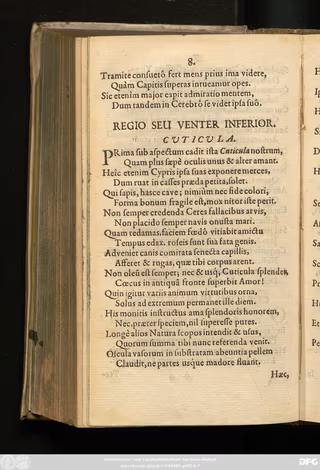
First to fall under our gaze is this Cuticle,
Which one or another often loves more than his own eyes.
For here Cypris herself is accustomed to display her wares,
Until the sought-after prey rushes into her nets.
You who are wise, beware of these; do not trust too much in color,
Beauty is a fragile good, soon that splendor perishes.
Ceres is not always to be entrusted to deceptive fields,
Nor a laden ship always to a calm sea.
The face that you love in return, devouring Time will spoil with a foul garment.
Rosy cheeks have their own fates.
Old age will arrive, accompanied by white hair,
And will bring wrinkles, which will plow your body.
There is not always oil; nor does the Cuticle always shine,
Blind Love prides himself on an ancient brow!
Rather, therefore, adorn your mind with various virtues,
It alone remains to the final day.
Instructed by these warnings, love the honor of its splendor,
And do not think that, beyond appearances, nothing remains.
Nature intends far different aims and uses,
The sum of which must now be recounted to you.
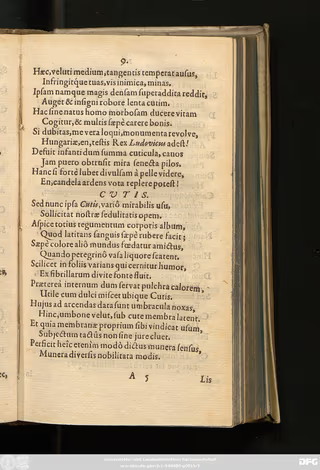
It closes the mouths of the vessels going into the underlying skin,
Lest the parts constantly flow with moisture.
This, like a medium, tempers the boldness of the one touching,
And breaks your threats, O hostile force.
For, added on top, it renders the skin itself denser,
And, being pliant, enhances the skin with remarkable strength.
A human born without this is forced to lead a diseased life,
And often to lack many goods.
If you doubt that I speak the truth, turn over the records,
Behold, King Louis of Hungary is present as a witness!
While the outermost cuticle was lacking to the infant, a wondrous old age
Thrust hoary hairs upon him already as a boy.
If by chance it pleases you to see this torn away from the skin,
Behold, a burning candle can fulfill your wishes!
PRima ſub aſpectum cadit iſta Cuticula noſtrum,
Quam plùs ſæpè oculis unus & alter amant.
Heîc etenim Cypris ipſa ſuas exponere merces,
Dum ruat in caſſes præda petita, ſolet.
Qui ſapis, hasce cave; nimiùm nec fide colori,
Forma bonum fragile eſt, mox nitor iſte perit.
Non ſemper credenda Ceres fallacibus arvis,
Non placido ſemper navis onuſta mari.
Quam redamas, faciem fœdô vitiabit amictu
Tempus edax. roſeis ſunt ſua fata genis.
Adveniet canis comitata ſenecta capillis,
Afferet & rugas, quæ tibi corpus arent.
Non oleũ eſt ſemper; nec & usq́; Cuticula ſplendet,
Cœcus in antiquâ fronte ſuperbit Amor!
Quin igitur variis animum virtutibus orna,
Solus ad extremum permanet ille diem.
His monitis inſtructus ama ſplendoris honorem,
Nec, præter ſpeciem, nil ſupereſſe putes.
Longè alios Natura ſcopos intendit & uſus,
Quorum ſumma tibi nunc referenda venit.
Oſcula vaſorum in ſubſtratam abeuntia pellem
Claudit, ne partes usq́ue madore fluant.
Hæc, veluti medium, tangentis temperat auſus,
Infringitq́ue tuas, vis inimica, minas.
Ipſam namque magis denſam ſuperaddita reddit,
Auget & inſigni robore lenta cutim.
Hac ſine natus homo morboſam ducere vitam
Cogitur, & multis ſæpè carere bonis.
Si dubitas, me vera loqui, monumenta revolve,
Hungariæ, en, teſtis Rex Ludovicus adeſt!
Defuit infanti dum ſumma cuticula, canos
Jam puero obtruſit mira ſenecta pilos.
Hanc ſi fortè lubet divulſam à pelle videre,
En, candela ardens vota replere poteſt!