Hover or tap a word to see its match.
Part 1
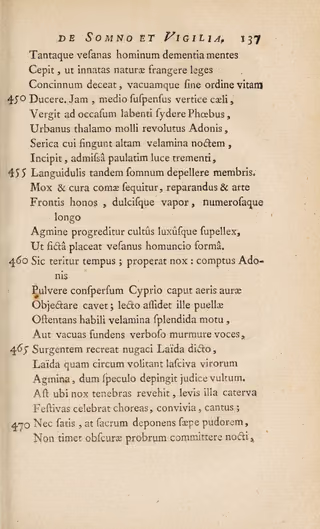
And such great madness has seized the insane minds of men,
That it seems fashionable to break the innate laws of nature,
And to lead an empty life without order.
Already, suspended from the middle summit of the sky,
Phoebus inclines toward his setting as his star glides down;
The urban Adonis, rolling over in his soft bedchamber,
For whom silken curtains fashion deep night,
Begins, as the trembling light is gradually admitted,
To drive sleep at last from his languid limbs.
Soon follows the care of his hair, and the grace of his brow
To be restored by art, and sweet perfume, and a numerous
Apparatus of adornment and luxury advances in a long train,
So that the insane little man may please with a feigned beauty.
Thus time is wasted; night hastens on: the coiffed Adonis
Takes care not to expose his head, sprinkled with Cyprian powder,
To the breeze of the air; he sits by a girl's bed,
Showing off his splendid garments with a deft motion,
Or pouring forth empty words in a verbose murmur,
He amuses the rising Lais with trifling talk,
Lais, around whom flutter lascivious throngs
Of men, while she paints her face with the mirror as judge.
But when night brings back the darkness, that frivolous crowd
Celebrates festive dances, banquets, songs;
Nor is this enough, for, often laying aside sacred modesty,
It does not fear to entrust to the dark night a disgrace,
Tantaque veſanas hominum dementia mentes
Cepit , ut innatas naturæ frangere leges
Concinnum deceat , vacuamque ſine ordine vitam
Ducere. Jam , medio ſuſpenſus vertice cæli ,
Vergit ad occaſum labenti ſydere Phœbus ,
Urbanus thalamo molli revolutus Adonis ,
Serica cui fingunt altam velamina noctem ,
Incipit , admiſsâ paulatim luce trementi ,
Languidulis tandem ſomnum depellere membris.
Mox & cura comæ ſequitur , reparandus & arte
Frontis honos , dulciſque vapor , numeroſaque
longo
Agmine progreditur cultûs luxûſque ſupellex,
Ut fictâ placeat veſanus homuncio formâ.
Sic teritur tempus ; properat nox : comptus Ado-
nis
Pulvere conſperſum Cyprio caput aeris auræ
Objectare cavet ; lecto aſſidet ille puellæ
Oſtentans habili velamina ſplendida motu ,
Aut vacuas fundens verboſo murmure voces ,
Surgentem recreat nugaci Laïda dicto ,
Laïda quam circum volitant laſciva virorum
Agmina , dum ſpeculo depingit judice vultum.
Aſt ubi nox tenebras revehit , levis illa caterva
Feſtivas celebrat choreas , convivia , cantus ;
Nec ſatis , at ſacrum deponens ſæpe pudorem ,
Non timet obſcuræ probrum committere nocti,
Part 2
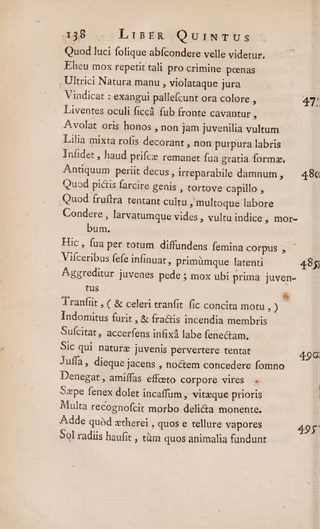
Which it seems to wish to hide from the light and the sun.
Alas, Nature with an avenging hand soon exacts punishment
For such a crime, and vindicates her violated laws:
The face grows pale with a bloodless hue,
The livid eyes are hollowed beneath a dry brow,
The beauty of the face flies away, no longer do youthful
Lilies mixed with roses adorn the countenance, no purple sits
Upon the lips, nor does the grace of its former beauty remain.
The ancient comeliness has perished, an irreparable loss,
Which with painted cheeks, or curled hair,
Which with adornment and much labor they try in vain
To hide, and you see, with the face as an index, the masked disease.
This, spreading its seeds through the whole body,
Insinuates itself into the entrails, and at first with a stealthy
Foot attacks the young; soon, when first youth
Has passed, (and thus roused, it passes with swift motion,)
Untamed it rages, and stirs up fires in the broken
Limbs, summoning old age with a deeply fixed taint.
Thus the youth who tries to pervert the commands
Of nature, and lying in bed by day, refuses to yield the night
To sleep, often as an old man mourns in vain his lost
Strength in an exhausted body, and recognizes
Many transgressions of his former life, with disease as a monitor.
Add to this that the ethereal vapors, which from the earth
The sun has drawn with its rays, then those which animal
Quod luci ſolique abſcondere velle videtur.
Eheu mox repetit tali pro crimine pœnas
Ultrici Natura manu, violataque jura
Vindicat: exangui palleſcunt ora colore,
Liventes oculi ſiccâ ſub fronte cavantur,
Avolat oris honos, non jam juvenilia vultum
Lilia mixta roſis decorant, non purpura labris
Inſidet, haud priſcæ remanet ſua gratia formæ.
Antiquum periit decus, irreparabile damnum,
Quod pictis ſarcire genis, tortove capillo,
Quod fruſtra tentant cultu, multoque labore
Condere, larvatumque vides, vultu indice, mor-
bum.
Hic, ſua per totum diffundens ſemina corpus,
Viſceribus ſeſe inſinuat, primùmque latenti
Aggreditur juvenes pede; mox ubi prima juven-
tus
Tranſiit, (& celeri tranſit ſic concita motu,)
Indomitus furit, & fractis incendia membris
Suſcitat, accerſens infixâ labe ſenectam.
Sic qui naturæ juvenis pervertere tentat
Juſſa, dieque jacens, noctem concedere ſomno
Denegat, amiſſas effœto corpore vires
Sæpe ſenex dolet incaſſum, vitæque prioris
Multa recognoſcit morbo delicta monente.
Adde quòd ætherei, quos e tellure vapores
Sol radiis hauſit, tùm quos animalia fundunt
Part 3
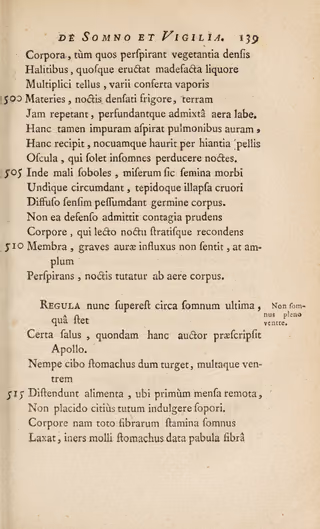
bodies, and those which plants breathe out in dense
exhalations, and those which the earth, soaked with manifold
moisture, belches forth—a crowded mass of varied
vapor—condensed by the chill of night, now
return to the earth, and steep the air with an admixed taint.
Yet this impure air he breathes in with his lungs,
this he receives, and draws in the noxious breeze through the gaping pores
of his skin, who is accustomed to pass sleepless nights.
Thence comes a brood of evil; thus the seeds of disease
surround the wretched man on all sides, and gliding into the warm blood,
with their diffused germ they gradually ruin the body.
The prudent man does not admit these contagions into his defended
body, who, hiding his limbs at night in his bed and covers,
does not feel the heavy influxes of the air, but breathing out
freely, protects his body from the air of night.
Corpora, tùm quos perſpirant vegetantia denſis
Halitibus, quoſque eructat madefacta liquore
Multiplici tellus, varii conferta vaporis
Materies, noctis denſati frigore, terram
Jam repetant, perfundantque admixtâ aera labe.
Hanc tamen impuram aſpirat pulmonibus auram,
Hanc recipit, nocuamque haurit per hiantia pellis
Oſcula, qui ſolet inſomnes perducere noctes.
Inde mali ſoboles, miſerum ſic ſemina morbi
Undique circumdant, tepidoque illapſa cruori
Diffuſo ſenſim peſſumdant germine corpus.
Non ea defenſo admittit contagia prudens
Corpore, qui lecto noctu ſtratiſque recondens
Membra, graves auræ influxus non ſentit, at am-
plum
Perſpirans, noctis tutatur ab aere corpus.