Hover or tap a word to see its match.
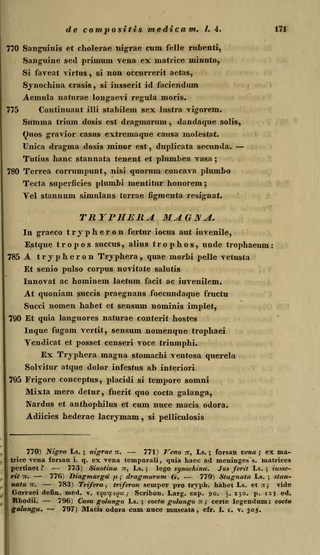
In Greek, *trypheron* is said to mean a jest or a youthful thing,
And *tropos* is juice, another is *trophos*, from which comes trophy:
From *trypheron* comes *Tryphera*, which, with the old skin of disease
And old age driven off, renews the body with the novelty of health
And makes a man joyful and youthful.
But since, pregnant with juices and fecund with fruit,
It has the name of juice and fulfills the meaning of the name,
And because it wears down weaknesses, the enemies of nature,
And puts them to flight, it claims the meaning and name of a trophy,
And could be judged by the word of triumph.
By *Tryphera magna* the windy complaint of the stomach
Is resolved, as well as the hostile pain conceived from inner
Cold, if at the time of peaceful sleep
It is given mixed with unmixed wine, in which galangal has been cooked,
Spikenard and clove and fragrant mace with nut.
You shall add the tear of ivy, if in the membranous
The force of the pain is shut up in the hiding places of the stomach.
It is beneficial to those suffering from rheum with the powder of frankincense mixed into it,
And offers sleep to those keeping awake from black bile,
When, after the *phrenesis* has been dispelled, the fever now being resolved,
A surviving fantastic affliction agitates the brain,
Wearying the ever-watchful eyes in a sleepless night,
*Tryphera*, mixed with seeds of white poppy
And given with warm water, in which mandrake bark
Will have been cooked, restores sleep and lulls the brain to sleep. —
When days have been fulfilled by a correct reckoning of the number,
Fourteen, when now the rupture of the swelling
Emits sanies, taken with the wine of myrrh
It wards off the causes of empyema from peripneumonic patients. —
If a preceding purgation has been suitable to the cause,
Taken, it cures lientery born from phlegm.
Drunk with bitter substances, it kills ascarids,
With southernwood, rue, and lesser centaury.
If, committed to the liquid of a uterine herb,
It is either applied as a suppository or drunk mixed with wine,
It cultivates the sterile field of nature, and with generative
Fruitfulness fills it, while it cuts away whatever is harmful,
The cells besieged by mud and foul bitumen
It ploughs out and cleanses and discharges its dues,
So that the clean furnishings of the womb,
More promptly receiving the injected seed within its enclosures, may mint it.
Let the woman renew twice during the night a suppository
Made from *Tryphera*, when *cacochymia* lubricates the villi,
And lets go the fugitive seed, of the passages
The slipperiness, when the moisture of thick mucilage
Corrupts the seed, and brings in the defect of putrefaction,
When it shuts in the menses in the constricted veins,
The chamber of childbirth, having been thickened by cold stiffness.
Retaining the fellowship of Theban opium, for cold causes
it is not effective, but to whomever the devoted and
pleasing temperament of poppy smiles, it is suitable for them,
and it afflicts the limbs with less harsh cold.
Platearius, a doctor of the medical art,
celebrated its work and the form of compounding it and its use. —
If burning heat should distemper a barren belly,
if dryness should wrinkle the empty membranes,
if a hard scar drinking the fomentations of the limbs
and calloused skin hinder the flow of blood
to be purged, the use of great Tryphera is not suitable,
nor do warm species nor aromatics benefit this hot cause. —
After great Tryphera has completed two years,
previously potent, it falls from the goodness of its first vigor.
In graeco *trypheron* fertur iocus aut iuvenile,
Estque *tropos* succus, alius *trophos*, unde trophaeum:
A *trypheron* Tryphera, quae morbi pelle vetusta
Et senio pulso corpus novitate salutis
Innovat ac hominem laetum facit ac iuvenilem.
At quoniam succis praegnans foecundaque fructu
Succi nomen habet et sensum nominis implet,
Et quia languores naturae conterit hostes
Inque fugam vertit, sensum nomenque trophaei
Vendicat et posset censeri voce triumphi.
Ex Tryphera magna stomachi ventosa querela
Solvitur atque dolor infestus ab interiori
Frigore conceptus, placidi si tempore somni
Mixta mero detur, fuerit quo cocta galanga,
Nardus et anthophilus et cum nuce macis odora.
Adiicies hederae lacrymam, si pelliculosis
In stomachi latebris vis est conclusa doloris.
Confert rheumaticis mixto sibi pulvere thuris
Et somnum ex cholera nigra vigilantibus offert,
Cum post discussam phrenesim, iam febre soluta,
Exagitat cerebrum phantastica poena superstes
Pervigiles oculos insomni nocte fatigans,
Tryphera seminibus commixta papaveris albi
Et data cum tepida, qua cortex mandragoratus
Coctus erit, somnum reparat cerebrumque soporat. —
Expletis recta numeri ratione diebus
Quatuor et denis, cum iam ruptura tumoris
Emittit saniem cum myrrhae sumta Lyaeo
A peripleumonicis causas empimatis arcet. —
Praevia si fuerit purgatio congrua causae
Sumta lienteriam curat de phlegmate natam.
Ascarides potata necat cum rebus amaris
Abrotano, ruta, centaureaque minori.
Si matricalis herbae mandata liquori
Vel supponatur vel vino mixta bibatur,
Agrum naturae sterilem colit, et geniali
Ubertate replet, dum noxia quaeque rescindit,
Obsessas limo turpique bitumine cellas
Exarat et mundat et vectigalia solvit,
Semen ut iniectum matricis munda supellex
Promtius excipiens intra sua claustra monetet.
Bis renovet mulier per noctem suppositivum
Ex Tryphera factum, quando cacochymia villos
Lubricat et profugum dimittit sperma viarum
Lubricitas, grossae cum muscillaginis humor
Semen corrumpit, vitiumque putredinis infert,
Quando coarctatis concludit menstrua venis
Cella puerperii gelida densata rigore.
Thebaici retinens opii consortia causis
Non valet in gelidis, sed cui devota miconis
Grataque temperies arridet convenit illis
Et minus austero contristat frigore membra.
Eius opus medicae doctor Platearius artis
Et componendi formam celebravit et usum. —
Si calor exurens sterilem distemperet alvum,
Ariditas si membranas corruget inanes,
Membrorum fomenta bibens si dura cicatrix
Et callosa cutis purgandi sanguinis arcet
Profluvium, Trypherae magnae non congruit usus,
Nec calidae huic causae species nec aromata prosunt. —
Tryphera magna duos postquam compleverit annos
Ante potens primi cadit a bonitate vigoris.