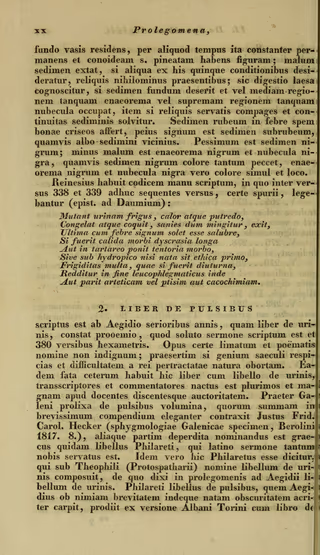
Mutant urinam frigus, calor atque putredo,

Form
Hexameter
Open the page in the book
The page this poem fills. Each opens in the Aegidii Corboliensis carmina medica reader.

Hover or tap a word to see its match.

Cold, heat, and putrefaction change the urine,

It congeals and concocts, while pus is passed, it exits,

The last with a fever is usually a wholesome sign,

If the hot dyscrasia of the disease has been lengthy

Or pitches its tents in a tartareous disease,

Or under a dropsical one, unless hectic was born first,

Much coldness, which if it has been long-lasting,

From it one is rendered leucophlegmatic in the end

Or it produces an arthritic condition or phthisis or cacochymia.

*Mutant urinam frigus, calor atque putredo,*

*Congelat atque coquit, sanies dum mingitur, exit,*

*Ultima cum febre signum solet esse salubre,*

*Si fuerit calida morbi dyscrasia longa*

*Aut in tartareo ponit tentoria morbo,*

*Sive sub hydropico nisi nata sit ethica primo,*

*Frigiditas multa, quae si fuerit diuturna,*

*Redditur in fine leucophlegmaticus inde*

*Aut parit arteticam vel ptisim aut cacochimiam.*
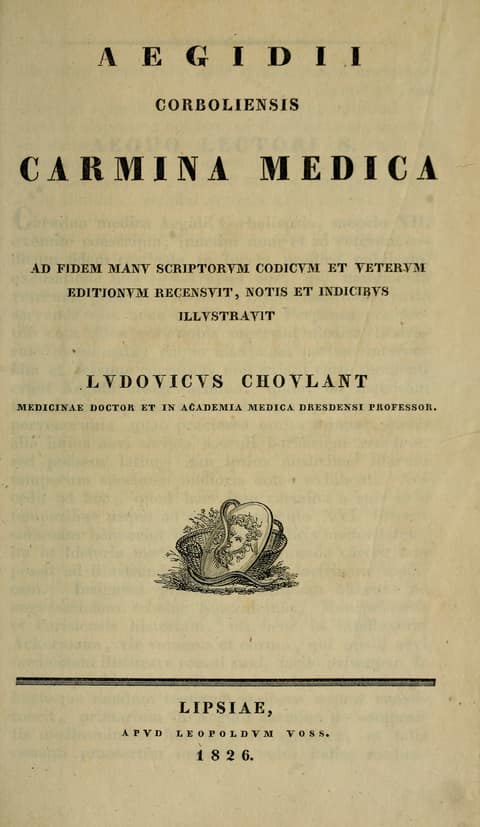
Title page of Aegidii Corboliensis carmina medica
Title page of Aegidii Corboliensis carmina medica , 1826

About this text

Provenance

This digital edition is derived from the Internet Archive copy of Ludwig Choulant's 1826 edition of Aegidii Corboliensis carmina medica, preserving medieval Latin medical poems attributed to Aegidius Corboliensis.

Methodology

Each scan is treated as a page-level unit. The page image remains the authority for the edition. Local Kraken OCR was used as a Latin-print reading aid, then Gemini generated scan-grounded Latin transcription and English translation from the images, the OCR aid, and the approved glossary. Word links connect the English translation to the Latin transcription and locations on the scans. 9 uncertain word-link decisions remain unlinked. Some links highlight only the text because the source word could not be located on the scan.

Rights

The source work is in the public domain by publication age. The local rights evidence points to a Public Domain Mark record for the Internet Archive-derived file. Poet Doctor's presentation adds generated OCR, transcription, translation, navigation metadata, and editorial context.

Original scans: Countway Library / Medical Heritage Library copy via Internet Archive ( Public Domain Mark 1.0 ).

Historian’s note. This text records the medicine of its own time, and later evidence has replaced most of it. It is not medical advice. We read it as history, and we ask what, if anything, connects it to medicine today. More on how we read old medical books