Hover or tap a word to see its match.
Twice ten colors can vary the urine
Which you will be able to weigh from the forms written below. —
A *blacker* appearance of urine resolves the troubles of a quartan
Fever, portends death, burns.
If a black humor settling depresses itself to the bottom
The womb is purged as a bilge of much flux.
In fever, black, fetid, scanty, *fatty* [urine] brings death,
With a defect of the bladder and kidneys completely removed. —
Abundant [urine] on a critical day, which a black and pendulous cloud
Darkens more broadly, and a swimming sediment makes turbid,
With the ears oppressed, the peace of sleep disturbed
Signifies a future bloody flux from the nose,
But if signs of evil or of health concur,
It condemns the sick man to a judgment of death or liberates him. —
Preserving the congruous bonds of mixture with the thick,
The blackness shuns the union of a subtle liquor,
That it should tolerate a thin one, which does not cling of the same color as itself,
An event obtains, and a violent chance brings about:
The closed drawing-off of the passages, obstructed not a little. —
If it should be livid, the lividity will be either partial
Or total; livid throughout: it shows that a member
Or the humor of a member is mortifying;
But livid at the top is suited to various causes:
A minor hemitritaeus, a medium one, and the falling sickness,
Ascites, synochus, the rupture of a vein, catarrh,
An attack of strangury, suffering of the matrix, a flux,
A defect of the rib or lung, articular pain,
Consumptive phthisis, a force extinguishing heat,
Let these be the causes of lividity for you, which you should gather from signs.
A very small amount, scarcely voided, livid, oily [indicates] death;
Livid, scant, frequent [urine] indicates strangury;
Lividity with separate and minute grains
Constantly speaks of a spiritual illness;
Atomous lividity proves an articular illness,
It is also a faithful messenger of a rheumatic illness.
If the matrix has oppressed the vertebrae or the diaphragm,
A livid color infects the border of the urine. —
A thin urine joined to a white color [indicates]
The spleen, dropsy, intoxication, nephritis, phrenesis, diabetes,
Arthritis, and black cholera, paedicon, scotomia,
Coldness of the liver, with the burning heat of a fever [foretells] death;
In an old man fragile strength, or a boyish defect,
In those injured in the shoulders or neck, lipothymia;
Declares quartan fever and amphimerine,
Notes various complaints of the womb in a woman,
This indicates hemorrhoids and condylomata.
(White, passed frequently, thin, prolonged resolution
Of flesh: if they occur together, they notify diabetes.)
So that a deceptive error does not introduce itself into the judgments
Such [urine] can be called raw and undigested.
A clearer white [urine], with no crisis preceding, reveals
Straightaway delirium: delirium brings about death. —
(Glaucous or white, leaden around, notes hieranosos).
Admitting no commerce with thick fluid,
In judgment, the glaucous color is a rival to white,
But it offends less the rights of innate heat.
If it is moderately thin, or moderately
Glaucous or white, it notes an excess of sharp phlegm;
Glaucous is a conscious witness of a melancholic crasis.
Somewhat thin milky [urine] in the burning heat of an acute fever,
Joined with sinister signs at the onset of the conflict,
Condemns and accuses the patient with the charge of death;
The judgment of the urine is deceived, if for you in a certain
Order the vital signs concur:
Mind, sleep, appetite, good respiration, strength.
Somewhat thin milky [urine], poured out with copious fluid
Coming at the end of the disease, with the heat subsiding
Resolves and emancipates the sick person from the snares of the disease;
In a fever, which a typical deviation repeats and interrupts,
A somewhat thin milky [urine] dictates that its cause is
Cold, about to produce the pressure of a long hardship.
A somewhat thin milky [urine] as the fever declines
Obtains health and relieves the body and restores life.
A whitish *charopos* or thick milky [urine] represents
Dropsy, colic, stone, and headache,
An excess of phlegm, rheums of the limbs, flux,
Such a mixture dissolves the cause of an apostasis.
(A milky or *charopos* [urine] is never found thin.) —
Often the substance of the urine becomes distinct, its appearance
Unequal, so that the bottom differs from the middle or top:
A thick top, middle, or bottom surface
Disturbs the top, or middle, or bottom part,
And a similar region serves a similar region,
In the rest the general reasoning is entirely similar. —
A *pallid* [urine] with a fatty or somewhat citrine liquor
Shows the periodic chills of a phlegmatic fever.
A pallid [urine] with a thin [liquor] declares burnt choler,
A pallid somewhat thin [urine] a fever from acrid phlegm.
A pallid [urine] to which a moderately thick [substance] is associated
Is proven a faithful interpreter of a phlegmatic crasis.
If in a badly disposed body a glaucous,
Milky, or *charopos* [urine] precedes and a pallid one is seen afterward:
By the sign of pallor nature resumes its strength
And the digestive force returns to its proper course.
In a slow continuous fever a clear somewhat pallid [urine]
The weight of a future apostasis in the right part
It indicates [this], with the condition constant and vigor flourishing.
If a flux of the belly is absent, and does not assail the bowels,
pale, foamy, fatty, livid, ash-colored,
scanty [urine] becomes a not discordant witness of the phthisic plague;
If a flux is added, death enters, life departs. —
Crudity and emphraxis, flux, consumption, indicate
*scanty* urine, the opposite condition *abundant*. —
Thin *citrine* [urine] filled with many figures
condemns the phlegmatic youth, or him whom black humor afflicts,
to a tertian [fever]; it hinders the years of an old man with a double one;
a boy with a continuous one; a youth, in whom bile dominates,
it portends as healthy and marks with his proper character.
A wandering quartan fever produces such [urine]
preferably in autumn and during the winter hours.
It confesses faults of the thorax, spleen, and liver:
an injury of the chest, [if it is] covered with separated grains,
the spleen, if it gleams striped with many rays,
a large effusion of liquid shows a dry liver.
In continuous fever under the threshold of the disease such [urine]
by prolonging the evil brings detriments to vigor,
in the middle it shows phrenesis, near the end of the duel
it designates that the treaties of a critical peace are formed.
(If it endures for a long time either the liver or the spleen
is oppressed or a quartan or wandering fever is present.)
The union of phlegm and choler, which it produces, renders
The bordering humor of citron thin and citrine:
More thin when raw, and less thin when dissolved,
More intense with fever, remiss without fever. —
A color verging on red, rivaling pure gold,
To which an equal, pure, intermediate liquor unites itself,
Announces the robust actions of a well-tempered body.
In a boy, youth, old man, phlegmatic, woman,
Remaining red and thin, it denotes these troubles of fever:
Continuous, tertian, double; but over a long time
An offense of the liver, or a quartan fever. —
At the beginning of the cause, while the seeds of the disease are new,
Red, somewhat thin, the highest region of which
A rare cloud occupies, generated by the motion of heat,
It kindles a typical fever from salty phlegm;
But it figures a tertian as the disease now progresses.
Somewhat thick, now not a tertian, rather a remittent
Fever it indicates from salty or sweet phlegm.
But the biting humor of salty phlegm abounds
And raging without fever it excites enormous actions,
Pricking the extreme parts with the sharpness of heat,
If it becomes sub-red, somewhat thin, not cloudy,
And preserves such a form over a constant time;
Such is portended as fatal to a dropsical patient.
Slightly red, *thick*, retaining the shadows of a cloud
indicates that a fever from sweet phlegm is being kindled;
If the color remains below and the substance is consistent,
an excess of sweet phlegm without fever is noted.
Slightly red, thin or thick, remaining livid,
shows by certain reasoning that the parts by which breathing occurs
are burdened by sweet or salty phlegm;
In a woman it rather portends defects of the *moneta*.
If the color is red, the substance thick, it signifies
a continuous fever from phlegm holding the vessels;
It can be disposed thick and of red color,
with a rheumatic complaint holding a weak limb,
If the cause is recent and lividity overshadows the top:
Either the minor is intimated, or pleurisy is indicated;
If old: ascites or rather empyema is noted.
If it becomes more foamy, and a rival of ash color,
distinctly livid, mild sub-red:
the disease of the side travels to the places of the lung.
Thick, slightly red, livid, oily, covered with bran-like particles
it becomes a faithful envoy of hectic fever. —
Clear *red* can intimate a double tertian, or a heated liver,
and a quartan type.
This duration or brevity, cloud, season, condition, age,
These the affliction, form, and location of the sick person demonstrate:
So that the sentence may proceed with a stable foot, all these things
Must be examined by your judgment. —
Turbid, somewhat thick, suffused with a red color,
A certain knowledge of a continuous hemitritaeus is given;
If greenness should occupy the top, or a livid cloud,
It portends a medium hemitritaeus or a pleuritic illness;
Thick and red figures a synochus, if lividness overshadows the top;
Thick and red figures a synocha, with lividness removed;
A causonides, if it is more thin than thick; conversely,
A synochides; thin and fiery shows a causon,
The appearance of a *rubicund* color is a more certain witness. —
If the color is *inopos*, it brings detriments to health
In a continuous fever; it is less to be feared without a fever,
For a caustic humor inflames the kidneys or liver,
Or the chilis is ruptured, or exuding from a broken vessel,
Menstrual blood is drawn out from a woman's body.
In a healthy body, leaping disposes it to be such,
Or excessive intercourse, running, immoderate labor. —
*Kyanos* is not degenerating from the law of the former. —
Agriaca, spasm, a greater one, and finally death
Urine dyed with a *leek-green* color indicates.
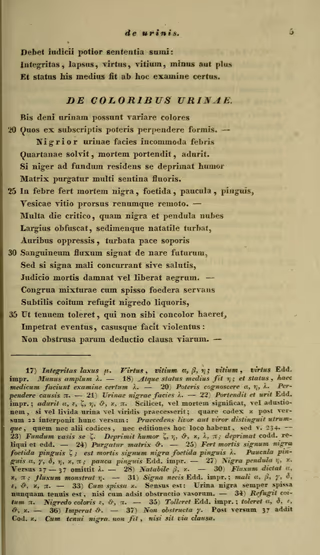
Bis deni urinam possunt variare colores
Quos ex subscriptis poteris perpendere formis. —
*Nigrior* urinae facies incommoda febris
Quartanae solvit, mortem portendit, adurit.
Si niger ad fundum residens se deprimat humor
Matrix purgatur multi sentina fluoris.
In febre fert mortem nigra, foetida, paucula, pinguis,
Vesicae vitio prorsus renumque remoto. —
Multa die critico, quam nigra et pendula nubes
Largius obfuscat, sedimenque natatile turbat,
Auribus oppressis, turbata pace soporis
Sanguineum fluxum signat de nare futurum,
Sed si signa mali concurrant sive salutis,
Iudicio mortis damnat vel liberat aegrum. —
Congrua mixturae cum spisso foedera servans
Subtilis coitum refugit nigredo liquoris,
Ut tenuem toleret, qui non sibi concolor haeret,
Impetrat eventus, casusque facit violentus:
Non obstrusa parum deductio clausa viarum. —
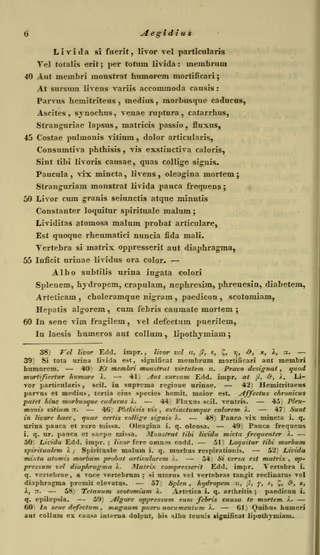
Livida si fuerit, livor vel particularis
Vel totalis erit; per totum livida: membrum
Aut membri monstrat humorem mortificari;
At sursum livens variis accommoda causis:
Parvus hemitriteus, medius, morbusque caducus,
Ascites, synochus, venae ruptura, catarrhus,
Stranguriae lapsus, matricis passio, fluxus,
Costae pulmonis vitium, dolor articularis,
Consumtiva phthisis, vis exstinctiva caloris,
Sint tibi livoris causae, quas collige signis.
Paucula, vix mincta, livens, oleagina mortem;
Stranguriam monstrat livida pauca frequens;
Livor cum granis seiunctis atque minutis
Constanter loquitur spirituale malum;
Lividitas atomosa malum probat articulare,
Est quoque rheumatici nuncia fida mali.
Vertebra si matrix oppresserit aut diaphragma,
Inficit urinae lividus ora color. —
Albo subtilis urina iugata colori
Splenem, hydropem, crapulam, nephresim, phrenesin, diabetem,
Arteticam, choleramque nigram, paedicon, scotomiam,
Hepatis algorem, cum febris caumate mortem;
In sene vim fragilem, vel defectum puerilem,
In laesis humeros aut collum, lipothymiam;
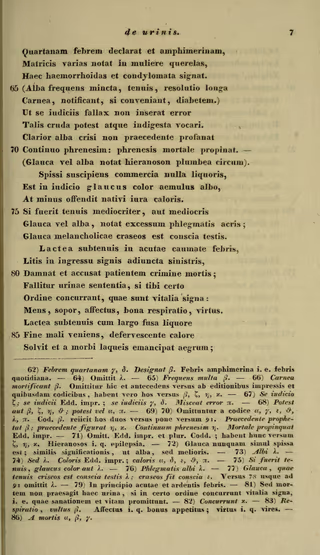
Quartanam febrem declarat et amphimerinam,
Matricis varias notat in muliere querelas,
Haec haemorrhoidas et condylomata signat.
(Alba frequens mincta, tenuis, resolutio longa
Carnea, notificant, si conveniant, diabetem.)
Ut se iudiciis fallax non inserat error
Talis cruda potest atque indigesta vocari.
Clarior alba crisi non praecedente profanat
Continuo phrenesim: phrenesis mortale propinat. —
(Glauca vel alba notat hieranoson plumbea circum).
Spissi suscipiens commercia nulla liquoris,
Est in iudicio glaucus color aemulus albo,
At minus offendit nativi iura caloris.
Si fuerit tenuis mediocriter, aut mediocris
Glauca vel alba, notat excessum phlegmatis acris;
Glauca melancholicae craseos est conscia testis.
Lactea subtenuis in acutae caumate febris,
Litis in ingressu signis adiuncta sinistris,
Damnat et accusat patientem crimine mortis;
Fallitur urinae sententia, si tibi certo
Ordine concurrant, quae sunt vitalia signa:
Mens, sopor, affectus, bona respiratio, virtus.
Lactea subtenuis cum largo fusa liquore
Fine mali veniens, defervescente calore
Solvit et a morbi laqueis emancipat aegrum;
In febre, quam replicat typicusque interpolat error,
Lactea subtenuis dictat, quod causa sit eius
Frigida, pressuram longi factura laboris.
Lactea subtenuis febre declinante salutem
Impetrat et corpus relevat vitamque refirmat.
Albescens *charopos* vel lactea spissa figurat
Hydropisim, colicam, lapidem, capitisque dolorem,
Phlegmatis excessum, membrorum rheumata, fluxum,
Talis apostaseos causam complexio solvit.
(Lactea vel charopos nunquam tenuis reperitur.) —
Saepe fit urinae distans substantia, vultus
Dispar, ut a medio vel summo discrepet imum:
Summa superficies, mediana vel infima spissa
Summam vel mediam, vel partem concutit imam,
Et similis simili servit regio regioni,
In reliquis est consimilis ratio generalis. —
*Pallida* cum pingui vel subcitrina liquore
Phlegmaticae monstrat periodica frigora febris.
Pallida cum tenui choleram declarat adustam,
Pallida subtenuis ex acri phlegmate febrem.
Pallida cui spissum mediocriter associatur
Phlegmaticae craseos interpres fida probatur.
Si male disposito praecedat corpore glauca
Lactea vel charopos et pallida post videatur:
Signo palloris vires natura resumit
Et redit ad proprium vis digestiva tenorem.
In febre continua lenta subpallida clara
Pondus apostaseos in dextra parte futurum
Indicat, affectu constante, vigore vigente.
Si fluor absentet ventris, nec viscera tentet,
Pallida, spumosa, pinguis, livens, cinerosa,
Paucula fit pestis phthisicae non absona testis,
Si fluor accedit, mors intrat, vita recedit. —
Crudor et emphraxis, fluxus, consumtio, *paucam*
Indicat urinam, ratio contraria *multam*. —
Est multis tenuis *citrina* referta figuris
Phlegmaticum iuvenem, vel quem niger afficit humor,
Condemnat triteo; duplici senis impedit annos;
Continua puerum; iuvenem, cui fel dominatur,
Portendit sanum proprioque charactere signat.
Talem constituit quartana planetica febris
Autumno potius et sub brumalibus horis.
Thoracis, splenis, hepatis delicta fatetur:
Pectoris offensam, seiunctis obsita granis,
Splenem si multis radiis virgata coruscat,
Siccum monstrat hepar effusio larga liquoris.
In febre continua sub morbi limine talis
Prolixando malum fert detrimenta vigoris,
In medio phrenesim monstrat, sub fine duelli
Designat criticae formari foedera pacis.
(Tempore si longo duraverit aut hepar aut splen
Opprimitur vel febris inest quartana vel errans.)
Phlegmatis et cholerae, quem conficit, unio reddit
Citrinam tenuem citri conterminus humor:
Plus tenuem crudus, tenuemque minus resolutus,
Intensam cum febre magis, sine febre remissam. —
In rufum vergens puri color aemulus auri
Aequalis, purus, medius cui se liquor unit,
Corporis eucratici validos denunciat actus.
In puero, iuvene, sene, phlegmatico, muliere,
Rufa manens tenuis notat haec incommoda febris:
Continuam, triteum, duplicem; sed tempore longo
Hepatis offensam, vel febrem quatriduanam. —
Principio causae, dum sunt nova semina morbi,
Rufa, parum tenuis, summam cuius regionem
Nubes rara tenet, motu generata caloris,
De salso typicam succendit phlegmate febrem;
Sed triteum morbo iam procedente figurat.
Spissa parum iam non triteum, magis induciosam
Indicat ex salso vel dulci phlegmate febrem.
Phlegmatis at salsi mordax exuberat humor
Et sine febre furens enormes excitat actus,
Extremas pungens fervoris acumine partes,
Si subrufa parum tenuis non nubila fiat,
Et talem servet constanti tempore formam;
Hydropico talis portenditur exitialis.
Rufa parum *pinguis* retinens umbracula nubis
Indicat accendi febrem de phlegmate dulci;
Infra si substet color et substantia constet,
Phlegmatis excessus dulcis sine febre notatur.
Rufa parum tenuis vel pinguis, livida constans,
Membra, quibus fiunt spiramina, phlegmate dulci
Vel salso monstrat certa ratione gravari;
In muliere magis portendit probra monetae.
Si color est rufus, pinguis substantia, febrem
Signat continuam de phlegmate vasa tenente;
Debile rheumatica membrum tenente querela
Disponi poterit pinguis rufique coloris,
Si sit causa recens et summum livor obumbret:
Aut minor innuitur, aut pleuresis insinuatur;
Si vetus: ascites magis aut empyma notatur.
Si spumosa magis fiat, cinerisque coloris
Aemula, distincte livens, subrufa remissa:
Ad loca pulmonis morbus lateris peregrinat.
Pinguis, rufa parum, livens, oleagina, crimnis
Obsita fit febris ethicae legata fidelis. —
Clara *rubens* triteum duplicem, vel hepar calefactum,
Quartanumque potest insinuare typum.
Haec mora vel brevitas, nubes, tempus, status, aetas,
Haec probat infirmi passio, forma, locus:
Ut pede procedat stabili sententia, sunt haec
Omnia iudicio discutienda tuo. —
Turbida spissa parum rubeo perfusa colore
Continui tritei notio certa datur;
Si summum viror obtineat vel livida nubes,
Portendit medium pleureticumve malum;
Spissa rubens synochum, si summum livor obumbret,
Spissa rubens synocham demto livore figurat;
Causonidem si plus tenuis, quam spissa; re versa
Synochidem; causon subtilis et ignea monstrat,
Certior est testis *rubicundi* forma coloris. —
Si color est *inopos*, fert detrimenta salutis
In febre continua; minus est sine febre verenda,
Nam renes vel hepar succendit causticus humor
Aut est rupta chilis aut fracto vase resudans
Menstruus elicitur muliebri corpore sanguis.
Talem disponit in sano corpore saltus,
Aut nimius coitus, cursus, labor immoderatus. —
Non est degenerans *kyanos* a lege prioris. —
Agriacam, spasmum, maiorem, denique mortem
Indicat urina *prasino* tincta colore.