Hover or tap a word to see its match.
Part 1
MOREOVER, if you wish to preserve firm vigor,
Let this always be your sure rule for intercourse:
That, with a stomach empty of food, or overly stuffed,
You never imprudently ascend the altars of love.
For indeed, if the empty belly languishes with hunger,
The blood does not bathe the dry vessels with salutary fluid,
And the threads of the nerves, scarcely turgid with lively juice,
Do not pour forth their wonted vigor with their dew.
Unfed Venus lies sluggish and inert, nor is the body,
When the viscera are fasting, rich and potent with abundant semen.
If, on the contrary, the stomach is oppressed under too great a mass
Of food, and digests the given nourishment with a slow effort,
Then Venus enervates the strength, and disturbs the functions
Of the failing stomach; the matter of the food remains
Undigested: happy is he who can cast it up by vomiting
As it clings there, or loose it with a flowing belly as it presses.
Nay more, he whom pleasure, with its uncertain law, has drawn blind
And burning with love from wine and banquets
To foul unions and the perils of a cruel bed—
Lo, in the midst of his exertions black death seizes him,
And rolling back from the couch, he plunges headlong to Orcus.
But when the belly, not overly empty, has duly digested
The food entrusted to it,
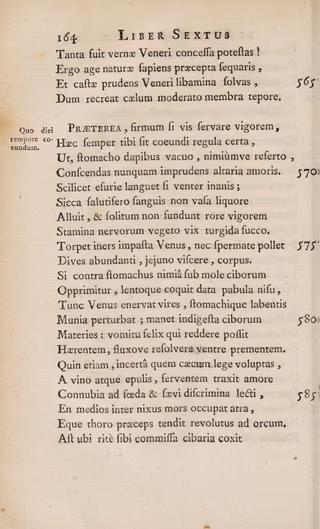
PRÆTEREA, firmum ſi vis ſervare vigorem,
Hæc ſemper tibi ſit coeundi regula certa ,
Ut, ſtomacho dapibus vacuo , nimiùmve referto ,
Conſcendas nunquam imprudens altaria amoris.
Scilicet eſurie languet ſi venter inanis ;
Sicca ſalutifero ſanguis non vaſa liquore
Alluit , & ſolitum non fundunt rore vigorem
Stamina nervorum vegeto vix turgida ſucco.
Torpet iners impaſta Venus , nec ſpermate pollet
Dives abundanti , jejuno viſcere , corpus.
Si contra ſtomachus nimiâ ſub mole ciborum
Opprimitur , lentoque coquit data pabula niſu ,
Tunc Venus enervat vires , ſtomachique labentis
Munia perturbat ; manet indigeſta ciborum
Materies : vomitu felix qui reddere poſſit
Hærentem , fluxove reſolvere ventre prementem.
Quin etiam , incertâ quem cæcum lege voluptas ,
A vino atque epulis , ferventem traxit amore
Connubia ad fœda & ſævi diſcrimina lecti ,
En medios inter nixus mors occupat atra ,
Eque thoro præceps tendit revolutus ad orcum.
Aſt ubi ritè ſibi commiſſa cibaria coxit
Part 2
a belly not overly empty, then it is permitted
to celebrate the rites of love, then it is pleasing
to pay one's vows to Venus, and safely to join in a sweet embrace.
AND NOW you see what times are more suited
for the sports
of Venus, if you wish to preserve firm health.
This one thing remains: to curb the impulses of the mind
and so to restrain the fervent heats of lust,
that in your folly you may never weary your vitals with excessive
coitus, and enervate your body when its strength is broken.
Yet one rule does not govern all mortals;
as many as are the dissimilar faces, by so much do limbs vary
in dissimilar vigor; this weak man is fatigued by a single
rare libation of semen poured forth upon a woman's
bed, while those without any peril are able
thrice and four times to bedew the couch with a copious fluid.
You whom reason alone governs, and whom blind lust does not
harass, hold love in just moderation,
so that, amid the sports and charms of Venus,
you may preserve a robust body with an unharmed chest. How many times one ought to indulge in Venus.
INDEED, those whom unbridled lust drives on with immoderate
goads, and provokes with its wanton fire,
pitiable ailments vex on all sides as they languish.
First perishes the surpassing beauty in the handsome body,
the grace of the countenance fails, with which the comely brow shone; The harms of immoderate Venus.
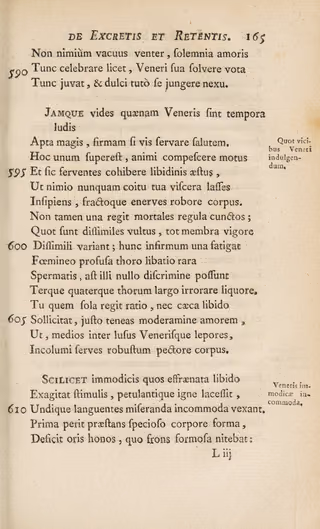
Non nimiùm vacuus venter, ſolemnia amoris
Tunc celebrare licet, Veneri ſua ſolvere vota
Tunc juvat, & dulci tutò ſe jungere nexu.
JAMQUE vides quænam Veneris ſint tempora
ludis
Apta magis, firmam ſi vis ſervare ſalutem.
Hoc unum ſupereſt, animi compeſcere motus
Et ſic ferventes cohibere libidinis æſtus,
Ut nimio nunquam coitu tua viſcera laſſes
Inſipiens, fractoque enerves robore corpus.
Non tamen una regit mortales regula cunctos;
Quot ſunt diſſimiles vultus, tot membra vigore
Diſſimili variant; hunc infirmum una fatigat
Fœmineo profuſa thoro libatio rara
Spermatis, aſt illi nullo diſcrimine poſſunt
Terque quaterque thorum largo irrorare liquore.
Tu quem ſola regit ratio, nec cæca libido
Sollicitat, juſto teneas moderamine amorem,
Ut, medios inter luſus Veneriſque lepores,
Incolumi ſerves robuſtum pectore corpus. Quot vicibus Veneri indulgendum.
SCILICET immodicis quos effrænata libido
Exagitat ſtimulis, petulantique igne laceſſit,
Undique languentes miſeranda incommoda vexant.
Prima perit præſtans ſpecioſo corpore forma,
Deficit oris honos, quo frons formoſa nitebat: Veneris immodicæ incommoda.
Part 3
The shattered sharpness of the eyes grows dull, the hollow orbs
languish,
And baldness disfigures the head with a bare crown.
Meanwhile, pain in the loins racks the viscera with acute
torments, the flaccid genitals languish in a sad
decay, and that part, once worthy of Hercules,
lies wasted away, consumed by a deserved rot.
Indeed, evils rise up in a terrible host on all sides around
the wretches; the belly is unable to perform its duties
with its wonted effort, catarrhs vex the exhausted
viscera, and savage gout rends the parched limbs.
No less is the sapless lung afflicted in the ruined
chest, and, consumed by a slow wasting, it putrefies.
Moreover, the seat of the soul, the very innermost chambers
of the mind, the brain, stripped of its health-giving dew,
fails, and the once intact vigor of the spirit totters,
Until premature old age, hastening with swift foot,
puts an end to the diseases by a foreseen death,
And the dying man too late curses his loves.
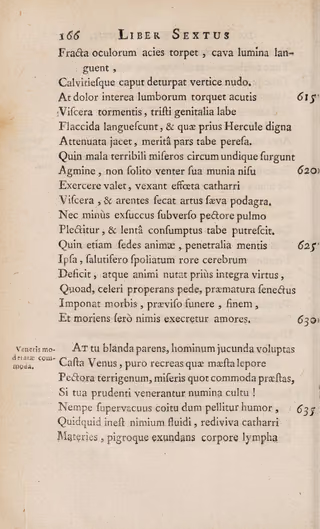
Fracta oculorum acies torpet , cava lumina lan-
guent ,
Calvitieſque caput deturpat vertice nudo.
At dolor interea lumborum torquet acutis
Viſcera tormentis , triſti genitalia labe
Flaccida langueſcunt , & quæ prius Hercule digna
Attenuata jacet , meritâ pars tabe pereſa.
Quin mala terribili miſeros circum undique ſurgunt
Agmine , non ſolito venter ſua munia niſu
Exercere valet , vexant effœta catharri
Viſcera , & arentes ſecat artus ſæva podagra.
Nec minùs exſuccus ſubverſo pectore pulmo
Plectitur , & lentâ conſumptus tabe putreſcit.
Quin etiam ſedes animæ , penetralia mentis
Ipſa , ſalutifero ſpoliatum rore cerebrum
Deficit , atque animi nutat priùs integra virtus ,
Quoad, celeri properans pede, præmatura ſenectus
Imponat morbis , præviſo funere , finem ,
Et moriens ſerò nimis execretur amores.