Hover or tap a word to see its match.
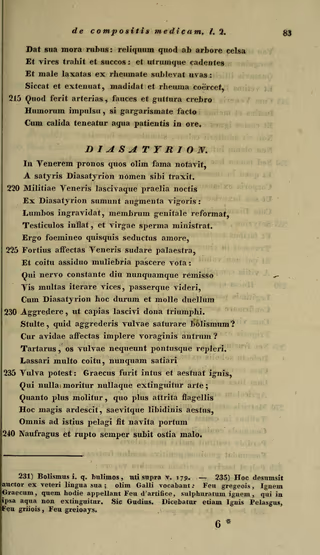
Those whom fame once noted as prone to Venus,
From the satyrs *Diasatyrion* drew its name.
The campaigns of Venus and the wanton battles of the night
Take increases of vigor from *Diasatyrion*:
It makes the loins heavy, restores the genital member,
Inflates the testicles, and supplies sperm to the rod.
Therefore, whoever, seduced by the love of women,
You desire to sweat more vigorously in the wrestling-school of Venus,
And to feed womanly desires with constant intercourse:
You who, with a nerve standing firm for a long time and never relaxed,
Wish to repeat many turns, and to seem a sparrow,
Engage in this hard and soft duel with *Diasatyrion*,
So that you may seize the gifts of a wanton triumph.
Fool, why do you attempt to satisfy the bolismus of the vulva?
Why do you desire to fill the cave of a greedy abyss?
Tartarus, the mouth of the vulva, and the sea cannot be filled.
To be wearied by much intercourse, never to be satiated
The vulva is able: Greek fire rages and seethes within,
Which dies by nothing and is extinguished by no art;
The more it labors, the more it is worn by whips,
By this it burns the more, and the heat of lust rages,
Every sailor becomes shipwrecked at the port of that sea
And always enters the doors with a broken mast.
Woe to you, who purchase the empty and vile love of a harlot
With your own blood, and with all your marrow!
Although it may stir up illicit and profane Venus,
And Diasatyrion kindle forbidden loves,
Since it makes the knights of Venus prepared for battle:
More justly and better does it serve a just love
And celebrates chaste fires and marriage torches.
Let it not be a spur to adultery, and a goad to madness;
Let it not pour oil on a furnace burning of its own accord.
But nevertheless it would be better for this to happen, that the passion should increase,
And that the forbidden fire should surge up to an immense degree,
With the body's humors and marrow drained,
So that its own consumption would bring an end to excess;
Add skinks with Diasatyrion, let there be drunk
Satyrion, lusty rocket, Indian nut, skink,
So that with such great torches, the tinder being consumed,
The whole fire may pass into lukewarm ashes and weaken,
And he who could not be chaste of his own free will,
May be forced by compulsion to cease from his vices.
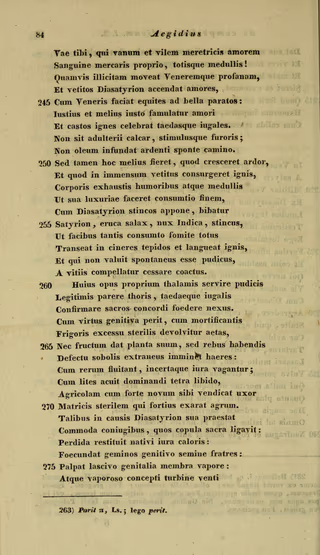
Its proper task is to serve chaste bedrooms,
To obey lawful beds, and to strengthen
The sacred bonds of the marriage torch in a harmonious pact.
When the generative power perishes, when a sterile age
Rolls down due to the excess of deadening cold,
And the plant does not yield its fruit, but an outside heir
Threatens the estate due to a lack of offspring:
When the rights to property fluctuate and wander uncertainly;
When the foul lust for ruling sharpens disputes,
When a wife perhaps claims for herself a new farmer
Who may plow more vigorously the sterile field of her womb.
In such cases Diasatyrion provides its
Benefits to spouses, whom a sacred bond has tied:
It restores the lost rights of native heat:
It fertilizes twin brothers with generative seed:
It strokes the genital members with a wanton vapor:
And with the vaporous whirlwind of the conceived wind
It compels a languid and small nerve to rise,
It aids conception and confirms a stable love:
It repairs the breach of lineage with fertile offspring. —
Let it be given with well-spiced and strong Falernian wine.
But if perhaps you fear the body will be dissolved by sweat,
let a suitable mixture of water temper the vigor of the wine,
so that the limbs may be warmed with a soothing heat.
But some, wishing to inflame Venus more,
serve broths of skinks with *Diasatyrion*:
And such madness is produced, and such heat of lust,
that the heat exhales, that sweat emerges from opened pores:
the moisture feeding the intercourse is consumed:
the nerve acts sluggishly: the bow of Venus is unstrung:
the rod lies limp, although frequently stroked by the soothing
touch of hands, the somewhat deaf pamphilus does not raise an ear:
the expectant woman bears with difficulty that joys are
delayed for her, languishing in a long-held desire:
she accuses *Diasatyrion*: the art of medicine
she denounces and reproaches the physicians, who impart such things,
whereas the method of giving is at fault, not the medicine. —
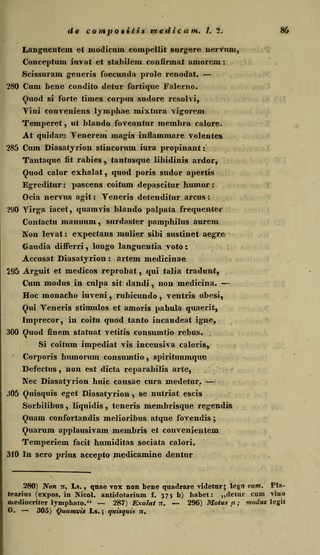
This upon a young monk, ruddy, of obese belly,
who seeks the goads of Venus and the fodder of love,
I pray, that in intercourse he may burn with such a fire,
that consumption may set an end to forbidden things.
If the kindling force of heat impedes intercourse,
the consumption of the body's humors, and the failure
of the spirits, it is not reparable by the said art,
nor does the treatment of *Diasatyrion* cure this cause. —
Whoever needs *Diasatyrion*, let him nourish himself with foods
that can be supped, liquid, tender, and for governing the limbs
better than for comforting and warming them;
whose moisture, allied to heat, produces a
temperament pleasing and suitable to the limbs.
In the evening, the medicine having been taken previously, let there be given
Palm fruits and sweet almonds, figs.
Taken with wine, it strengthens cold loins, or those whom viscous
Matter afflicts, with the robust power of its virtue:
But you mix diuretics with it,
If the disease drags along with it a gathering of humor.
Those who wish to castrate their loins, and strive to gird
The unbridled motions of the flesh with chaste bonds,
For whom the holy shadow of modesty cools the heat,
For whom the divine breeze puts to flight the heat of lust,
Whom the sacred doctrine of holy Fulco has taught
To take the severe path of a better life:
While virtue is new, while it is unformed, and still a little recruit,
When, still under age, infant religion wails
Within the cradle, having newly left Babylon:
Let these, by whatever evil from the coldness of the kidneys they may be burdened,
Never presume to medicate themselves with *Diasatyrion*,
Although it is the highest medicine for coldness.
It would attract peace to the kidneys, but it would stir up wars
In the testicles, it would produce scandals for the neighboring members:
The neighboring wall would burn: that heavy tyrant,
The tinder of sin, the inciter of lascivious love,
The stimulus of nature, at first sluggish, hidden in the lowest
Parts, lurking in the torpor of a warm ash,
Boils when torches are applied, sparkles and burns:
Love stretches the veins, nor does the anger of the heat cease,
Until it foams away, languid with the nerve relaxed.
But when religion has driven its roots deeper
With stable cement, consolidated by a firm course,
To which the habit of a long time prescribes strength:
*Diasatyrion* does not move it, even if it beats on the doors
And explores the approaches; although it may try to overturn
The first rampart, it cannot storm the second.
Meditation is not drawn to consent: the little one
Dashed against the rock does not allow himself to be a giant:
The fruit perishes in the seed, the harvest in the blade,
It dies in the warm ash and thin spark
A little spark: the little fox does not gnaw the vine. —
The end which ends the year ends the lifespan for this.
In Venerem pronos quos olim fama notavit,
A satyris Diasatyrion nomen sibi traxit.
Militiae Veneris lascivaque praelia noctis
Ex Diasatyrion sumunt augmenta vigoris:
Lumbos ingravidat, membrum genitale reformat,
Testiculos inflat, et virgae sperma ministrat.
Ergo foemineo quisquis seductus amore,
Fortius affectas Veneris sudare palaestra,
Et coitu assiduo muliebria pascere vota:
Qui nervo constante diu nunquamque remisso
Vis multas iterare vices, passerque videri,
Cum Diasatyrion hoc durum et molle duellum
Aggredere, ut capias lascivi dona triumphi.
Stulte, quid aggrederis vulvae saturare bolismum?
Cur avidae affectas implere voraginis antrum?
Tartarus, os vulvae nequeunt pontusque repleri.
Lassari multo coitu, nunquam satiari
Vulva potest: Graecus furit intus et aestuat ignis,
Qui nulla moritur nullaque extinguitur arte;
Quanto plus molitur, quo plus attrita flagellis
Hoc magis ardescit, saevitque libidinis aestus,
Omnis ad istius pelagi fit navita portum
Naufragus et rupto semper subit ostia malo.
Vae tibi, qui vanum et vilem meretricis amorem
Sanguine mercaris proprio, totisque medullis!
Quamvis illicitam moveat Veneremque profanam,
Et vetitos *Diasatyrion* accendat amores,
Cum Veneris faciat equites ad bella paratos:
Iustius et melius iusto famulatur amori
Et castos ignes celebrat taedasque iugales.
Non sit adulterii calcar, stimulusque furoris;
Non oleum infundat ardenti sponte camino.
Sed tamen hoc melius fieret, quod cresceret ardor,
Et quod in immensum vetitus consurgeret ignis,
Corporis exhaustis humoribus atque medullis
Ut sua luxuriae faceret consumtio finem,
Cum *Diasatyrion* stincos appone, bibatur
Satyrion, eruca salax, nux Indica, stincus,
Ut facibus tantis consumto fomite totus
Transeat in cineres tepidos et langueat ignis,
Et qui non valuit spontaneus esse pudicus,
A vitiis compellatur cessare coactus.
Huius opus proprium thalamis servire pudicis
Legitimis parere thoris, taedaeque iugalis
Confirmare sacros concordi foedere nexus.
Cum virtus genitiva perit, cum mortificantis
Frigoris excessu sterilis devolvitur aetas,
Nec fructum dat planta suum, sed rebus habendis
Defectu sobolis extraneus imminet haeres:
Cum rerum fluitant, incertaque iura vagantur;
Cum lites acuit dominandi tetra libido,
Agricolam cum forte novum sibi vendicat uxor
Matricis sterilem qui fortius exarat agrum.
Talibus in causis *Diasatyrion* sua praestat
Commoda coniugibus, quos copula sacra ligavit:
Perdita restituit nativi iura caloris:
Foecundat geminos genitivo semine fratres:
Palpat lascivo genitalia membra vapore:
Atque vaporoso concepti turbine venti
Languentem et modicum compellit surgere nervum,
Conceptum iuvat et stabilem confirmat amorem:
Scissuram generis foecunda prole renodat. —
Cum bene condito detur fortique Falerno.
Quod si forte times corpus sudore resolvi,
Vini conveniens lymphae mixtura vigorem
Temperet, ut blando foveantur membra calore.
At quidam Venerem magis inflammare volentes
Cum Diasatyrion stincorum iura propinant:
Tantaque fit rabies, tantusque libidinis ardor,
Quod calor exhalat, quod poris sudor apertis
Egreditur: pascens coitum depascitur humor:
Ocia nervus agit: Veneris detenditur arcus:
Virga iacet, quamvis blando palpata frequenter
Contactu manuum, surdaster pamphilus aurem
Non levat: expectans mulier sibi sustinet aegre
Gaudia differri, longo languentia voto:
Accusat Diasatyrion: artem medicinae
Arguit et medicos reprobat, qui talia tradunt,
Cum modus in culpa sit dandi, non medicina. —
Hoc monacho iuveni, rubicundo, ventris obesi,
Qui Veneris stimulos et amoris pabula quaerit,
Imprecor, in coitu quod tanto incandeat igne,
Quod finem statuat vetitis consuntio rebus.
Si coitum impediat vis incensiva caloris,
Corporis humorum consumtio, spirituumque
Defectus, non est dicta reparabilis arte,
Nec Diasatyrion huic causae cura medetur. —
Quisquis eget Diasatyrion, se nutriat escis
Sorbilibus, liquidis, teneris membrisque regendis
Quam confortandis melioribus atque fovendis;
Quarum applausivam membris et convenientem
Temperiem facit humiditas sociata calori.
In sero prius accepto medicamine dentur
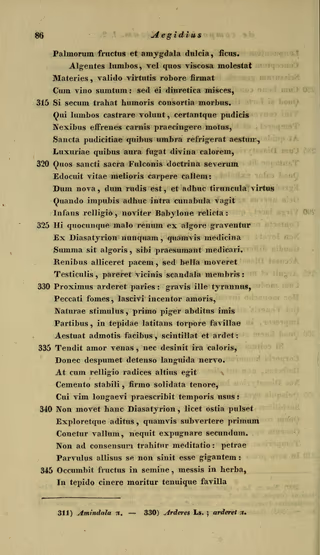
Palmorum fructus et amygdala dulcia, ficus.
Algentes lumbos, vel quos viscosa molestat
Materies, valido virtutis robore firmat
Cum vino sumtum: sed ei diuretica misces,
Si secum trahat humoris consortia morbus.
Qui lumbos castrare volunt, certantque pudicis
Nexibus effrenes carnis praecingere motus,
Sancta pudicitiae quibus umbra refrigerat aestum,
Luxuriae quibus aura fugat divina calorem,
Quos sancti sacra Fulconis doctrina severum
Edocuit vitae melioris carpere callem:
Dum nova, dum rudis est, et adhuc tiruncula virtus
Quando impubis adhuc intra cunabula vagit
Infans relligio, noviter Babylone relicta:
Hi quocunque malo renum ex algore graventur
Ex Diasatyrion nunquam, quamvis medicina
Summa sit algoris, sibi praesumant medicari.
Renibus alliceret pacem, sed bella moveret
Testiculis, pareret vicinis scandala membris:
Proximus arderet paries: gravis ille tyrannus,
Peccati fomes, lascivi incentor amoris,
Naturae stimulus, primo piger abditus imis
Partibus, in tepidae latitans torpore favillae
Aestuat admotis facibus, scintillat et ardet:
Tendit amor venas, nec desinit ira caloris,
Donec despumet detenso languida nervo.
At cum relligio radices altius egit
Cemento stabili, firmo solidata tenore,
Cui vim longaevi praescribit temporis usus:
Non movet hanc Diasatyrion, licet ostia pulset
Exploretque aditus, quamvis subvertere primum
Conetur vallum, nequit expugnare secundum.
Non ad consensum trahitur meditatio: petrae
Parvulus allisus se non sinit esse gigantem:
Occumbit fructus in semine, messis in herba,
In tepido cinere moritur tenuique favilla
Igniculus: non corrodit vulpecula vitem. —
Terminat huic aevum finis qui terminat annum.