Hover or tap a word to see its match.
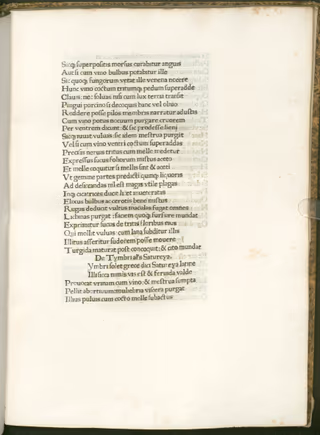
*Tymbri* is customarily called in Greek, *Satureya* in Latin.
Its power is excessively dry and strongly hot.
Taken with wine, it provokes urine: and the menses.
It expels an aborted fetus: it purges the female innards.
Its powder kneaded with cooked honey
And chewed, or if the same is taken with wine,
It drives out tenacious humor of the chest through spit.
With warm wine it calms the gripings of the belly,
If it is drunk copiously; indeed I have often proven this.
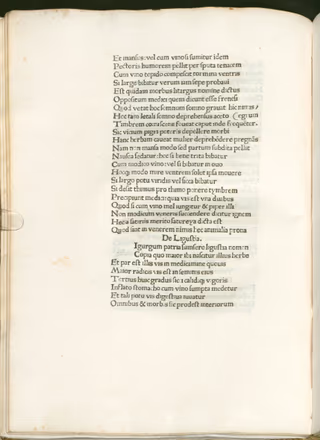
There is a certain disease called lethargy by name,
Which physicians say is the opposite to frenzy:
Because the one forbids sleep, the other burdens the sick one too much with sleep.
Let one caught by this so deadly sleep,
Mixing savory with vinegar, foment the head frequently with it.
Thus you will be able to drive away the affliction of the sluggish disease.
Let a pregnant woman beware of taking this herb,
For not only chewed, but applied as a suppository, it drives out the fetus.
Nausea is settled if it is drunk well ground,
With a little wine, or if it is drunk in an egg;
And in this manner it is wonderfully accustomed to move the belly,
If it is drunk green or dry in a copious draft.
If thyme is lacking, physicians prescribe
To substitute savory for thyme, because the virtue is the same for both.
But if honey and pepper are joined to it with wine,
It is said to kindle the fire of Venus not a little.
This is rightly called *satureya* from the satyrs,
Because these creatures are exceedingly prone to Venus.
Ymbri ſolet grece dici Satureya latine
Illi ſicca nimis vis eſt & feruida valde
Prouocat vrinam cum vino: & meſtrua ſumpta
Pellit abortiuum: muliebria viſcera purgat
Illius puluis cum cocto melle ſubactus
Et manſus: vel cum vino ſi ſumitur idem
Pectoris humorem pellit per ſputa tenacem
Cum vino tepido compeſcit tormina ventris
Si large bibitur verum iam ſepe probaui
Eſt quidam morbus litargus nomine dictus
Oppoſitum medici quem dicunt eſſe freneſi
Quod vetat hoc ſomnum ſomno grauat hic nimis egrum
Hec tam letali ſomno deprehenſus aceto
Timbrem comiſcens foueat caput inde frequēter.
Sic vicium pigri poteris depellere morbi
Hanc herbam caueat mulier deprehēdere pregnās
Nam non manſa modo ſed partum ſubdita pellit
Nauſea ſedatur: hec ſi bene trita bibatur
Cum modico vino: vel ſi bibatur in ouo
Hocqꝫ modo mire ventrem ſolet ipſa mouere
Si largo potu viridis vel ſicca bibatur
Si deſit thimus pro thimo ponere tymbrem
Precipiunt medici: quia vis eſt vna duabus
Quod ſi cum vino mel iungitur & piper illi
Non modicum veneris ſuccendere dicitur ignem
Hec a ſatiriis merito ſatureya dicta eſt
Quod ſint in venerem nimis hec animalia prona