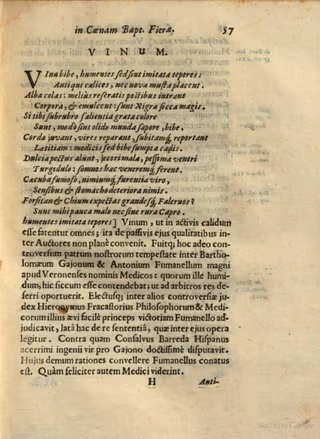
V I N U M.

Poet
Baptista Fiera
Form
Elegiac couplet
Open the page in the book
The page this poem fills. Each opens in the Coena, sive De cibariorum virtutibus reader.

Hover or tap a word to see its match.

Drink wines, but let them imitate moist warmth:

Old cups, and not new musts, are pleasing.

Strain the white ones: through unbarred doors they better enter

Bodies, and soothe them: the Black ones are drier.

If sparkling ones of a reddish color are pleasing to you,

Provided they are clean with a fragrant taste, drink them.

They aid the heart, restore strength, and bring sudden

Joy: but drink them drawn from modest casks.

Sweet ones nourish the chest, are bad for the liver, worst for a swollen

Belly: these will bring sleep and love.

Caecuban wines with their smoky, and excessively raging venom,

Are far worse for the senses and the stomach.

Perhaps you also expect Chian and grand Falernians?

I have but few estates, and not without a mischievous Goat.

VIna bibe, humentes ſed ſint imitata tepores:

Antiqui calices, nec nova muſta placent.

Alba colas: meliùs reſeratis poſtibus intrant

Corpora, & emulcent: ſunt Nigra ſicca magis.

Si tibi ſubrubro ſalientia grata colore

Sunt, modò ſint olido munda ſapore, bibe.

Corda juvant, vires reparant, ſubitamq́; reportant

Lætitiam: modicis ſed bibe ſumpta cadis.

Dulcia pectus alunt, jecori mala, peſſima ventri

Turgidulo: ſomnos hæc veneremq́; ferent.

Cæcuba fumoſo, nimiumq́; furentia viro,

Senſibus & ſtomacho deteriora nimis.

Forſitan & Chium expectas grandesq́; Falernos ?

Sunt mihi pauca malo nec ſine rura Capro.
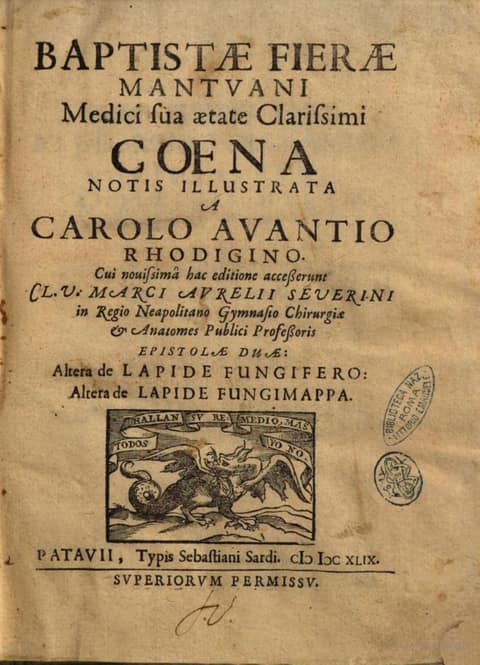
Title page of Coena, sive De cibariorum virtutibus
Title page of Coena, sive De cibariorum virtutibus , 1649

About this text

Provenance

This digital edition is derived from the Internet Archive copy of Battista Fiera's 1649 _Coena, sive De cibariorum virtutibus_, a Latin medical dinner poem with Carlo Avanzi's notes and related material.

Methodology

Each scan is treated as a page-level unit. The page image remains the authority for the edition. Local Kraken OCR used the Reichenau Latin early-print model as a reading aid, then Gemini generated scan-grounded Latin transcription and scholarly English translation from the images, the OCR aid, and the approved glossary. Word links connect the English translation to the Latin transcription and locations on the scans. 32 uncertain word-link decisions remain unlinked. Some links highlight only the text because the source word could not be located on the scan.

Rights

The Internet Archive metadata and IIIF manifest record the digital surrogate under the Creative Commons Public Domain Mark 1.0. Poet Doctor's presentation adds generated OCR, transcription, translation, navigation metadata, and editorial context.

Original scans: Internet Archive / Google Books ( Public Domain Mark 1.0 ).

Historian’s note. This text records the medicine of its own time, and later evidence has replaced most of it. It is not medical advice. We read it as history, and we ask what, if anything, connects it to medicine today. More on how we read old medical books