Hover or tap a word to see its match.
Part 1
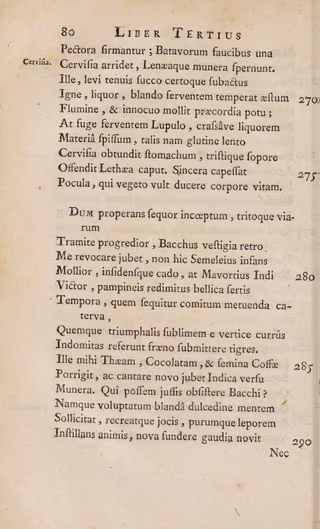
WHILE hastening I pursue my undertaking, and advance along
the beaten path of the roads, Bacchus bids me recall
my footsteps backward—not here the softer infant of Semele,
sitting upon a cask, but the martial conqueror
of the Indus, his warlike temples wreathed with vine-leaf
garlands, whom a fearsome crowd of companions
follows,
and whom, high from the summit of his triumphal chariot,
they say subjects untamed tigers to the bridle.
He holds out to me tea, chocolate, and the seeds of coffee,
and bids me sing in novel verse the Indian
gifts. How could I resist the commands of Bacchus?
For he entices the mind with the alluring sweetness of pleasures,
and refreshes it with jests, and instilling pure charm
into our spirits, he knows how to pour forth new joys.
DUM properans ſequor incœptum , tritoque via-
rum
Tramite progredior , Bacchus veſtigia retro
Me revocare jubet , non hic Semeleius infans
Mollior , inſidenſque cado , at Mavortius Indi
Victor , pampineis redimitus bellica ſertis
Tempora , quem ſequitur comitum metuenda ca-
terva ,
Quemque triumphalis ſublimem e vertice currûs
Indomitas referunt fræno ſubmittere tigres.
Ille mihi Thæam , Cocolatam , & ſemina Coffæ
Porrigit , ac cantare novo jubet Indica verſu
Munera. Quî poſſem juſſis obſiſtere Bacchi ?
Namque voluptatum blandâ dulcedine mentem
Sollicitat , recreatque jocis , purumque leporem
Inſtillans animis , nova fundere gaudia novit
Part 2
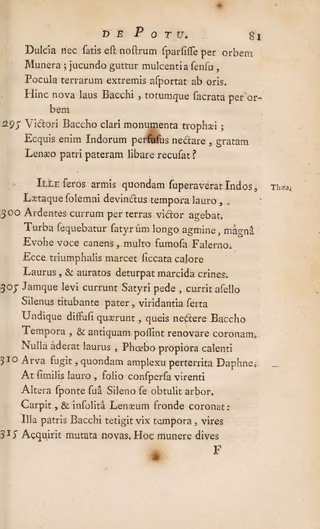
Nor is it enough to have scattered sweet gifts throughout our
world; cups soothing the throat with a pleasant sensation
he brings from the farthest shores of the earth.
Hence arises new praise of Bacchus, and monuments of a glorious trophy
consecrated throughout the whole world to victorious Bacchus;
For who, steeped in the nectar of the Indians, refuses
to pour a grateful libation from the bowl to Father Lenaeus?
He had once conquered the fierce Indians by arms,
And having bound his joyful temples with solemn laurel,
As victor he drove his chariot through the burning lands.
A crowd of satyrs followed in a long column, singing
"Evohe!" with a loud voice, fuming with much Falernian wine.
Behold, the triumphal laurel withers, dried by the heat,
And wilted, disfigures his golden locks.
And now the Satyrs run with light foot, Father Silenus
runs on his staggering little ass; scattered everywhere
they seek green garlands, with which they might bind the temples
of Bacchus, and renew his ancient crown.
No laurel was there; Daphne, once terrified by his embrace,
flees the fields closer to burning Phoebus.
But another tree, similar to the laurel, sprinkled with green leaf,
of its own accord presented itself to Silenus.
He plucks it, and crowns Lenaeus with the unfamiliar foliage:
Scarcely had it touched the temples of Father Bacchus, when changed,
it acquires new powers. Rich with this gift, Tea.
Dulcia nec ſatis eſt noſtrum ſparſiſſe per orbem
Munera ; jucundo guttur mulcentia ſenſu ,
Pocula terrarum extremis aſportat ab oris.
Hinc nova laus Bacchi , totumque ſacrata per or-
bem
Victori Baccho clari monumenta trophæi ;
Ecquis enim Indorum perfuſus nectare , gratam
Lenæo patri pateram libare recuſat?
Ille feros armis quondam ſuperaverat Indos ,
Lætaque ſolemni devinctus tempora lauro ,
Ardentes currum per terras victor agebat.
Turba ſequebatur ſatyrûm longo agmine , magnâ
Evohe voce canens , multo fumoſa Falerno.
Ecce triumphalis marcet ſiccata calore
Laurus , & auratos deturpat marcida crines.
Jamque levi currunt Satyri pede , currit aſello
Silenus titubante pater , viridantia ſerta
Undique diffuſi quærunt , queis nectere Baccho
Tempora , & antiquam poſſint renovare coronam.
Nulla aderat laurus , Phœbo propiora calenti
Arva fugit , quondam amplexu perterrita Daphne.
At ſimilis lauro , folio conſperſa virenti
Altera ſponte ſuâ Sileno ſe obtulit arbor.
Carpit , & inſolitâ Lenæum fronde coronat :
Illa patris Bacchi tetigit vix tempora , vires
Acquirit mutata novas. Hoc munere dives Thæa.
Part 3
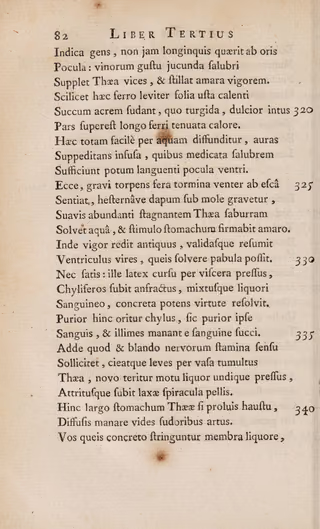
the Indian nation no longer seeks from distant shores
its cups: pleasant in its wholesome taste, in place of wines
tea supplies their office, and, though bitter, instills vigor.
For indeed these leaves, lightly parched on heated iron,
sweat out an acrid juice with which they were swollen; a sweeter
part remains within, attenuated by the prolonged heat of the iron.
This is easily diffused through all the water, when infused
supplying aromas, medicated with which the cups
furnish a wholesome drink to the languishing belly.
Behold, should the sluggish belly feel fierce gripes from heavy food,
or be weighed down beneath the mass of yesterday's feasts,
pleasant tea with its abundant water will dissolve the stagnant saburra,
and will strengthen the stomach with its bitter stimulus.
Thence ancient vigor returns, and the stomach resumes
sturdy strength, wherewith it can dissolve its food.
Nor is this enough: that fluid, pressed in its course through the viscera,
enters the chyle-bearing windings, and mixed with the bloody
liquor, powerful in its virtue, dissolves concretions.
Hence arises a purer chyle, thus the blood itself
is purer, and unmuddied juices flow from the blood.
Add that with a soothing sensation tea also stimulates
the stamens of the nerves, and stirs up gentle commotions through the vessels;
the fluid, pressed on all sides, is rubbed by a new motion,
and, attenuated, enters the pores of the relaxed skin.
Hence, if you drench the stomach with a copious draught of tea,
you see the limbs streaming with diffused sweat.
You whose limbs are bound by congealed fluid,
Indica gens , non jam longinquis quærit ab oris
Pocula : vinorum guſtu jucunda ſalubri
Supplet Thæa vices , & ſtillat amara vigorem.
Scilicet hæc ferro leviter folia uſta calenti
Succum acrem ſudant , quo turgida , dulcior intus
Pars ſupereſt longo ferri tenuata calore.
Hæc totam facilè per aquam diffunditur , auras
Suppeditans infuſa , quibus medicata ſalubrem
Sufficiunt potum languenti pocula ventri.
Ecce , gravi torpens fera tormina venter ab eſcâ
Sentiat , heſternâve dapum ſub mole gravetur ,
Suavis abundanti ſtagnantem Thæa ſaburram
Solvet aquâ , & ſtimulo ſtomachum firmabit amaro.
Inde vigor redit antiquus , validaſque reſumit
Ventriculus vires , queis ſolvere pabula poſſit.
Nec ſatis : ille latex curſu per viſcera preſſus ,
Chyliferos ſubit anfractus , mixtuſque liquori
Sanguineo , concreta potens virtute reſolvit.
Purior hinc oritur chylus , ſic purior ipſe
Sanguis , & illimes manant e ſanguine ſucci.
Adde quod & blando nervorum ſtamina ſenſu
Sollicitet , cieatque leves per vaſa tumultus
Thæa , novo teritur motu liquor undique preſſus ,
Attrituſque ſubit laxæ ſpiracula pellis.
Hinc largo ſtomachum Thææ ſi proluis hauſtu ,
Diffuſis manare vides ſudoribus artus.
Vos queis concreto ſtringuntur membra liquore ,
Part 4
you in whom, with constricted skin, the dreaded matter of thick
serum is driven back within, which might harm
the chest, or offend various parts by its influx,
do not despise the gifts of Bacchus offered for such great
evils; tea dissolves congealed fluids,
and, mixed with them, drives them through the accustomed passages of the skin.
Nor less, if the body, oppressed by excessive phlegm,
lies sluggish and inert, tea offers you immediate relief:
behold, strength returns; with the weight removed, the body
becomes lighter; no longer is the chest weighed down by an incumbent
mass; the limbs are braced by strengthened muscles:
such great power has been granted to the health-bringing leaf!
Yet you should not, sipping tea with an unceasing throat,
distend your belly with an immoderate weight of lymph.
Thence the vigor of the stomach would soon collapse, the limbs on all sides
would melt away with a copious stream, soon the blood, drained of its friendly
liquid, would thicken, and at last a lethal wasting
would gradually attenuate the parched viscera.
But if the chest is constricted by an innate blemish,
and slender limbs are stretched by dry cords,
flee the drying drink, and prudently leave the cups
of tea, which you must avoid, to be sipped by the robust.
AFRICA sends coffee, unlike in native land and illustrious
for diverse gifts: these seeds of coffee
many a poet has already sung in distinguished verse,
stirred in his sublime mind by the subtle nectar. Coffee.
Queis, cute conſtrictâ, ſpiſſi retropellitur intus
Materies metuenda ſeri, quæ pectora poſſit
Lædere, vel varias affluxu offendere partes,
Non tantis oblata malis contemnite Bacchi
Munera, concretos diſſolvit Thæa liquores,
Perque cutis ſolitos pellit commixta meatus.
Nec minùs oppreſſum nimio ſi phlegmate corpus
Torpet iners, præſens offert tibi Thæa levamen:
En redeunt vires, ſubſtracto pondere corpus
Fit levius, non jam incumbenti mole gravantur
Pectora, firmatis tenduntur membra lacertis:
Tanta ſalutiferæ frondi conceſſa poteſtas!
Non tamen, aſſiduo ſorbillans gutture Thæam,
Immodico lymphæ diſtendas pondere ventrem.
Inde brevì rueret ſtomachi vigor, undique largo
Flumine diffluerent artus, mox ſanguis amico
Exhauſtus liquido ſpiſſeſceret, arida demum
Lethalis ſenſim tenuaret viſcera tabes.
Quod ſi nativâ ſtringuntur pectora labe,
Et graciles ſiccis tenduntur funibus artus,
Siccantem fugias potum, vitandaque Thææ
Pocula robuſtis prudens ſorbenda relinquas.
DISSIMILEM patriâ diverſis Africa mittit
Dotibus illuſtrem Coffæam: hæc ſemina Coffe
Plurimus inſigni cecinit jam carmine vates,
Sublimem ſubtili agitatus nectare mentem. Coffæa.
Part 5
And now the honor of your Aganippean wave grows cheap,
Father Phoebus; the wine-filled cups of Lyaeus lie foul
with much squalor, and throughout the whole world coffee
brings more throats of the nations under its sway.
For once Mahomet, daring to deny Bacchus
his honors, and overthrowing the altars of Bacchus from their seats,
and the fruitful vines with their torn-off shoots,
impiously condemned wine with an audacious charge.
Without delay, the band of Bacchantes with frenzied mind
roared out, Bacchus blazed into swelling wrath,
and the Satyrs filled the air with rabid wailing.
And now the impious Arab, his mind oppressed with dread,
tries to appease the angry God, and with downcast face
to bend the furious hearts of the Satyrs.
Yet to restore its ancient glory to the banished wine,
and to recall again the previously condemned cups,
he refuses; he dreads the fuming powers of the vinous
nectar, by which the violence of the sacred disease increases.
But coffee, sweet with its warm nectar, so that
it might replace wine, he consecrated to the God, tempting
the thirsty throats of the Arabs with their ancestral drink.
Thus coffee, previously unknown, is scattered through
the whole world, and steals from wine its ancient honor.
Indeed, deluded throats everywhere indulge in the new
liquor, nor does coffee hold only Libya and the Nabathaean
realms in its sway; boasted of by the Indian,
Jamque tuæ vileſcit honos Aganippidos undæ,
Phæbe pater, multo ſordent vinoſa Lyæi
Pocula ſquallore, & totum Coffæa per orbem
Plura ſub imperio populorum guttura mittit.
Nempe ſuos Baccho quondam Mahometus honores
Detrectare auſus, Bacchique a ſedibus aras,
Lætaſque avulſo ſubvertens palmite vites,
Impius audaci damnavit crimine vinum.
Nec mora, Bacchantûm lymphatâ mente caterva
Infremuit, tumidas exarſit Bacchus in iras,
Et rabido Satyri complerunt aera planctu.
Jamque nefandus Arabs mentem formidine preſſus,
Iratum placare Deum, furibundaque tentat
Submiſſo vultu Satyrorum flectere corda.
At decus antiquum depulſo reddere vino,
Et damnata priùs rurſum revocare recuſat
Pocula; fumoſas vinoſi nectaris horret
Vires, queis creſcit ſacri violentia morbi.
Sed ſuavem calido Coffæam nectare, vinum
Quò poſſit ſupplere, Deo ſacravit, avito
Sollicitans Arabum ſitientia guttura potu.
Sic ignota priùs totum Coffæa per orbem
Spargitur, & vino antiquum ſubducit honorem.
Quippe novo paſſim indulgent deluſa liquori
Guttura, nec Lybiam ſolùm Nabathæaque regna
Imperio Coffæa tenet, jactantur ab Indo