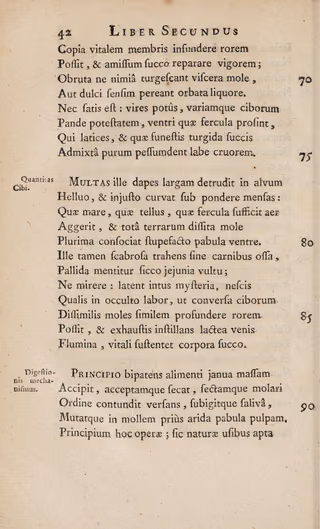
Quantitas Cibi. MULTAS ille dapes largam detrudit in alvum

Poet
Étienne-Louis Geoffroy
Form
Not identifiable from book
Open the page in the book
The page this poem fills. Each opens in the Hygieine, sive ars sanitatem conservandi reader.

Quantity of Food. That glutton thrusts many feasts into his capacious belly,

and bends the tables under an unjust weight:

the dishes which the sea, the earth, and the air supply,

he heaps together, and in his stupefied belly unites

very many foods scattered over the whole mass of the earth.

Yet he, dragging rough bones without flesh,

feigns pale fasts with his dry countenance;

do not marvel: mysteries lie hidden within, you know not

what labor goes on in secret, so that the transformed,

dissimilar mass of foods may pour forth a uniform dew,

and, instilling milky rivers into the exhausted veins,

sustain the body with vital juice.

Helluo, & injusto curvat sub pondere mensas :

Quæ mare, quæ tellus, quæ fercula sufficit aer

Aggerit, & totâ terrarum dissita mole

Plurima consociat stupefacto pabula ventre.

Ille tamen scabrosa trahens sine carnibus ossa,

Pallida mentitur sicco jejunia vultu;

Ne mirere : latent intus mysteria, nescis

Qualis in occulto labor, ut conversa ciborum

Dissimilis moles similem profundere rorem

Possit, & exhaustis instillans lactea venis

Flumina, vitali sustentet corpora succo.
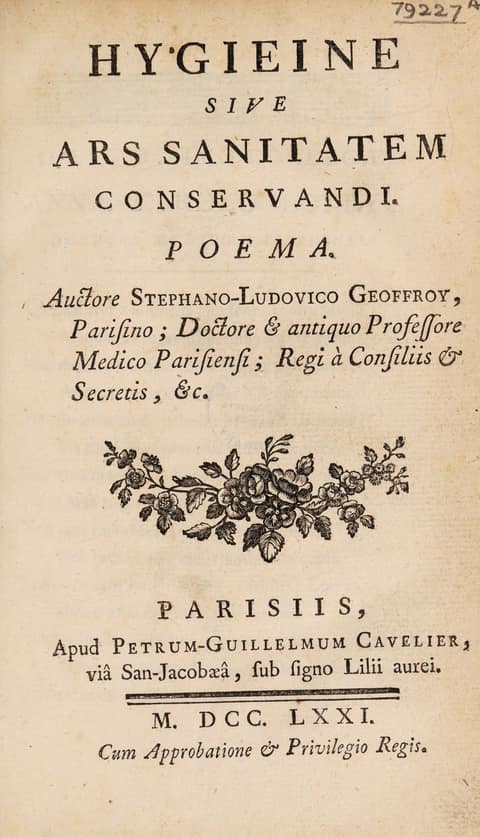
Title page of Hygieine, sive ars sanitatem conservandi
Title page of Hygieine, sive ars sanitatem conservandi , 1771

About this text

Provenance

This edition uses the Wellcome Collection copy, catalogue number b30508277. It starts at scan 6, after the front board, the marbled endpapers, a flyleaf with shelf marks and the digitization notice. The half-title is scan 7 and the title page is scan 9. Book One begins on scan 19, and the poem ends on scan 209. The last scans show blank leaves, the back endpapers and the back board.

Rights

The Wellcome Collection marks the digital images with the Public Domain Mark 1.0. Credit the Wellcome Collection.

Original scans: Wellcome Collection ( Public Domain Mark 1.0 ).

Historian’s note. This text records the medicine of its own time, and later evidence has replaced most of it. It is not medical advice. We read it as history, and we ask what, if anything, connects it to medicine today. More on how we read old medical books