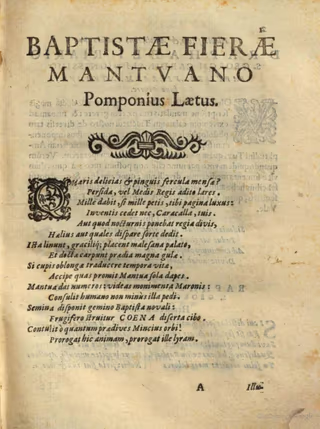
BAPTISTÆ FIERÆ M A N T V A N O

Poet
Pomponius Lætus
Form
Elegiac couplet
Open the page in the book
The page this poem fills. Each opens in the Coena, sive De cibariorum virtutibus reader.

Hover or tap a word to see its match.

Do you seek the delights and dishes of a rich table?

Go to Persia, or the homes of the Median King.

A page will give you a thousand luxuries, if a thousand you seek:

Nor will it yield to your inventions, Caracalla.

Or what the palace used to serve to the nocturnal gods,

Or such as Helius gave with an unequal fate.

Those things cloy, and, unhealthy, please a slender palate,

And consume the great estates of a learned gluttony.

If you desire to pass the time of a prolonged life,

Accept the feasts that Mantua alone brings forth.

Mantua gives verses: you may see the monuments of Maro:

She cares no less for the human foot.

Battista distributes seeds in a double field:

An eloquent SUPPER is built with fruitful food.

O how much the exceedingly rich Mincius has bestowed upon the world!

This one prolongs life, that one prolongs the lyre.

Quæris delicias & pinguis fercula menſæ?

Perſida, vel Medis Regis adito lares.

Mille dabit, ſi mille petis, tibi pagina luxus:

Inventis cedet nec, Caracalla, tuis.

Aut quod nocturnis ponebat regia divis,

Helius aut quales diſpare ſorte dedit.

Iſta linunt, graciliq́; placent male ſana palato,

Et doctæ carpunt prædia magna gulæ.

Si cupis oblongæ traducere tempora vitæ,

Accipe quas promit Mantua ſola dapes.

Mantua dat numeros: videas monimenta Maronis:

Conſulit humano non minùs illa pedi.

Semina diſponit gemino Baptiſta novali:

Frugifero ſtruitur C O E N A diſerta cibo.

Contulit ò quantum prædives Mincius orbi!

Prorogat hic animam, prorogat ille lyram.
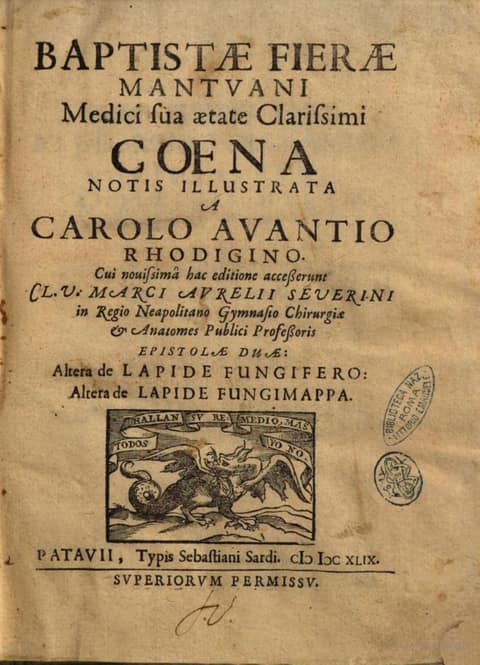
Title page of Coena, sive De cibariorum virtutibus
Title page of Coena, sive De cibariorum virtutibus , 1649

About this text

Provenance

This digital edition is derived from the Internet Archive copy of Battista Fiera's 1649 _Coena, sive De cibariorum virtutibus_, a Latin medical dinner poem with Carlo Avanzi's notes and related material.

Methodology

Each scan is treated as a page-level unit. The page image remains the authority for the edition. Local Kraken OCR used the Reichenau Latin early-print model as a reading aid, then Gemini generated scan-grounded Latin transcription and scholarly English translation from the images, the OCR aid, and the approved glossary. Word links connect the English translation to the Latin transcription and locations on the scans. 32 uncertain word-link decisions remain unlinked. Some links highlight only the text because the source word could not be located on the scan.

Rights

The Internet Archive metadata and IIIF manifest record the digital surrogate under the Creative Commons Public Domain Mark 1.0. Poet Doctor's presentation adds generated OCR, transcription, translation, navigation metadata, and editorial context.

Original scans: Internet Archive / Google Books ( Public Domain Mark 1.0 ).

Historian’s note. This text records the medicine of its own time, and later evidence has replaced most of it. It is not medical advice. We read it as history, and we ask what, if anything, connects it to medicine today. More on how we read old medical books