Hover or tap a word to see its match.
Part 1
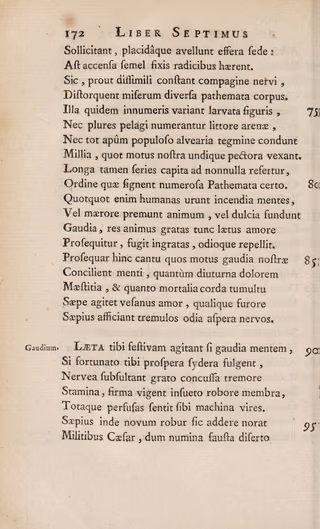
Joy. If cheerful joys stir your festive mind,
If prosperous stars shine upon you in your good fortune,
The nervous stamens leap up, shaken by a pleasing tremor,
The firm limbs flourish with unwonted strength,
And the whole frame feels strength diffused throughout itself.
Hence Caesar quite often knew how to add new strength
To his soldiers in this way, while with eloquent
Gaudium. LÆTA tibi feſtivam agitant ſi gaudia mentem,
Si fortunato tibi proſpera ſydera fulgent,
Nervea ſubſultant grato concuſſa tremore
Stamina, firma vigent inſueto robore membra,
Totaque perfuſas ſentit ſibi machina vires.
Sæpius inde novum robur ſic addere norat
Militibus Cæſar, dum numina fauſta diſerto
Part 2
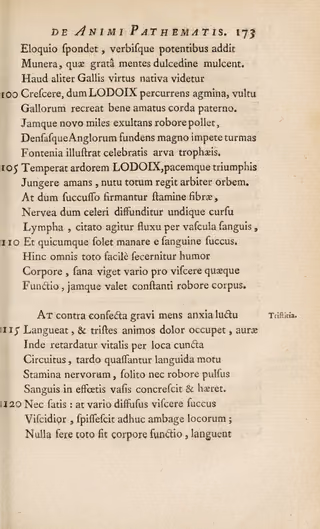
speech, and to his powerful words he adds
gifts that soothe their minds with a pleasing sweetness.
Not otherwise does native valor seem in the French
to grow, while the well-beloved Louis, riding through the ranks,
revives the hearts of the French with his paternal countenance.
And now the exulting soldier is strong with new vigor,
and routing the dense squadrons of the English with a great charge,
he renders the fields of Fontenoy illustrious with celebrated trophies.
Louis tempers his ardor, and loving to join peace
with triumphs, as arbiter he rules the whole world with his nod.
Yet while the fibers are strengthened by their shaken threads,
while the nervous lymph is diffused everywhere in a swift course,
the blood is driven in a rapid flow through the small vessels,
along with whatever juice is wont to flow from the blood.
Hence every humor is easily secreted throughout the whole
body, each healthy function flourishes in accordance with its
diverse organ, and now the body is strong with constant vigor.
BUT if, on the contrary, the anxious mind, worn out by heavy grief,
should languish, and sorrow seize the sad spirits, then
the circulation of the vital breath is retarded through all
parts, the languid threads of the nerves are shaken with a slow
motion, and the blood, not propelled with its usual vigor,
congeals and sticks in the exhausted vessels.
Nor is this enough: for the more viscid juice diffused through the
diverse organs thickens still more in the winding passages;
almost no function takes place in the whole body, the Sadness.
Eloquio ſpondet, verbiſque potentibus addit
Munera, quæ gratâ mentes dulcedine mulcent.
Haud aliter Gallis virtus nativa videtur
Creſcere, dum LODOIX percurrens agmina, vultu
Gallorum recreat bene amatus corda paterno.
Jamque novo miles exultans robore pollet,
Denſaſque Anglorum fundens magno impete turmas
Fontenia illuſtrat celebratis arva trophæis.
Temperat ardorem LODOIX, pacemque triumphis
Jungere amans, nutu totum regit arbiter orbem.
At dum ſuccuſſo firmantur ſtamine fibræ,
Nervea dum celeri diffunditur undique curſu
Lympha, citato agitur fluxu per vaſcula ſanguis,
Et quicumque ſolet manare e ſanguine ſuccus.
Hinc omnis toto facilè ſecernitur humor
Corpore, ſana viget vario pro viſcere quæque
Functio, jamque valet conſtanti robore corpus.
AT contra confecta gravi mens anxia luctu
Langueat, & triſtes animos dolor occupet, auræ
Inde retardatur vitalis per loca cuncta
Circuitus, tardo quaſſantur languida motu
Stamina nervorum, ſolito nec robore pulſus
Sanguis in effœtis vaſis concreſcit & hæret.
Nec ſatis: at vario diffuſus viſcere ſuccus
Viſcidior, ſpiſſeſcit adhuc ambage locorum;
Nulla fere toto fit corpore functio, languent Triſtitia.
Part 3
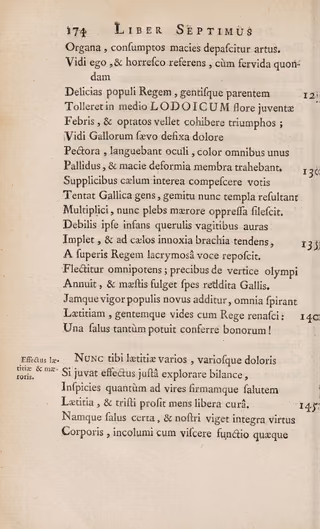
and emaciation feeds upon the wasted limbs.
I myself have seen—and I shudder to relate it—when once a burning
fever was carrying off the delight of the people, the King, the father of the nation,
LOUIS, in the very flower of his youth,
and sought to check his wished-for triumphs;
I saw the hearts of the French transfixed by cruel
grief; their eyes were languishing, all shared a single pale
hue, and they dragged along limbs deformed by emaciation.
Meanwhile, with suppliant vows the French nation strives
to appease heaven; now the temples echo with manifold
groaning, now the common folk, overwhelmed by sorrow, fall silent.
The weak infant himself fills the air with plaintive
cries, and stretching his innocent arms toward the heavens,
demands the King back from the gods above with a tearful voice.
The Almighty is moved; from the summit of Olympus He nods
assent to their prayers, and restored hope shines upon the sorrowing French.
And now new vigor is added to the peoples, all things breathe
joy, and you see the nation reborn along with the King:
A single recovery was able to bestow so many blessings!
Organa, conſumptos macies depaſcitur artus.
Vidi ego, & horreſco referens, cùm fervida quon-
dam
Delicias populi Regem, gentiſque parentem
Tolleret in medio LODOICUM flore juventæ
Febris, & optatos vellet cohibere triumphos ;
Vidi Gallorum ſævo defixa dolore
Pectora, languebant oculi, color omnibus unus
Pallidus, & macie deformia membra trahebant.
Supplicibus cælum interea compeſcere votis
Tentat Gallica gens, gemitu nunc templa reſultant
Multiplici, nunc plebs mærore oppreſſa ſileſcit.
Debilis ipſe infans querulis vagitibus auras
Implet , & ad cælos innoxia brachia tendens ,
A ſuperis Regem lacrymosâ voce repoſcit.
Flectitur omnipotens ; precibus de vertice olympi
Annuit , & mæſtis fulget ſpes reddita Gallis.
Jamque vigor populis novus additur, omnia ſpirant
Lætitiam , gentemque vides cum Rege renaſci :
Una ſalus tantùm potuit conferre bonorum !