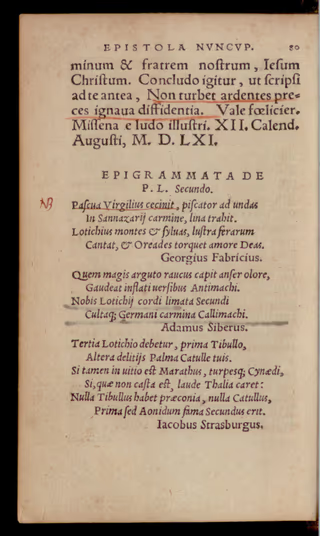
Tertia Lotichio debetur, prima Tibullo,

Poet
Iacobus Strasburgus
Book
Poemata , 1561
Form
Elegiac couplet
Open the page in the book
The page this poem fills. Each opens in the Poemata reader.

Hover or tap a word to see its match.

The third palm is owed to Lotichius, the first to Tibullus,

the second, Catullus, to your delights.

If, however, Marathus is a fault, and shameful catamites,

if a Thalia who is not chaste lacks praise:

Tibullus has no heralds, Catullus has none,

but Secundus will be the foremost glory of the Aonides.

Tertia Lotichio debetur, prima Tibullo,

Altera delitijs Palma Catulle tuis.

Si tamen in uitio eſt Marathus, turpesqꝫ Cynædi,

Si, quæ non caſta eſt, laude Thalia caret:

Nulla Tibullus habet præconia, nulla Catullus,

Prima ſed Aonidum fama Secundus erit.
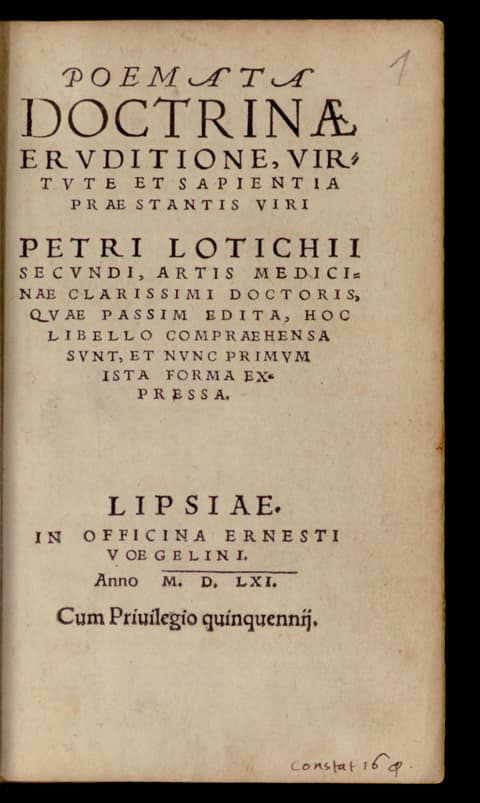
Title page of Poemata
Title page of Poemata , 1561

About this text

Provenance

This digital edition is derived from the Bayerische Staatsbibliothek digitization of the 1561 Leipzig edition of Petrus Lotichius Secundus's Poemata.

Methodology

Each scan is treated as a page-level unit. The page image remains the authority for the edition. Local Kraken OCR was used as a Latin early-print reading aid, then Gemini generated scan-grounded Latin transcription and English translation from the images, the OCR aid, and the approved glossary. Word links connect the English translation to the Latin transcription and locations on the scans. 62 uncertain word-link decisions remain unlinked. Some links highlight only the text because the source word could not be located on the scan.

Rights

The BSB IIIF manifest declares the digital surrogate under the Public Domain Mark 1.0. Poet Doctor's presentation adds generated OCR, transcription, translation, navigation metadata, and editorial context.

Original scans: Bayerische Staatsbibliothek ( Public Domain Mark 1.0 ).

Historian’s note. This text records the medicine of its own time, and later evidence has replaced most of it. It is not medical advice. We read it as history, and we ask what, if anything, connects it to medicine today. More on how we read old medical books