Hover or tap a word to see its match.
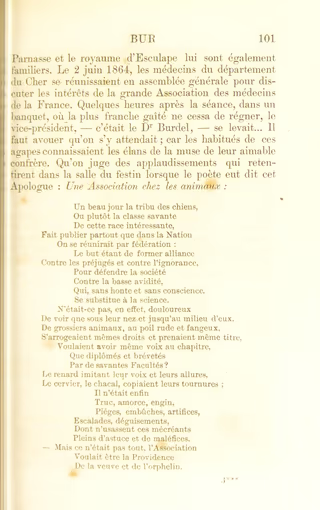
One fine day the tribe of dogs,
Or rather the learned class
Of this interesting breed,
Had it published everywhere that in the Nation
They would unite by federation:
The goal being to form an alliance
Against prejudice and against ignorance,
To defend society
Against base greed,
Which, without shame and without conscience,
Substitutes itself for science.
Was it not, indeed, painful
To see that under their noses and right in their midst,
Coarse animals, with rough and muddy coats,
Arrogated to themselves the same rights and took the same title,
Wanted to have the same say in the matter,
As those holding diplomas and certificates
By learned Faculties?
The fox imitating their voice and their gait,
The lynx, the jackal, copied their manners;
There was, in short, no
Trick, bait, snare,
Traps, ambushes, artifices,
Scaling of walls, disguises,
That these miscreants did not use,
Full of cunning and wickedness.
— But that was not all, the Association
Wanted to be the Providence
Of the widow and the orphan,
So that honest destitution
Would always have a piece of bread.
Then, as foresighted as it was humane,
It wished to grant with open hand,
To the infirm, to the noble old man,
Large quarters of fine meat
Fresh, savory, delicious,
With plenty of bacon rinds.
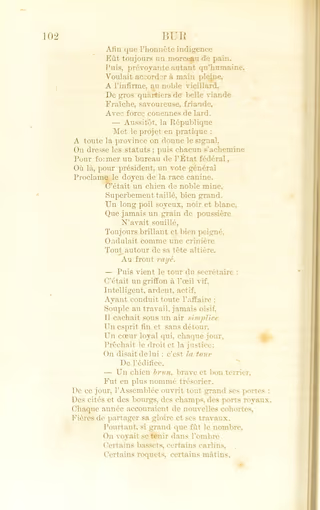
— Immediately, the Republic
Puts the project into practice:
To the whole province the signal is given,
The statutes are drawn up; then everyone sets out
To form an office of the federal State,
Where, for president, a general vote
Proclaims the doyen of the canine race.
It was a dog of noble mien,
Superbly built, very large.
A long silky coat, black and white,
That never a grain of dust
Had soiled,
Always shining and well combed,
Waved like a mane
All around his proud head,
With its striped brow.
— Then comes the turn of the secretary:
It was a griffon with a bright eye,
Intelligent, ardent, active,
Having managed the whole affair:
Adaptable at work, never idle,
He hid beneath an artless air
A keen and straightforward mind,
A loyal heart which, every day,
Preached right and justice;
It was said of him: he is the tower
Of the edifice.
— A brown dog, a brave and good terrier,
Was moreover named treasurer.
From that day, the Assembly threw its doors wide open:
From cities and boroughs, from fields, from royal ports,
Each year new cohorts hastened,
Proud to share its glory and its labors.
Yet, however great the number was,
One saw keeping to the shadows
Certain bassets, certain pugs,
Certain curs, certain mastiffs,
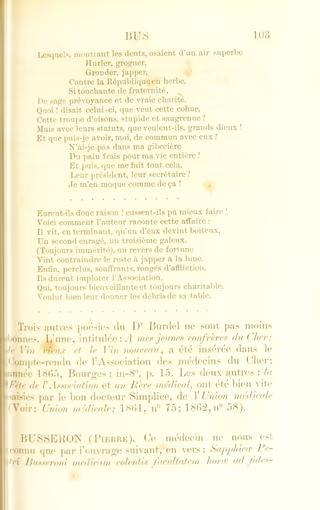
Who, baring their teeth, dared with a haughty air
To howl, to grunt,
To snarl, to yelp,
Against the budding Republic,
So touching in its fraternity,
In wise foresight and true charity.
What! said this one, what does this mob want,
This flock of goslings, stupid and absurd?
But with their statutes, what do they want, great gods!
And what can I have in common with them?
Do I not have in my pouch
Fresh bread for my entire life?
And besides, what does all that matter to me,
Their president, their secretary?
I don't give a fig about that!
Were they right then? Could they have done better?
Here is how the author recounts this affair:
He saw, in the end, that one of them became lame,
A second rabid, a third mangy.
(Always unmerited), a reversal of fortune
Came to force the rest to bark at the moon.
Finally, crippled, suffering, consumed by affliction,
They had to implore the Association,
Which, always benevolent and always charitable,
Was willing to give them the scraps from its table.
Un beau jour la tribu des chiens,
Ou plutôt la classe savante
De cette race intéressante,
Fait publier partout que dans la Nation
On se réunirait par fédération :
Le but étant de former alliance
Contre les préjugés et contre l'ignorance,
Pour défendre la société
Contre la basse avidité,
Qui, sans honte et sans conscience,
Se substitue à la science.
N'était-ce pas, en effet, douloureux
De voir que sous leur nez et jusqu'au milieu d'eux,
De grossiers animaux, au poil rude et fangeux,
S'arrogeaient mêmes droits et prenaient même titre,
Voulaient avoir même voix au chapitre,
Que diplômés et brévetés
Par de savantes Facultés ?
Le renard imitant leur voix et leurs allures,
Le cervier, le chacal, copiaient leurs tournures ;
Il n'était enfin
Truc, amorce, engin,
Piéges, embûches, artifices,
Escalades, déguisements,
Dont n'usassent ces mécréants
Pleins d'astuce et de maléfices.
— Mais ce n'était pas tout, l'Association
Voulait être la Providence
De la veuve et de l'orphelin,
Afin que l'honnête indigence
Eût toujours un morceau de pain.
Puis, prévoyante autant qu'humaine,
Voulait accorder à main pleine,
A l'infirme, au noble vieillard,
De gros quartiers de belle viande
Fraîche, savoureuse, friande,
Avec force couennes de lard.
— Aussitôt, la République
Met le projet en pratique :
A toute la province on donne le signal,
On dresse les statuts ; puis chacun s'achemine
Pour former un bureau de l'État fédéral,
Où là, pour président, un vote général
Proclame le doyen de la race canine.
C'était un chien de noble mine,
Superbement taillé, bien grand.
Un long poil soyeux, noir et blanc,
Que jamais un grain de poussière
N'avait souillé,
Toujours brillant et bien peigné,
Ondulait comme une crinière
Tout autour de sa tête altière,
Au front rayé.
— Puis vient le tour du secrétaire :
C'était un griffon à l'œil vif,
Intelligent, ardent, actif,
Ayant conduit toute l'affaire :
Souple au travail, jamais oisif,
Il cachait sous un air simplice
Un esprit fin et sans détour,
Un cœur loyal qui, chaque jour,
Prêchait le droit et la justice;
On disait de lui : c'est la tour
De l'édifice.
— Un chien brun, brave et bon terrier,
Fut en plus nommé trésorier.
De ce jour, l'Assemblée ouvrit tout grand ses portes :
Des cités et des bourgs, des champs, des ports royaux,
Chaque année accouraient de nouvelles cohortes,
Fières de partager sa gloire et ses travaux.
Pourtant, si grand que fût le nombre,
On voyait se tenir dans l'ombre
Certains bassets, certains carlins,
Certains roquets, certains mâtins,
Lesquels, montrant les dents, osaient d'un air superbe
Hurler, grogner,
Gronder, japper,
Contre la République en herbe,
Si touchante de fraternité,
De sage prévoyance et de vraie charité.
Quoi ! disait celui-ci, que veut cette cohue,
Cette troupe d'oisons, stupide et saugrenue ?
Mais avec leurs statuts, que veulent-ils, grands dieux !
Et que puis-je avoir, moi, de commun avec eux ?
N'ai-je pas dans ma gibecière
Du pain frais pour ma vie entière ?
Et puis, que me fait tout cela,
Leur président, leur secrétaire ?
Je m'en moque comme de ça !
Eurent-ils donc raison ? eussent-ils pu mieux faire ?
Voici comment l'auteur raconte cette affaire :
Il vit, en terminant, qu'un d'eux devint boiteux,
Un second enragé, un troisième galeux.
(Toujours immérité), un revers de fortune
Vint contraindre le reste à japper à la lune.
Enfin, perclus, souffrants, rongés d'affliction,
Ils durent implorer l'Association,
Qui, toujours bienveillante et toujours charitable,
Voulut bien leur donner les débris de sa table.