Hover or tap a word to see its match.
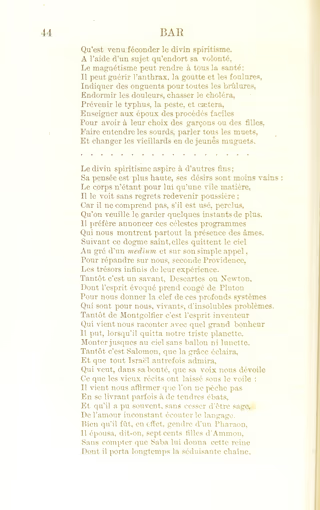
In this great school,
Which takes the marvelous for its sole compass,
And which knows how to draw from it those useful profits,
That clairvoyant minds do not disdain,
All lies, I have told you, in the art of magnetism,
Which divine spiritism has come to make fruitful.
With the help of a subject whom its will puts to sleep,
Magnetism can restore health to everyone;
It can cure carbuncles, gout, and sprains,
Prescribe ointments for all burns,
Put pain to sleep, drive away cholera,
Prevent typhus, the plague, et cetera,
Teach spouses easy methods
To have boys or girls of their choosing,
Make the deaf hear, all the mutes speak,
And turn old men into young dandies.
Divine spiritism aspires to other ends;
Its thought is higher, its desires are less vain:
The body being for it but vile matter,
It sees it return to dust without regret;
For it does not understand, if it is worn out, crippled,
That one would want to keep it a few moments longer.
It prefers to announce those celestial programs
Which show us the presence of souls everywhere.
According to this holy dogma, they leave heaven
At the will of a medium and upon his simple call,
To spread upon us, a second Providence,
The infinite treasures of their experience.
Sometimes it is a scholar, Descartes or Newton,
Whose evoked spirit takes leave of Pluto
To give us the key to those profound systems
Which are for us, the living, insoluble problems.
Sometimes it is the inventive spirit of Montgolfier
Who comes to tell us with what great happiness
He was able, when he left our sad planet,
To ascend up to heaven without balloon or telescope.
Sometimes it is Solomon, whom grace enlightened,
And whom all Israel once admired,
Who wants, in his goodness, for his voice to unveil to us
What the old tales left under the veil:
He comes to assure us that one does not sin
By indulging sometimes in tender frolics,
And that he was often able, without ceasing to be wise,
To listen to the language of inconstant love.
Though he was, indeed, son-in-law to a Pharaoh,
He married, it is said, seven hundred daughters of Ammon,
Without counting that Sheba gave him that queen
Whose seductive chain he wore for a long time.
Dans cette grande école,
Qui prend le merveilleux pour unique boussole,
Et qui sait en tirer ces utiles profits,
Que ne dédaignent pas les clairvoyants esprits,
Tout gît, je te l'ai dit, dans l'art du magnétisme,
Qu'est venu féconder le divin spiritisme.
A l'aide d'un sujet qu'endort sa volonté,
Le magnétisme peut rendre à tous la santé;
Il peut guérir l'anthrax, la goutte et les foulures,
Indiquer des onguents pour toutes les brûlures,
Endormir les douleurs, chasser le choléra,
Prévenir le typhus, la peste, et cætera,
Enseigner aux époux des procédés faciles
Pour avoir à leur choix des garçons ou des filles,
Faire entendre les sourds, parler tous les muets,
Et changer les vieillards en de jeunes muguets.
Le divin spiritisme aspire à d'autres fins;
Sa pensée est plus haute, ses désirs sont moins vains :
Le corps n'étant pour lui qu'une vile matière,
Il le voit sans regrets redevenir poussière ;
Car il ne comprend pas, s'il est usé, perclus,
Qu'on veuille le garder quelques instants de plus.
Il préfère annoncer ces célestes programmes
Qui nous montrent partout la présence des âmes.
Suivant ce dogme saint, elles quittent le ciel
Au gré d'un medium et sur son simple appel,
Pour répandre sur nous, seconde Providence,
Les trésors infinis de leur expérience.
Tantôt c'est un savant, Descartes ou Newton,
Dont l'esprit évoqué prend congé de Pluton
Pour nous donner la clef de ces profonds systèmes
Qui sont pour nous, vivants, d'insolubles problèmes.
Tantôt de Montgolfier c'est l'esprit inventeur
Qui vient nous raconter avec quel grand bonheur
Il put, lorsqu'il quitta notre triste planette,
Monter jusques au ciel sans ballon ni lunette.
Tantôt c'est Salomon, que la grâce éclaira,
Et que tout Israël autrefois admira,
Qui veut, dans sa bonté, que sa voix nous dévoile
Ce que les vieux récits ont laissé sous le voile :
Il vient nous affirmer que l'on ne pèche pas
En se livrant parfois à de tendres ébats,
Et qu'il a pu souvent, sans cesser d'être sage,
De l'amour inconstant écouter le langage.
Bien qu'il fût, en effet, gendre d'un Pharaon,
Il épousa, dit-on, sept cents filles d'Ammon,
Sans compter que Saba lui donna cette reine
Dont il porta longtemps la séduisante chaîne.