Hover or tap a word to see its match.
Oysters! How at this word, which flatters and touches him,
A true gourmand feels his mouth begin to water!
What call to the table is more joyous?
It is to say, with one word, dazzling place setting,
Small gilded salon of the Rocher de Cancale,
Opposing to winter its tropical heat;
Luncheon of aficionados, witticisms, wild gaiety,
Morning appetite and frank liberty.
Although our country claims to wrest it from her,
In the place of honor put the Ostend oyster,
The delicate jewel, fished outside of France,
Is the starting point of an *exquisite menu*!
But our Dieppe oysters and those of Cancale,
Without undoubtedly meriting equal favor,
With mignonette and lemon juice,
Are the finest ornament of the Montorgueil quarter.
And if you ask what wine accompanies them?
Wash them down with Arbois, Pouilly, Champagne,
With Graves, with Sauterne, aged by travel,
Wash them down above all with an old Chablis.
Remember that December is the month of the year
Which sees it brought to Paris in glory.
Although one can today, thanks to the railways,
Even during the months that do not take an R,
Easily receive fairly fresh seafood,
Let us reserve for winter the honor of this catch;
Let us leave the oyster in its bed to fatten in peace:
It is little to be a gourmand, one must be so seasonably.
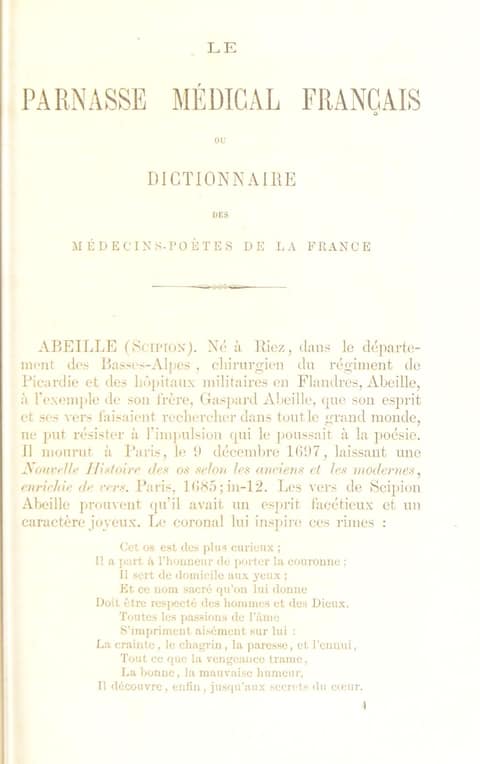
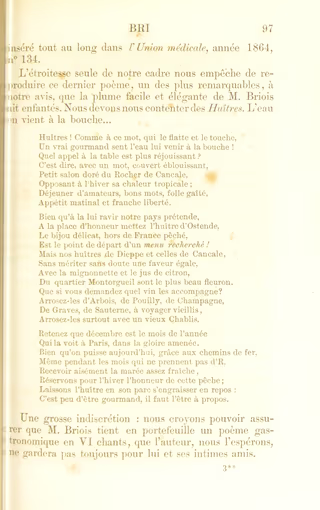
Huîtres ! Comme à ce mot, qui le flatte et le touche,
Un vrai gourmand sent l'eau lui venir à la bouche !
Quel appel à la table est plus réjouissant ?
C'est dire, avec un mot, couvert éblouissant,
Petit salon doré du Rocher de Cancale,
Opposant à l'hiver sa chaleur tropicale ;
Déjeuner d'amateurs, bons mots, folle gaîté,
Appétit matinal et franche liberté.
Bien qu'à la lui ravir notre pays prétende,
A la place d'honneur mettez l'huître d'Ostende,
Le bijou délicat, hors de France pêché,
Est le point de départ d'un menu recherché !
Mais nos huîtres de Dieppe et celles de Cancale,
Sans mériter sans doute une faveur égale,
Avec la mignonnette et le jus de citron,
Du quartier Montorgueil sont le plus beau fleuron.
Que si vous demandez quel vin les accompagne ?
Arrosez-les d'Arbois, de Pouilly, de Champagne,
De Graves, de Sauterne, à voyager vieillis,
Arrosez-les surtout avec un vieux Chablis.
Retenez que décembre est le mois de l'année
Qui la voit à Paris, dans la gloire amenée.
Bien qu'on puisse aujourd'hui, grâce aux chemins de fer,
Même pendant les mois qui ne prennent pas d'R,
Recevoir aisément la marée assez fraîche,
Réservons pour l'hiver l'honneur de cette pêche ;
Laissons l'huître en son parc s'engraisser en repos :
C'est peu d'être gourmand, il faut l'être à propos.