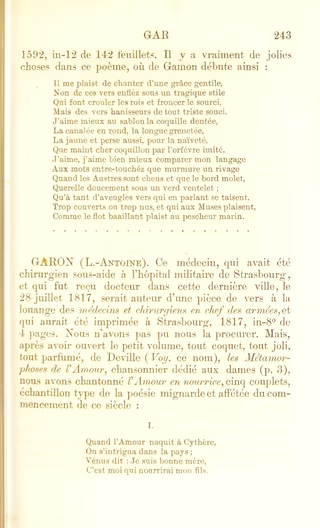
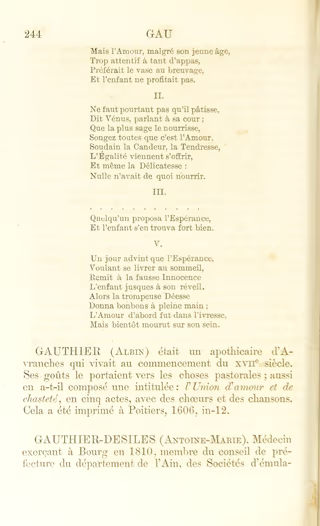
l'Amour en nourrice

Poet
Deville
Form
Octosyllable
Open the page in the book
The pages this poem fills. Each opens in the Le Parnasse médical français reader.

Hover or tap a word to see its match.

When Love was born in Cythera,

People intrigued in the land;

Venus said: I am a good mother,

It is I who will nurse my son.

But Love, despite his young age,

Too attentive to so many charms,

Preferred the vessel to the beverage,

And the child did not thrive.

Yet he must not suffer,

Said Venus, speaking to her court;

Let the wisest nurse him,

Remember, all of you, that he is Love.

Suddenly Candor, Tenderness,

Equality came to offer themselves,

And even Delicacy:

None had the means to nurse.

Someone proposed Hope,

And the child fared very well.

One day it happened that Hope,

Wishing to surrender to sleep,

Entrusted to false Innocence

The child until her awakening.

Then the deceitful Goddess

Gave sweets by the handful;

Love was at first intoxicated,

But soon died upon her breast.

Quand l'Amour naquit à Cythère,

On s'intrigua dans le pays ;

Vénus dit : Je suis bonne mère,

C'est moi qui nourrirai mon fils.

Mais l'Amour, malgré son jeune âge,

Trop attentif à tant d'appas,

Préférait le vase au breuvage,

Et l'enfant ne profitait pas.

Ne faut pourtant pas qu'il pâtisse,

Dit Vénus, parlant à sa cour ;

Que la plus sage le nourrisse,

Songez toutes que c'est l'Amour.

Soudain la Candeur, la Tendresse,

L'Égalité viennent s'offrir,

Et même la Délicatesse :

Nulle n'avait de quoi nourrir.

Quelqu'un proposa l'Espérance,

Et l'enfant s'en trouva fort bien.

Un jour advint que l'Espérance,

Voulant se livrer au sommeil,

Remit à la fausse Innocence

L'enfant jusques à son réveil.

Alors la trompeuse Déesse

Donna bonbons à pleine main ;

L'Amour d'abord fut dans l'ivresse,

Mais bientôt mourut sur son sein.
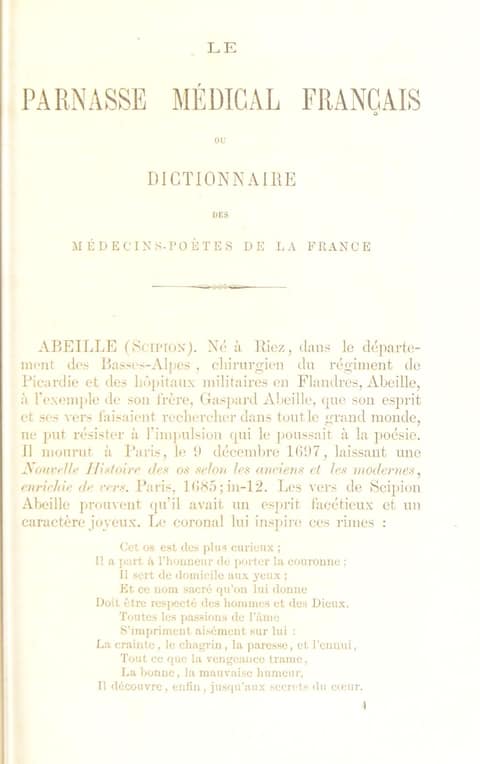
Title page of Le Parnasse médical français
Title page of Le Parnasse médical français , 1874

About this text

Provenance

This digital edition is derived from the Wellcome Collection copy of Achille Chéreau's 1874 dictionary of French physician-poets. The current reader uses the reacquired Wellcome IIIF JPEG corpus as the facsimile source of record.

Methodology

Each page is treated as a page-level unit. The page image remains the authority for the edition. Machine OCR is used as source OCR and reading aid, then corrected into French transcription, then translated into English. Word links connect the English translation to the French transcription and locations on the scans. Fifteen uncertain word-link decisions remain unlinked. Some links highlight only the text because the source word could not be located on the scan.

Rights

The source item is attributed to Wellcome Collection and marked with the Creative Commons Public Domain Mark. Poet Doctor's presentation adds generated transcription, translation, navigation metadata, and editorial context. No access control or anti-bulk-download measure should conflict with the public-domain status of the source material.

Original scans: Wellcome Collection ( Public Domain Mark 1.0 ).

Historian’s note. This text records the medicine of its own time, and later evidence has replaced most of it. It is not medical advice. We read it as history, and we ask what, if anything, connects it to medicine today. More on how we read old medical books