Hover or tap a word to see its match.
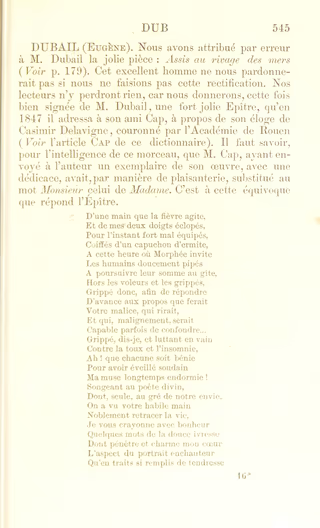
With a hand shaken by fever,
And with my two crippled fingers,
For the moment very poorly equipped,
Capped with a hermit's cowl,
At this hour when Morpheus invites
Humans, gently lured,
To pursue their slumber in their beds,
Except thieves and the flu-stricken,
Flu-stricken, then, in order to answer
In advance the remarks that would be made
By your malice, which would laugh,
And which, maliciously, would be
Capable sometimes of confounding...
Flu-stricken, I say, and struggling in vain
Against cough and insomnia,
Ah! may each be blessed
For having suddenly awakened
My long-sleeping muse!
Thinking of the divine poet,
Of whom, alone, to our heart's desire,
We have seen your skillful hand
Nobly retrace the life,
I happily sketch for you
A few words of the sweet rapture
With which my heart is penetrated and charmed
By the sight of the enchanting portrait
Which, in strokes so full of tenderness
Your happy skill has traced
With so much art and color!
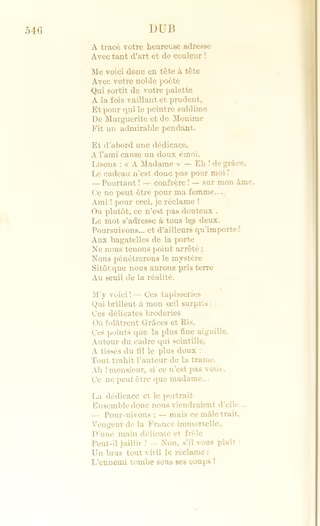
Here I am, then, face to face
With your noble poet
Who emerged from your palette
At once valiant and prudent,
And for whom the sublime painter
Of Marguerite and Monime
Made an admirable pendant.
And first, a dedication,
Causes the friend a sweet emotion.
Let us read: "To Madame"—Oh! for mercy's sake,
The gift is not for me, then?
—Yet!—colleague!—upon my soul,
It cannot be for my wife...
Friend! I protest this!
Or rather, there is no doubt,
The word is addressed to both of us.
Let us continue... and besides, what does it matter?
At the trifles by the door
Let us not remain stalled;
We shall penetrate the mystery
As soon as we have touched ground
On the threshold of reality.
Here I am! — These tapestries
That shine before my surprised eye:
These delicate embroideries
Where Graces and Smiles frolic,
These stitches that the finest needle,
Around the glittering frame,
Has woven with the softest thread:
Everything betrays the author of the weave.
Ah! sir, if it is not you,
It can only be madame...
The dedication and the portrait
Together, then, would come to us from her...
—Let us continue;—but this manly stroke,
Avenger of immortal France,
From a delicate and fragile hand
Can it spring forth? — No, if you please:
A fully virile arm claims it;
The enemy falls beneath its blows!
Ah! sir, since it is indeed you,
It cannot therefore be madam.
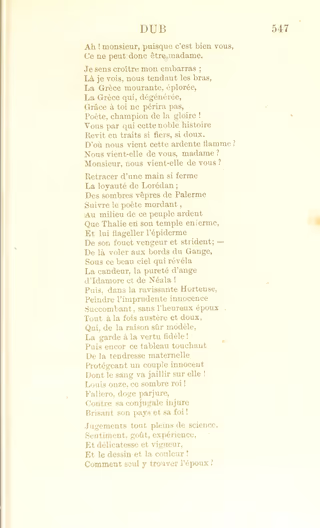
I feel my embarrassment grow;
There I see, reaching out her arms to us,
Dying, weeping Greece,
Greece which, degenerate,
Thanks to you will not perish,
Poet, champion of glory!
You through whom this noble history
Lives again in strokes so proud, so gentle.
From where comes this ardent flame to us?
Does it come to us from you, madam?
Sir, does it come to us from you?
To retrace with so firm a hand
The loyalty of Loredan;
From the somber vespers of Palermo
To follow the biting poet,
Amidst this ardent people
Whom Thalia shuts in her temple,
And to flog its skin
With his vengeful and strident whip;—
From there to fly to the banks of the Ganges,
Under this beautiful sky which revealed
The candor, the angelic purity
Of Idamore and Neala!
Then, in the ravishing Hortense,
To paint imprudent innocence
Succumbing, without the happy husband
At once austere and gentle,
Who, a sure model of reason,
Keeps her faithful to virtue!
Then again this touching tableau
Of maternal tenderness
Protecting an innocent couple
Whose blood will splatter upon her!
Louis XI, that somber king!
Faliero, perjured doge,
Against his conjugal injury
Shattering his country and his faith!
Judgments all full of knowledge,
Sentiment, taste, experience,
And delicacy and vigor,
And drawing and color!
How to find only the husband there?
How to find only the wife in it?
Ah! sir, if it is too much for you,
It is too much for you too, madam.
The mystery is therefore cleared up,
And with a half share in all this,
You, madam, bring the grace,
The feeling, that nothing erases,
The delicacy, the wit!
— To you, sir, a higher place;
To you, the vigor and the boldness,
The art, the science and all the fruit
Of a rigorous and enduring study.
Ah! I understand the dedication;
And since a common law
Merges the husband with his lady
From the shepherd to the king,
You, madam, thank you for me!
You, friend, thank you for my wife!
D'une main que la fièvre agite,
Et de mes deux doigts éclopés,
Pour l'instant fort mal équipés,
Coiffés d'un capuchon d'ermite,
A cette heure où Morphée invite
Les humains doucement pipés
A poursuivre leur somme au gîte,
Hors les voleurs et les grippés,
Grippé donc, afin de répondre
D'avance aux propos que ferait
Votre malice, qui rirait,
Et qui, malignement, serait
Capable parfois de confondre...
Grippé, dis-je, et luttant en vain
Contre la toux et l'insomnie,
Ah ! que chacune soit bénie
Pour avoir éveillé soudain
Ma muse longtemps endormie !
Songeant au poète divin,
Dont, seule, au gré de notre envie,
On a vu votre habile main
Noblement retracer la vie,
Je vous crayonne avec bonheur
Quelques mots de la douce ivresse
Dont pénètre et charme mon cœur
L'aspect du portrait enchanteur
Qu'en traits si remplis de tendresse
A tracé votre heureuse adresse
Avec tant d'art et de couleur !
Me voici donc en tête à tête
Avec votre noble poète
Qui sortit de votre palette
A la fois vaillant et prudent,
Et pour qui le peintre sublime
De Marguerite et de Monime
Fit un admirable pendant.
Et d'abord une dédicace,
A l'ami cause un doux émoi.
Lisons : « A Madame » — Eh ! de grâce,
Le cadeau n'est donc pas pour moi ?
— Pourtant ! — confrère ! — sur mon âme,
Ce ne peut être pour ma femme...
Ami ! pour ceci, je réclame !
Ou plutôt, ce n'est pas douteux,
Le mot s'adresse à tous les deux.
Poursuivons... et d'ailleurs qu'importe ?
Aux bagatelles de la porte
Ne nous tenons point arrêté ;
Nous pénétrerons le mystère
Sitôt que nous aurons pris terre
Au seuil de la réalité.
M'y voici ! — Ces tapisseries
Qui brillent à mon œil surpris :
Ces délicates broderies
Où folâtrent Grâces et Ris,
Ces points que la plus fine aiguille,
Autour du cadre qui scintille,
A tissés du fil le plus doux :
Tout trahit l'auteur de la trame.
Ah ! monsieur, si ce n'est pas vous,
Ce ne peut être que madame...
La dédicace et le portrait
Ensemble donc nous viendraient d'elle...
— Poursuivons ; — mais ce mâle trait,
Vengeur de la France immortelle,
D'une main délicate et frêle
Peut-il jaillir ? — Non, s'il vous plaît :
Un bras tout viril le réclame ;
L'ennemi tombe sous ses coups !
Ah ! monsieur, puisque c'est bien vous,
Ce ne peut donc être madame.
Je sens croître mon embarras ;
Là je vois, nous tendant les bras,
La Grèce mourante, éplorée,
La Grèce qui, dégénérée,
Grâce à toi ne périra pas,
Poète, champion de la gloire !
Vous par qui cette noble histoire
Revit en traits si fiers, si doux.
D'où nous vient cette ardente flamme ?
Nous vient-elle de vous, madame ?
Monsieur, nous vient-elle de vous ?
Retracer d'une main si ferme
La loyauté de Lorédan ;
Des sombres vêpres de Palerme
Suivre le poète mordant,
Au milieu de ce peuple ardent
Que Thalie en son temple enferme,
Et lui flageller l'épiderme
De son fouet vengeur et strident ; —
De là voler aux bords du Gange,
Sous ce beau ciel qui révéla
La candeur, la pureté d'ange
d'Idamore et de Néala !
Puis, dans la ravissante Hortense,
Peindre l'imprudente innocence
Succombant, sans l'heureux époux
Tout à la fois austère et doux,
Qui, de la raison sûr modèle,
La garde à la vertu fidèle !
Puis encor ce tableau touchant
De la tendresse maternelle
Protégeant un couple innocent
Dont le sang va jaillir sur elle !
Louis onze, ce sombre roi !
Faliero, doge parjure,
Contre sa conjugale injure
Brisant son pays et sa foi !
Jugements tout pleins de science,
Sentiment, goût, expérience,
Et délicatesse et vigueur,
Et le dessin et la couleur !
Comment seul y trouver l'époux ?
Comment seule y trouver la femme ?
Ah ! monsieur, si c'est trop pour vous,
C'est trop pour vous aussi, madame.
Le mystère est donc éclairci,
Et de moitié dans tout ceci,
Vous, madame, apportez la grâce,
Le sentiment, que rien n'efface,
La délicatesse, l'esprit !
— A vous, monsieur, plus haute place ;
A vous, la vigueur et l'audace,
L'art, la science et tout le fruit
D'une étude rude et vivace.
Ah ! je comprends la dédicace ;
Et puisqu'une commune loi
Confond l'époux avec sa dame
Depuis le berger jusqu'au roi,
Vous, madame, merci pour moi !
Vous, ami, merci pour ma femme !